
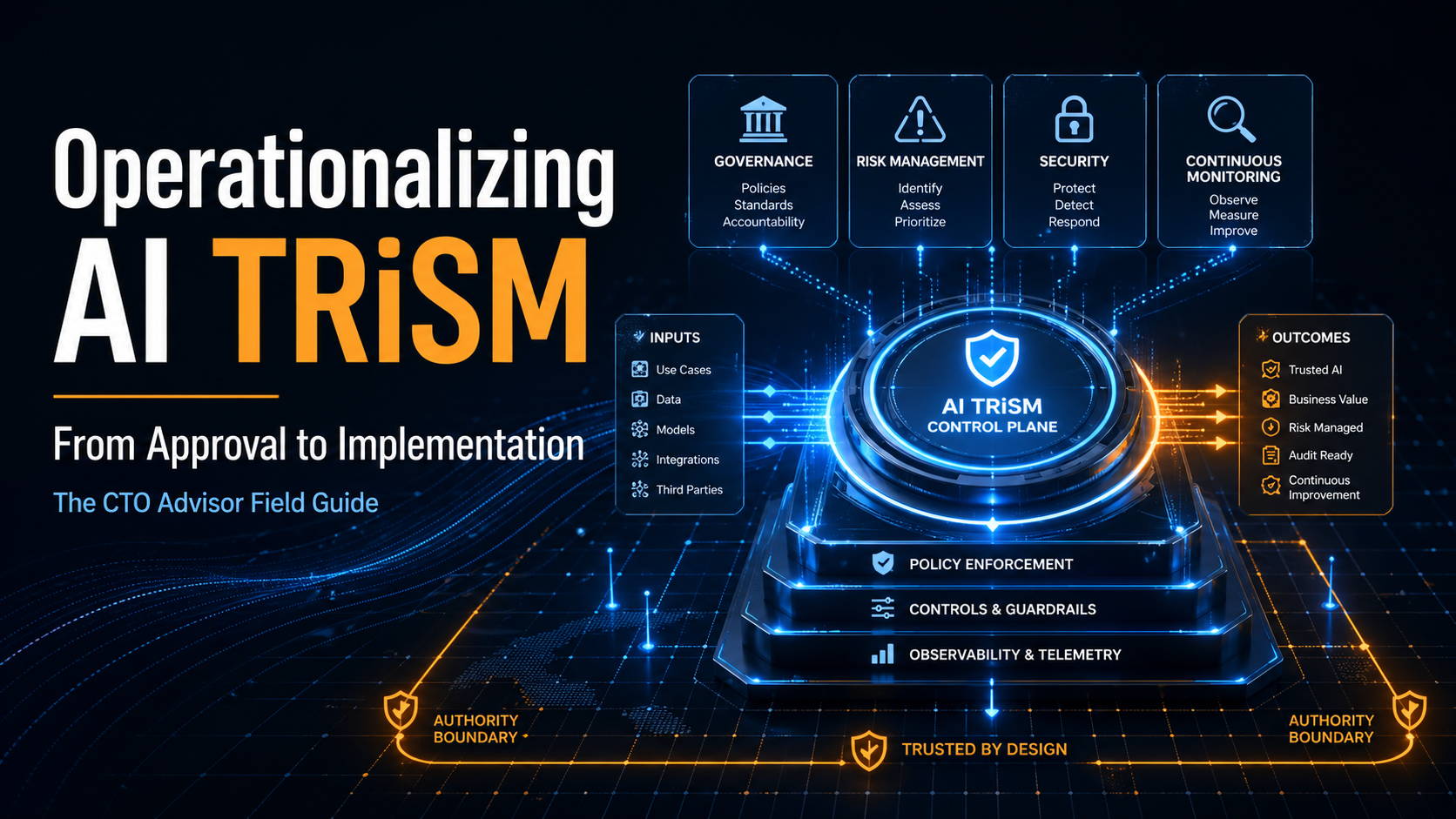
Operationalizing AI TRiSM: A CTO Advisor Field Guide
Operationalizing AI TRiSM: A CTO Advisor Field Guide
A practitioner’s map for turning AI trust, risk, and security management into architecture, controls, evidence, and operating decisions.
Status
Version: 0.1 Format: Living field guide Audience: CIOs, CTOs, CISOs, enterprise architects, platform teams, data leaders, AI governance teams, and vendor product/GTM teams trying to make AI trust, risk, and security real in production.
Why This Guide Exists
Gartner AI TRiSM gives enterprise leaders a useful and defensible category for AI trust, risk, and security management. That matters. Large organizations need institutional language before they fund work, assign owners, defend investment decisions, or ask vendors to align with an enterprise risk model.
But approval language is not implementation design.
Once TRiSM becomes a funded initiative, the work does not happen inside the category definition. It lands on architects, platform teams, security leaders, data teams, legal, procurement, and business owners who have to decide where controls live, what evidence gets captured, who owns authority, and how the system survives production.
This field guide is my attempt to map that work.
I am not trying to compete with Gartner. Gartner is the institutional authority many enterprises use to approve, fund, and defend AI trust, risk, and security work. My contribution is the practitioner map underneath it: where decision authority lives, where runtime control belongs, where evidence is captured, where deterministic enforcement is required, and how the system survives production economics.
TRiSM helps the enterprise say yes to the work. This guide is about what the work actually is.
The Operationalization Matrix
| Gartner TRiSM concern | What has to be operationalized | CTO Advisor implementation map | Practical implementation question |
|---|---|---|---|
| Governance | Ownership, authority, approval, accountability, and decision rights | DAPM — Decision Authority Placement Model | Who or what is allowed to decide, recommend, approve, or act? |
| Trustworthiness | Defensible system behavior and decision reconstruction | DAPM + Evidence Chain pattern | Can we prove why the system was allowed to act? |
| Transparency | Visibility into model behavior, workflow behavior, context, policy, and tool use | Layer 2C / Reasoning Plane + Evidence Chain pattern | Can we see the decision path, not just the final output? |
| Reliability | Consistent behavior under production conditions | Inter-loop Governance + Deterministic Code in the Loop | Who decides when the AI is done, wrong, stuck, or needs escalation? |
| Robustness | Safe failure, retry control, recovery, adversarial resistance, and bounded action | Layer 2C + Deterministic Code in the Loop | Can the system fail safely without authority drift or runaway cost? |
| Efficacy | Useful business outcomes at acceptable quality, latency, cost, and risk | AI Factory Economics + 4+1 AI Infrastructure Model | Does the system work economically and operationally outside the demo? |
| Fairness | Detection of biased outcomes across model, data, workflow, approval, and business process paths | DAPM + Evidence Chain pattern | Is the AI amplifying an existing process bias or creating a new one? |
| Data protection | Control of prompts, retrieval, embeddings, memory, logs, outputs, and tool-accessed data | 4+1 AI Infrastructure Model + Fourth Cloud + Layer 2C | Where does context travel, and where is policy enforced? |
| AI application security | Protection of agents, tools, sessions, APIs, memory, plugins, and execution paths | Agent Security Boundary + Layer 2C + Deterministic Code in the Loop | What is the actual security boundary when AI can call tools? |
| Monitoring and operations | Production visibility across quality, cost, drift, escalation, tool use, and behavior | Layer 2C + Inter-loop Governance + AI Factory Economics | Are we monitoring system behavior or only the final answer? |
| Shared responsibility | Ownership across vendor, model provider, cloud, SaaS platform, enterprise platform team, security, legal, and business owner | Fourth Cloud + DAPM | Who owns the decision boundary when the workflow spans platforms? |
| Procurement and vendor evaluation | Platform selection, control validation, evidence expectations, and operational fit | 4+1 RFP + Buyer Room lens + DAPM | Where does the control live, and can the vendor prove it? |
How to Read the Matrix
The left side uses the institutional language enterprises are already adopting around AI trust, risk, and security management.
The middle columns translate those concerns into implementation work.
The right side is the question architects, platform teams, security leaders, and business owners eventually have to answer.
This is the difference between agreeing that AI needs governance and actually designing a governed AI system.
A policy can say humans must remain accountable. DAPM asks whether the human still has practical authority once AI begins drafting, ranking, recommending, approving, or triggering downstream work.
A security review can say sensitive data must be protected. The 4+1 model and Layer 2C ask where context flows, where retrieval happens, what data enters the prompt, what gets logged, what tools can access, and where policy is enforced.
A vendor can say they support governance. The procurement question is sharper: where does the control live, what evidence is captured, and what authority does the system exercise?
CTO Advisor Frameworks Referenced in This Guide
This guide maps Gartner TRiSM concerns to CTO Advisor implementation patterns. Readers unfamiliar with these frameworks can follow the guide with the summaries below. Each entry links to the full published version for deeper context.
4+1 Layer AI Infrastructure Model — A reference architecture for enterprise AI infrastructure, organized into four layers plus one cross-cutting concern. Layer 0: Compute and Network Fabric. Layer 1: Data Plane (1A: Storage and Governance, 1B: Retrieval, Indexing, and Embeddings, 1C: Movement, Pipelines, and Lineage). Layer 2: Operational Tri-Plane (2A: Control Plane, 2B: Execution Plane, 2C: Reasoning Plane). Layer 3: Application Layer — agents, copilots, workflows, and user experiences. The model does not tell enterprises what to buy. It names what they are responsible for once something is built or purchased. Full framework →
Layer 2C / The Reasoning Plane — The most commonly missing layer in enterprise AI infrastructure. Layer 2C is where autonomous, multi-objective decisions are made across all other layers. It is where model selection, routing, context control, policy enforcement, tool access, escalation, and loop behavior can be observed and governed. Layer 2C has cross-layer scope but operates within the operational plane, not above the stack. Full framework →
DAPM — Decision Authority Placement Model — A framework for understanding who is authorized to make tradeoffs at runtime and where that authority actually lives inside automated enterprise systems. DAPM clarifies how authority is centralized within a platform, coupled to governance and escalation processes, or deliberately delegated to product teams within defined guardrails. DAPM uses a three-state governance classification: Retained (human decides), Delegated (human sets policy, AI executes within guardrails), and Ceded (AI decides autonomously). DAPM is not specific to AI — it applies to any enterprise system that automates decisions. Full framework →
DAPM Design Companion: Auditable Authority — Extends DAPM with a five-step design sequence for placing authority when AI enters an enterprise workflow. The companion introduces two failure modes specific to AI: misrecognized authority (where AI output format creates the illusion of decision legitimacy) and capability-driven drift (where improving AI quality causes authority to migrate from humans to AI without anyone making that decision). It establishes inspectability — not probability — as the governing property for authority placement: authority must reside where the decision path can be traced, reproduced, and defended. The design sequence begins with a compute model gate (is an LLM the right tool, or is the problem already solved by deterministic code or an inspectable model?), surfaces hidden decision domains that were constants under human execution and become ungoverned variables under AI (culture, voice, institutional perspective, risk posture), and maps inspectability requirements to viable authority placements. The companion governs what happens at the boundary of Layer 2C — the point where advisory output exits the Reasoning Plane and enters a domain where authority must be placed. Full companion →
Fourth Cloud — Enterprise AI infrastructure as a distinct operational paradigm beyond public, private, and hybrid cloud. Fourth Cloud describes the reality that AI workloads require cloud-like economics and operations in environments the enterprise controls — spanning SaaS, hyperscaler, private cloud, edge, neocloud, and embedded vendor platforms. The decision path in enterprise AI rarely lives inside one clean boundary, and Fourth Cloud frames the governance and operational challenge of spanning multiple venues.
AI Factory Economics — A framework for understanding AI as a production system, not a project. The factory floor metaphor maps AI infrastructure to industrial operations: GPUs are expensive robotic welding cells that often sit idle, the real constraint is not inference speed but the preprocessing, orchestration, and data movement that feeds the GPU, and Layer 2C acts as the factory floor manager that keeps expensive equipment productive. AI Factory Economics measures cost per decision, throughput, utilization, loop waste, escalation cost, and the ratio of expensive model inference to cheaper orchestration, tool execution, and deterministic control. The framework addresses whether the system works economically and operationally at production scale. Full framework →
Inter-loop Governance — The control framework for what happens between iterations of an AI workflow. The critical governance question is not what the AI can do, but what determines done — who or what evaluates the output of one loop and decides whether to proceed, retry, escalate, or stop. When the same model that creates the work is also the only authority deciding whether the work is done, the organization has a separation-of-duties problem.
Deterministic Code in the Loop — The architectural pattern for enforcing policy where enterprises need repeatability, auditability, and control. Human-in-the-loop does not survive production volume. AI-in-the-loop does not satisfy risk officers. Deterministic code in the loop is the missing middle — decisions too high-volume for humans and too consequential to leave to probabilistic systems are enforced by deterministic code that runs alongside AI reasoning, not inside it.
Evidence Chain — Introduced in this guide as a named operational pattern. Evidence Chain formalizes what has been implicit in DAPM since publication: the requirement that authority placement be provable, not just designed. DAPM places authority. The Evidence Chain proves that authority was respected. The pattern defines what evidence must be captured — identity, authority level, data and context, model and workflow version, policy and control, human or system action, and outcome — scaled to the authority level of the workflow.
Agent Security Boundary — Introduced in this guide as a named pattern. An agent is often discussed as if it is a single thing. In practice, the security boundary includes the user session, model endpoint, orchestration service, memory store, tool permission set, API credential, plugin, retrieval path, and downstream execution system. The agent label in the UI is not the boundary. The execution path is the boundary. Agent Security Boundary names the requirement to define, monitor, and enforce security at the execution path level rather than the application label level.
How these frameworks relate to each other: These are not independent ideas. They are observations of the same problem from different angles: enterprise AI reallocates judgment faster than organizations redesign governance. The 4+1 model names where responsibility accumulates. AI Factory Economics exposes what hidden responsibility costs. DAPM addresses who owns decision rights. Inter-loop Governance tackles what happens inside agentic loops. For the full synthesis, see One Problem, Five Frameworks: Why Enterprise AI Stalls — and How to Fix It.
Authority Classification Table
This table is the practical starting point for operationalizing DAPM inside TRiSM work. Before an enterprise can decide how much governance, evidence, monitoring, and enforcement a workflow requires, it needs to classify the authority that workflow exercises.
The same organization will usually have multiple AI workflows operating at different authority levels at the same time. A meeting summarizer, a sales assistant, an underwriting recommendation engine, and an operations remediation agent should not carry the same control burden. The point is not to over-govern every use of AI. The point is to match the control model to the authority level.
The table includes two classification dimensions. The authority level describes what the AI system is functionally doing in the workflow. The DAPM governance posture describes the organizational stance toward that authority — whether the enterprise has retained decision-making, delegated it within guardrails, or ceded it to the system. These two dimensions work together: the authority level tells you what the system does; the governance posture tells you who owns what happens next.
| Authority level | DAPM governance posture | Description | Example | Minimum control requirement |
|---|---|---|---|---|
| Advisory | Retained | AI provides information, synthesis, or analysis | Summarizes a policy or meeting transcript | Human owns decision; basic logging |
| Assistive | Retained | AI helps produce work product | Drafts an email, report, policy, or code suggestion | Human review; version tracking |
| Recommendatory | Retained or Delegated | AI ranks, scores, or recommends options | Suggests approval, denial, prioritization, or next best action | Evidence trail; override path; outcome monitoring |
| Action-triggering | Delegated | AI initiates a downstream workflow | Opens a ticket, sends an alert, updates a workflow queue | Policy enforcement; tool-call logging; escalation controls |
| Authoritative | Delegated or Ceded | AI makes or effectively makes a decision | Approves access, denies a claim, changes a configuration, releases a hold | Deterministic enforcement; audit package; separation of duties; rollback path |
| Autonomous within policy | Ceded | AI acts independently within bounded policy | Remediates a known issue, rotates credentials under defined conditions, resolves standard tickets | Runtime monitoring; bounded authority; evidence chain; exception handling; recovery plan |
A system where the authority level and governance posture are misaligned — for example, a functionally authoritative system where the organization believes authority is retained — is the failure mode DAPM exists to prevent. The gap between what the system does and what the organization believes about its own authority is where decision authority drift occurs. The most common mechanism is capability-driven drift: AI output improves, the human stops exercising authority, and the boundary between advisory and authoritative erodes without anyone making that decision. For the design sequence that addresses this failure mode, see Auditable Authority: When AI Can Advise, and Who Should Decide. For a documented example in a production workflow, see Case Study: Decision Authority Drift in an AI-Assisted Writing Workflow.
Portfolio-Level Authority Management
Most enterprises will not operationalize TRiSM one workflow at a time forever. They will end up with a portfolio of AI-enabled systems: advisory copilots, assistive writing tools, recommendatory decision systems, action-triggering automation, and eventually autonomous workflows operating inside bounded policy.
That portfolio creates a governance scaling problem.
If every workflow is treated as high-risk, the organization creates governance theater and slows down useful adoption. If every workflow is treated as low-risk experimentation, authority drifts into systems that were never designed to carry it. The practical answer is to manage AI workflows as a portfolio of authority levels.
The enterprise needs to know which systems are advisory, which are assistive, which are recommendatory, which can trigger action, and which are effectively authoritative. Each level should carry a different expectation for evidence, monitoring, security review, human oversight, deterministic enforcement, and vendor scrutiny.
This is where TRiSM becomes an operating model instead of a policy exercise.
The implementation question is:
Are we governing each AI workflow according to the authority it actually exercises?
Portfolio Questions to Ask
- Do we have an inventory of AI workflows, agents, copilots, embedded features, and automation?
- Has each workflow been classified by authority level?
- Do higher-authority workflows require stronger evidence chains?
- Do action-triggering and authoritative workflows require deterministic enforcement outside the model?
- Can workflows move from advisory to recommendatory or action-triggering without review?
- Who owns reclassification when a workflow gains new tools, data access, or downstream action?
- Can leadership see the organization’s AI authority portfolio in one view?
Field Guide Sections
1. Governance: Where Does Decision Authority Live?
TRiSM governance becomes real when authority is placed. AI systems do not need formal decision rights to change how decisions get made. A system that drafts, ranks, recommends, scores, approves, escalates, or triggers action may be exercising practical authority even if the org chart says a human owns the decision.
That is the core problem DAPM addresses.
DAPM asks where decision authority actually lives inside an AI-assisted process. Is the system advising? Is it recommending? Is it making the decision easier to rubber-stamp? Is it initiating downstream action? Is a human meaningfully reviewing the work, or has the human become ceremonial approval around a machine-shaped decision?
The implementation question is not simply, “Do we have governance?”
The implementation question is:
Who or what is allowed to decide, recommend, approve, or act?
Questions to Ask
- What decision is this AI system participating in?
- Is the AI advising, assisting, recommending, acting, or deciding?
- Who owns the final decision?
- Can that human meaningfully override the system?
- What happens when the human disagrees with the AI?
- What downstream action occurs after the AI output?
- What evidence proves the authority boundary was respected?
- What properties of the current process are guaranteed by human execution — culture, voice, institutional perspective, risk posture — that become ungoverned variables when AI enters the workflow?
For the design sequence that operationalizes these questions — including how to surface hidden decision domains and place authority based on inspectability requirements — see Auditable Authority: When AI Can Advise, and Who Should Decide.
2. Trustworthiness: Can We Prove Why the System Was Allowed to Act?
Trustworthiness is not just a statement that the AI system behaved correctly. In enterprise environments, trust eventually becomes evidence.
The organization needs to reconstruct what happened. Which user or system initiated the workflow? Which model was used? Which data was retrieved? Which policy applied? Which tool calls occurred? Which human reviewed the output? Which deterministic control enforced the final action?
This is where the Evidence Chain pattern becomes useful. Evidence Chain is introduced in this guide as a named operational pattern. It formalizes what has been implicit in DAPM since publication: the requirement that authority placement be provable, not just designed.
Evidence Chain is not a separate framework at this stage. It is an operational pattern required by DAPM. DAPM defines where authority belongs. The Evidence Chain proves how that authority was exercised.
The implementation question is:
Can we prove why the system was allowed to act?
Questions to Ask
- Can we reconstruct the decision path after the fact?
- Do we know which model, prompt, policy, and retrieval source were used?
- Do we know which human or system approved the outcome?
- Do we know whether the AI crossed from advice into action?
- Can we separate technical logs from governance evidence?
- Can we produce an audit package for high-impact decisions?
3. Transparency: Can We See the Decision Path?
Transparency is often reduced to model explainability. That is too narrow for enterprise AI systems.
In practical AI implementations, the final answer is only one artifact. The system may have routed across multiple models, retrieved context from multiple data sources, called tools, applied policy, escalated exceptions, and generated intermediate reasoning before producing an output or action.
Layer 2C, or the Reasoning Plane, is the implementation layer where much of this becomes visible and governable. It is where model selection, routing, context control, policy enforcement, tool access, escalation, and loop behavior can be observed and controlled.
The implementation question is:
Can we see the decision path, not just the final output?
Questions to Ask
- Which models can the workflow use?
- Who controls routing decisions?
- What context was retrieved?
- What tools were called?
- What policies were applied at runtime?
- What intermediate decisions occurred before the final output?
- Are we inspecting the workflow or only reviewing the answer?
4. Reliability: Who Decides the Loop Is Done?
Traditional reliability asks whether a system is available and performs consistently. Agentic AI adds a different reliability problem.
The system may loop. It may plan, call tools, inspect outputs, retry, summarize, escalate, or decide that the work is complete. If the same model that creates the work is also the only authority deciding whether the work is done, the organization has a separation-of-duties problem.
Inter-loop Governance addresses this control gap. The question is not only whether the model generated a good answer. The question is who or what governs retry behavior, completion criteria, escalation, and stopping conditions.
The implementation question is:
Who decides when the AI is done, wrong, stuck, or needs escalation?
Questions to Ask
- What defines done?
- Who decides the answer is acceptable?
- Can the loop retry indefinitely?
- What is the cost of each retry?
- When does the system escalate to a human?
- Can one model create and approve its own work?
- Where is separation of duties required?
5. Robustness: Can the System Fail Safely?
Robustness is not just whether the model handles edge cases. In production, robustness means the system can fail safely without exceeding authority, exposing data, taking unsafe action, or creating runaway cost.
This is where Layer 2C and Deterministic Code in the Loop work together.
AI can reason over ambiguity. Deterministic systems should enforce boundaries where the enterprise needs repeatability, auditability, and control. The more ambiguous the reasoning layer, the more explicit the enforcement boundary needs to be.
The implementation question is:
Can the system fail safely without authority drift or runaway cost?
Questions to Ask
- What happens when the AI is uncertain?
- What happens when inputs are hostile or malformed?
- What happens when retrieval returns bad context?
- What actions can the AI never take directly?
- Which controls are enforced outside the model?
- Can the system stop safely?
- Can the organization roll back or contain the failure?
6. Efficacy: Does the System Survive Production?
An AI system can be impressive in a demo and still fail in production.
Efficacy is not only about answer quality. It is about whether the system produces the intended business outcome at acceptable cost, latency, risk, and operational complexity.
AI Factory Economics addresses this gap by treating AI as a production system, not a project. The factory floor metaphor maps directly: GPUs are expensive robotic welding cells — fast, powerful, and often sitting idle. The real constraint is not inference speed. It is the preprocessing, batching, orchestration, and data movement that feeds the GPU. Layer 2C acts as the factory floor manager — the system that keeps expensive equipment productive by managing what work gets routed where, when, and at what cost.
The enterprise needs to understand cost per decision, throughput, recovery, utilization, loop waste, escalation cost, and the ratio of expensive model inference to cheaper orchestration, tool execution, and deterministic control. When the orchestration layer is missing or underpowered, the enterprise ends up paying GPU prices for work that could run on CPU, deterministic code, or lower-cost models. For a current example of how this plays out in platform competition, see The Industry Is Watching GPU Prices. Google Just Moved the Fight to the Judgment Layer.
The implementation question is:
Does the system work economically and operationally outside the demo?
Questions to Ask
- What is the cost per completed decision?
- What is the cost of failed or repeated loops?
- How much human escalation is required?
- What is the latency of the complete workflow?
- Which work requires GPU-heavy inference?
- Which work can run on CPU, deterministic code, or lower-cost models?
- What happens to cost and quality at production volume?
- Is the constraint the model or the orchestration that feeds it?
- What is the utilization rate of the most expensive infrastructure?
- Is an LLM the right compute model for this problem — or is the problem already solved by deterministic code or an inspectable model? The cheapest governance is the governance you don’t need because you chose the right tool. See Auditable Authority: When AI Can Advise, and Who Should Decide.
7. Fairness: Bias Lives in the Workflow Too
Fairness is often treated as a model issue. That is incomplete.
Bias can exist in the training data, but it can also exist in enterprise data, business rules, retrieval sources, approval patterns, exception handling, escalation paths, or the underlying process the AI is automating.
DAPM helps identify where decision authority sits. The Evidence Chain pattern helps reconstruct how a decision moved through the system. Together, they help determine whether AI is creating a new fairness problem or making an existing process bias harder to see.
The implementation question is:
Is the AI amplifying an existing process bias or creating a new one?
Questions to Ask
- What decision does this system influence?
- Who is affected if the decision is wrong?
- What data shaped the recommendation?
- Are outcomes different across populations, departments, regions, or customer types?
- Does the human approval process correct bias or simply institutionalize it?
- Can the organization detect disparate outcomes after deployment?
8. Data Protection: In AI Systems, Context Is a Data Path
Traditional data protection focuses on databases, files, applications, and access control. AI systems complicate this because useful data often becomes context.
Prompts, retrieval results, embeddings, memory, logs, tool outputs, generated content, and agent state can all become part of the data path. If the organization only governs the source system, it may miss where sensitive data travels during AI execution.
The 4+1 AI Infrastructure Model maps the infrastructure domains. Fourth Cloud reminds us that the decision path may span SaaS, hyperscaler, private cloud, edge, neocloud, and embedded vendor platforms. Layer 2C is where context control and runtime policy enforcement become critical. The deeper risk is what happens when an enterprise borrows judgment from a vendor platform without recognizing the governance dependency — a concept explored in Layer 1A Is Table Stakes. The Real AI Infrastructure Question Is Above It.
The implementation question is:
Where does context travel, and where is policy enforced?
Questions to Ask
- What data can enter the prompt?
- What data can be retrieved?
- What data can be stored in memory?
- What data is written to logs?
- What data can tools access?
- Can sensitive data cross platform boundaries?
- Can policy follow the context path?
9. AI Application Security: The Agent Is Not the Security Boundary
Agentic AI changes the security conversation.
An agent is often discussed as if it is a single thing. In practice, the security boundary may include a user session, model endpoint, orchestration service, memory store, tool permission set, API credential, plugin, retrieval path, and downstream execution system.
The agent label in the UI is not the boundary. The execution path is the boundary. Agent Security Boundary is introduced in this guide as a named pattern to address this gap. The pattern names the requirement to define, monitor, and enforce security at the execution path level — not the application label level.
The implementation question is:
What is the actual security boundary when AI can call tools?
Questions to Ask
- What identity does the agent use at runtime?
- Is the action tied to a human, service account, session, or delegated identity?
- What tools can the agent call?
- Can tool permissions change by task, data class, or authority level?
- Can prompt injection cross into action?
- Can poisoned context influence execution?
- Are memory, logs, and retrieval stores part of the attack surface?
10. Monitoring and Operations: Are We Watching the System or the Answer?
AI monitoring cannot stop at final output review.
Production AI systems need visibility into workflow behavior. That includes model routing, prompt changes, retrieval quality, tool calls, loop retries, escalation rates, cost per decision, policy violations, latency, drift, and user override patterns.
Layer 2C gives the runtime control point. Inter-loop Governance defines loop behavior. AI Factory Economics measures whether the system remains operationally viable.
The implementation question is:
Are we monitoring system behavior or only the final answer?
Questions to Ask
- What are we measuring in production?
- Are we tracking cost per decision?
- Are we tracking retry patterns?
- Are we tracking human overrides?
- Are we tracking tool-call failures?
- Are we tracking model or prompt drift?
- Can operations see when the workflow behaves differently than intended?
11. Shared Responsibility: Who Owns the Decision Boundary?
Enterprise AI workflows rarely live inside one clean boundary.
A single AI-assisted process may involve a SaaS application, hyperscaler model service, private data source, vector database, enterprise workflow engine, security platform, internal API, and business owner. Each provider may claim responsibility for its layer. That does not mean anyone owns the decision boundary.
Fourth Cloud helps frame the reality that AI control has to span venues. DAPM helps place authority when workflows cross platform boundaries. The risk is sharpest when enterprises borrow reasoning judgment from a vendor platform without recognizing the governance coupling — where shared responsibility becomes borrowed judgment.
The implementation question is:
Who owns the decision boundary when the workflow spans platforms?
Questions to Ask
- Which provider owns the model?
- Which team owns the data?
- Which platform owns orchestration?
- Which system executes the final action?
- Which business owner owns the decision?
- Which team investigates failure?
- Which party can produce evidence after an incident?
12. Procurement and Vendor Evaluation: Where Does the Control Live?
Vendors will increasingly claim support for AI governance, trust, risk, and security. Buyers need sharper questions.
The procurement conversation should not stop at whether a platform supports governance. It should ask where control lives, what evidence is captured, what authority the system exercises, and how the platform behaves under production conditions.
This is where the 4+1 RFP lens, DAPM, and Buyer Room-style questioning become useful.
The implementation question is:
Where does the control live, and can the vendor prove it?
Questions to Ask Vendors
- Where is policy enforced?
- Can customers separate model execution from loop governance?
- Can the platform inspect and constrain tool calls?
- Can prompts, models, policies, and retrieval sources be versioned separately?
- Can customers classify workflows by authority level?
- Can the platform produce evidence for a decision?
- Can the customer bring their own evaluator model or governance layer?
- Can the system enforce data boundaries across SaaS, cloud, and private infrastructure?
- What happens when the agent encounters prompt injection or poisoned context?
- How does the platform measure cost per task or cost per decision?
Key rule:
Do not ask whether a platform supports AI governance. Ask where the control lives.
Evidence Chain Pattern
Evidence Chain is introduced in this guide as a named operational pattern. It formalizes what has been implicit in DAPM since publication: the requirement that authority placement be provable, not just designed.
DAPM places authority. The Evidence Chain proves authority was respected.
An Evidence Chain should help reconstruct:
| Evidence area | What it proves |
|---|---|
| Identity | Who or what initiated the workflow |
| Authority level | Whether the AI was advising, assisting, recommending, acting, or deciding |
| Data and context | What information the system used or was allowed to use |
| Model and workflow version | Which model, prompt, agent, tool, policy, or workflow version was involved |
| Policy and control | Which rule, threshold, approval, or deterministic control applied |
| Human or system action | Who approved, rejected, overrode, escalated, or executed |
| Outcome | What final decision, recommendation, output, or action occurred |
The purpose is not to log everything forever. The purpose is to capture enough evidence for the authority level of the workflow.
A low-risk advisory workflow may need lightweight evidence. A high-impact authoritative workflow needs a stronger evidence chain.
Trust is not the belief that the AI behaved. Trust is the ability to reconstruct why the system was allowed to act.
Suggested Editorial Calendar
This living guide should be the hub. Each article below can expand one row of the matrix and link back to the guide.
- TRiSM Is the Approval Language. Now What?
- Operationalizing Governance: Where Does Decision Authority Live?
- Operationalizing Trust: Why AI Governance Needs an Evidence Chain
- Operationalizing Transparency: Can We See the Decision Path?
- Operationalizing Reliability: Who Decides the Loop Is Done?
- Operationalizing Robustness: Can the System Fail Safely?
- Operationalizing Efficacy: The Economics of Trustworthy AI
- Operationalizing Fairness: Bias Lives in the Workflow Too
- Operationalizing Data Protection: In AI Systems, Context Is a Data Path
- Operationalizing AI Application Security: The Agent Is Not the Security Boundary
- Operationalizing Shared Responsibility: Who Owns the Decision Boundary?
- Operationalizing Portfolio Governance: Managing AI by Authority Level
- Operationalizing Procurement: Questions That Expose Whether TRiSM Is Real
Change Log
v0.1
Initial draft structure:
- Defined the purpose of the field guide.
- Created the operationalization matrix.
- Mapped Gartner TRiSM concerns to CTO Advisor implementation patterns.
- Placed “How to Read the Matrix” directly after the matrix.
- Added CTO Advisor Frameworks reference section with compact definitions and links.
- Added authority classification table with DAPM governance posture (Retained, Delegated, Ceded) column.
- Added portfolio-level authority management section.
- Introduced Evidence Chain as a named operational pattern.
- Introduced Agent Security Boundary as a named pattern.
- Expanded Efficacy section to include AI Factory Economics factory floor framing.
- Added cross-links to published CTO Advisor content: One Problem Five Frameworks (framework synthesis), Decision Authority Drift case study, Layer 1A borrowed judgment analysis, and Google judgment layer analysis.
- Integrated DAPM Design Companion (Auditable Authority) into frameworks reference section, Authority Classification Table, Governance section, and Efficacy section.
- Added first-pass editorial calendar.
Planned Additions
- Vendor evaluation worksheet.
- Buyer Room discussion guide.
- TRiSM maturity model.
- Example architecture patterns.
- Example evidence chain for an agentic workflow.
- Mapping to 4+1 AI Infrastructure domains.
- Mapping to enterprise roles: CIO, CTO, CISO, legal, risk, procurement, platform engineering, data governance, and business owner.
Share This Story, Choose Your Platform!

Keith Townsend is a seasoned technology leader and Founder of The Advisor Bench, specializing in IT infrastructure, cloud technologies, and AI. With expertise spanning cloud, virtualization, networking, and storage, Keith has been a trusted partner in transforming IT operations across industries, including pharmaceuticals, manufacturing, government, software, and financial services.
Keith’s career highlights include leading global initiatives to consolidate multiple data centers, unify disparate IT operations, and modernize mission-critical platforms for “three-letter” federal agencies. His ability to align complex technology solutions with business objectives has made him a sought-after advisor for organizations navigating digital transformation.
A recognized voice in the industry, Keith combines his deep infrastructure knowledge with AI expertise to help enterprises integrate machine learning and AI-driven solutions into their IT strategies. His leadership has extended to designing scalable architectures that support advanced analytics and automation, empowering businesses to unlock new efficiencies and capabilities.
Whether guiding data center modernization, deploying AI solutions, or advising on cloud strategies, Keith brings a unique blend of technical depth and strategic insight to every project.


