
The Developer Speed vs. The Enterprise Brake: Merging the a16z Stack with the 4+1 Model
I talk to CIOs every week who are living in two different worlds at once.
Their developers are shipping AI agents at a blistering pace—LangChain pipelines, vector DBs, clever prompt chains, and whatever new model drops this quarter. The a16z “Emerging Architectures for LLM Apps” has become the gold standard blueprint for how to build an AI application.
But when I ask the CIO:
- “How many versions of GPT-4 are we paying for?”
- “Where are all your prompts and API keys stored?”
- “Who governs model access and data movement?”
The room gets quiet.
Developers are accelerating. The enterprise is hitting the brake. And unless we reconcile those forces, 2025 is going to look a lot like the worst parts of 2015.
We’ve Seen This Play Before: When Snowflakes Become an Avalanche
During the first cloud wave, Shadow IT multiplied everywhere. A marketing team would spin up a SaaS tool. Finance would buy their own reporting system. A line-of-business leader would launch a “quick win” analytics project. Each effort started as a harmless snowflake—easy, cheap, a local optimization.
But eventually:
- 17 systems did the same job.
- Costs ballooned.
- Security became inconsistent.
- Data fractured.
What started as snowflakes became an avalanche, and the CIO was left holding the bag.
AI is repeating this pattern—but faster, deeper, and exponentially more expensive. This time it’s not Shadow IT. It’s Shadow AI—and it’s far more dangerous.
A rogue SaaS subscription might cost $50K a year. A rogue AI application with poorly routed inference traffic can burn $50K in a weekend.
This is why the debate between the “a16z stack” and the “4+1 Model” is a false choice. They serve different audiences—and both are required.
The a16z Stack: The Perfect Architecture for One Application
Let’s give credit where it’s due: the a16z architecture is a beautifully articulated view of how to build a modern LLM app. For a product team with a single mission—ship value quickly—it’s exactly the right mental model.
It optimizes for:
- Speed of experimentation
- Agent behavior tuning
- Local orchestration logic
- Developer-owned retrieval pipelines
If you are building one app, this is ideal. But enterprises don’t stay at one. You may have five today. You will have fifty before you know it. And when each of those fifty follows the a16z blueprint in isolation, the avalanche begins.
Shadow AI: The Enterprise Pattern No One Intended
Here’s what Shadow AI looks like as it emerges inside the enterprise:
- Cost Unpredictability: No central routing, no policies, no model tiering strategy. CFO shock bills.
- Compliance Fragmentation: Prompts, keys, logs, and data movement patterns handled differently in every app.
- Redundant Infrastructure: Five vector databases. Eight RAG pipelines. Twelve embeddings formats.
- Model Sprawl: Each team picks GPT-4, Claude, Llama 3, or whatever’s trending that sprint.
No one team caused this. They were all just following the developer-side best practice. What’s missing is the enterprise-side foundation.
Layer 2C: The City Power Grid for AI
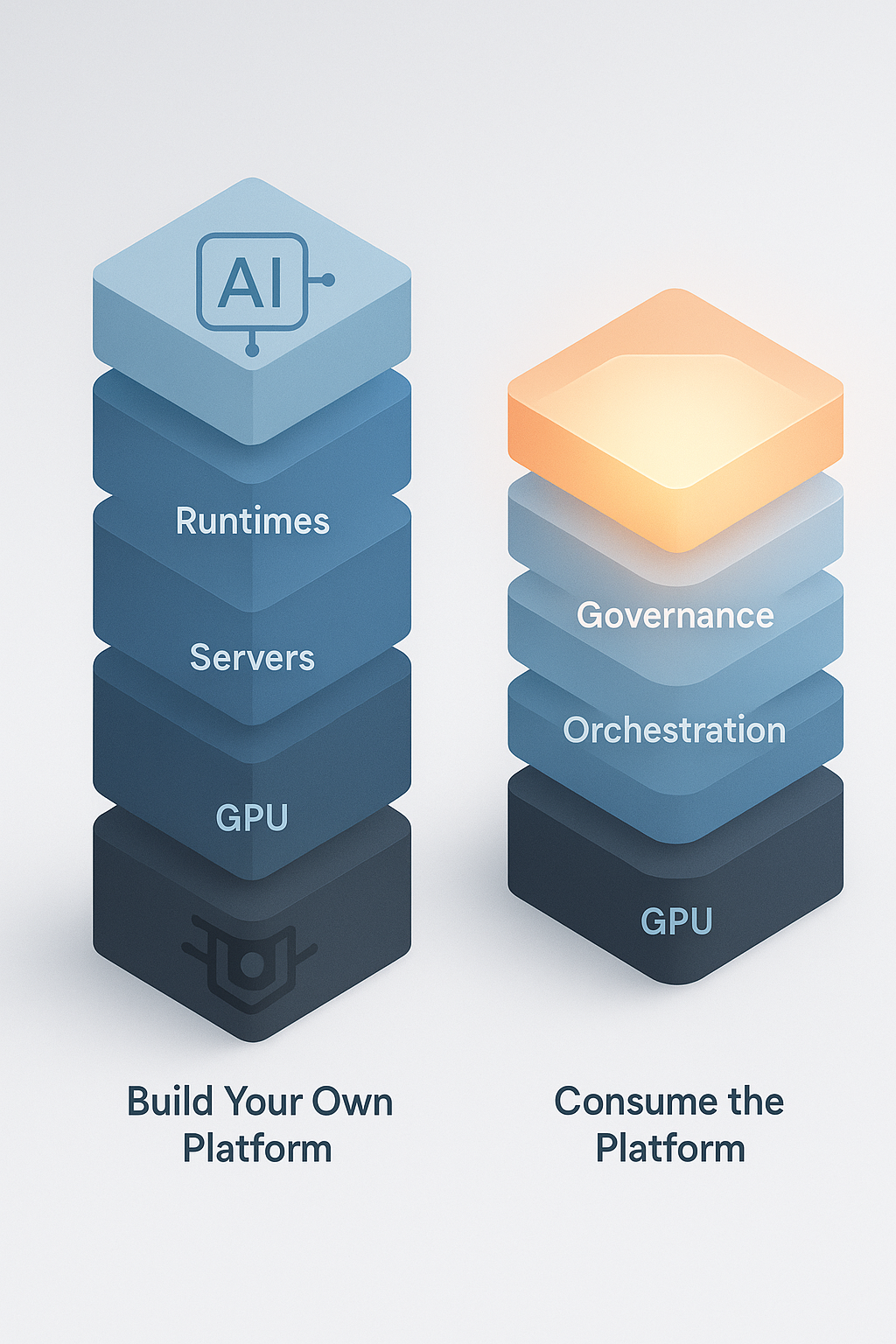
This is where the 4+1 Layer Model—and specifically Layer 2C (Reasoning / Agentic Infrastructure)—becomes essential.
If the a16z architecture is the set of appliances developers plug in… Layer 2C is the power grid.
A city doesn’t ask appliance makers to worry about voltage regulation, circuit protection, or who pays for electricity. The city builds infrastructure so innovation can flourish safely.
Layer 2C provides that same foundation for AI:
- Centralized Model Routing: (Cost-aware, policy-aware)
- Guardrails & Policy Engines: (PII filtering, safety constraints, RBAC)
- Observability: Lineage and event logging across all apps.
- Inference Cost Governance: Automatically routing simple tasks to cheaper models.
Developers should never have to think about these concerns—but CIOs absolutely must.
The Ideal State: a16z on Top of 4+1
When done right, Platform Teams build the grid (Layer 2C) and Developer Teams plug in their appliances (a16z).
Developers still get:
- Unblocked experimentation
- Freedom to build their agent logic
- Speed
But they now operate within:
- Governed data pathways
- Predictable cost controls
- Standardized retrieval
- Guardrails that “just work”
Layer 2C removes the enterprise brake. It absorbs the operational complexity so developers don’t have to. This is how you avoid the avalanche.
The Takeaway: Don’t Ban the a16z Architecture—Finish It
The mistake is treating the a16z stack as a full enterprise architecture. It isn’t. It’s the top half.
The missing half is Layer 2C—the part that keeps the lights on, the bills paid, and the compliance office out of your inbox.
If you’re a CIO, Platform Engineer, or Enterprise Architect, your next steps are clear:
- Accept that 50 AI apps are coming.
- Build the Layer 2C substrate before Shadow AI builds itself.
- Give developers paved roads, not brick walls.
If you don’t build the grid, every team will build their own generator. And when the avalanche hits, you’ll be the one holding the bag.
Share This Story, Choose Your Platform!

Keith Townsend is a seasoned technology leader and Founder of The Advisor Bench, specializing in IT infrastructure, cloud technologies, and AI. With expertise spanning cloud, virtualization, networking, and storage, Keith has been a trusted partner in transforming IT operations across industries, including pharmaceuticals, manufacturing, government, software, and financial services.
Keith’s career highlights include leading global initiatives to consolidate multiple data centers, unify disparate IT operations, and modernize mission-critical platforms for “three-letter” federal agencies. His ability to align complex technology solutions with business objectives has made him a sought-after advisor for organizations navigating digital transformation.
A recognized voice in the industry, Keith combines his deep infrastructure knowledge with AI expertise to help enterprises integrate machine learning and AI-driven solutions into their IT strategies. His leadership has extended to designing scalable architectures that support advanced analytics and automation, empowering businesses to unlock new efficiencies and capabilities.
Whether guiding data center modernization, deploying AI solutions, or advising on cloud strategies, Keith brings a unique blend of technical depth and strategic insight to every project.