
Enterprise AI Doesn't Fail at the Model or the Data. It Fails at the Layer Nobody Names.
Everyone quotes the number. Ninety-five percent of enterprise AI projects fail to return anything. Almost nobody asks the question that would actually help. Where in the stack do they fail?
The consensus answer is data. Siloed data, dirty data, broken pipelines. It’s a comfortable answer, and it’s mostly wrong.
Where do enterprise AI projects actually fail?
I’ve assessed 26 vendor platforms across all eight layers of the AI infrastructure stack. When you score every platform at every layer, one layer keeps failing. It isn’t the one the headlines name.
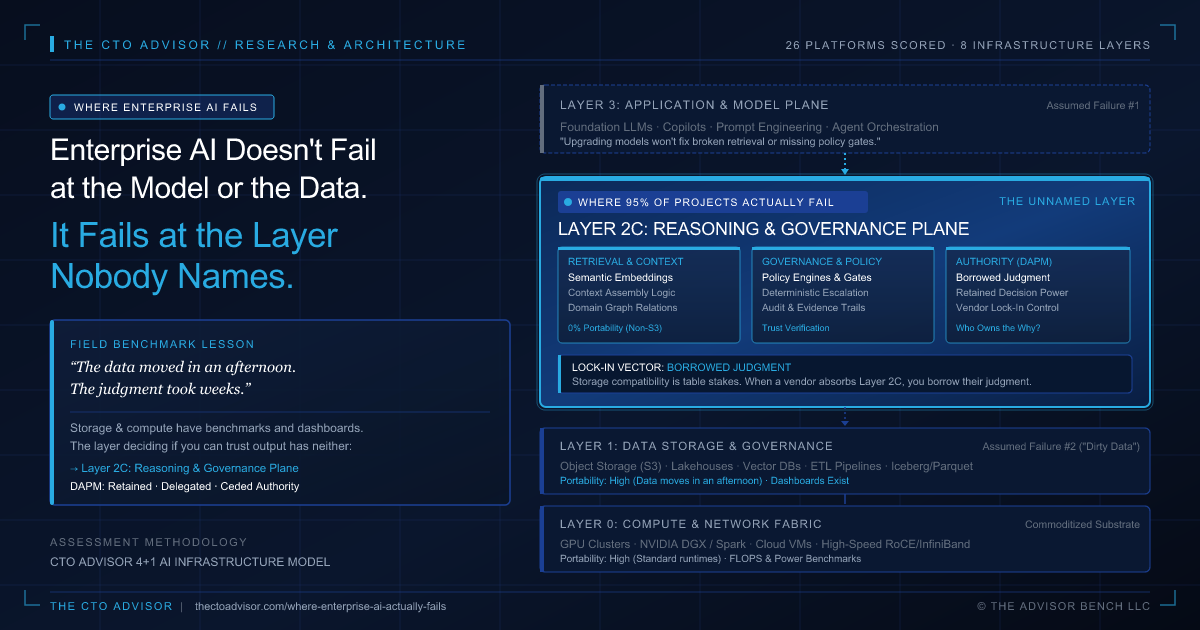
Last year I moved a production AI system off Google Cloud onto an on-premises NVIDIA DGX Spark. Not to leave Google. To learn what leaving would cost. The data moved in an afternoon. The judgment took weeks.
The embeddings, the retrieval logic, the semantic relationships that decide whether the model reasons or hallucinates. None of it ported. I rebuilt all of it by hand. That’s when the lesson landed. The data moved fine. The judgment didn’t.
This is the mistake I watch enterprises make on repeat. They upgrade the model when the retrieval pipeline is broken. They buy more storage when the embedding strategy is wrong. They tune Layer 0, the compute, and Layer 1, the data, because those layers have dashboards and benchmarks. The layer that decides whether you can trust the output has neither.
The layer nobody names
I call it Layer 2C. The reasoning and governance plane. It sits above your data and below your application, and it answers a different question than the rest of the stack. Not “can the model run.” Whether the organization can trust what it does. Policy, escalation, evidence, and decision authority all live here. Most platforms have no explicit home for any of them.
This is where a technical problem becomes a business one. When a single vendor absorbs that reasoning layer, you stop owning the judgment your AI depends on. You borrow it. I call that borrowed judgment, and it’s the lock-in no portability checklist will ever catch. Simple Storage Service (S3) compatibility is real. It’s also table stakes. It tells you nothing about who owns the logic that decides what your data means.
So, who owns it?
There’s a cleaner way to ask. For every decision your AI system makes, who holds the authority? The human, a policy engine, or the vendor’s platform? I put that under the Decision Authority Placement Model (DAPM). Every decision is Retained, Delegated, or Ceded. Most enterprises have never mapped it. They find out in year two, when the system hallucinates on production data, nobody can explain why, and the judgment they need to fix it belongs to someone else.
You don’t have to take my word that this is where the value sits. Watch the vendors. The storage companies stopped selling storage. Pure Storage rebranded. VAST calls itself an operating system now. Google productized the exact layer I found was non-portable. They’re all climbing toward the reasoning plane, because that’s where the control lives. And the control is the lock-in.
The real question
So when the board asks where the AI money went, don’t point at the model and don’t point at the data. Point one layer up. You don’t buy AI from a vendor. You buy decisions about which layers you own and which layers you let the platform own. The storage was never the decision that mattered.
If your organization can’t say who holds decision authority at the reasoning layer, you don’t have an AI strategy yet. You have someone else’s.