Before You Build a Private Cloud, Ask This One Question
Most private cloud initiatives don’t fail because of bad architecture.
They fail because the organization was never ready to operate one.
Over the last 15 years, I’ve watched private cloud fail in remarkably consistent ways.
Not at install time.
Not during the pilot.
Not because the technology didn’t work.
Private cloud fails 18–36 months later, when:
-
upgrades stall,
-
integration debt piles up,
-
the original team moves on,
-
and what was sold as a “cloud platform” quietly becomes an expensive system no one wants to touch.
That pattern is repeating again today—just with better branding, bigger suites, and higher stakes.
This post exists to interrupt that cycle before you spend millions.
The Private Cloud Question No One Asks Early Enough
When enterprises evaluate private cloud platforms—VCF, OpenShift-based stacks, HCI suites, or “hybrid cloud” offerings—the conversation usually starts with:
-
Do we have feature parity with public cloud?
-
Does this support Kubernetes, VMs, and AI workloads?
-
Can we standardize on a single platform?
-
Will this reduce cloud spend?
Those are architecture questions.
The question that actually determines success is simpler—and almost never asked:
Are we ready to operate a private cloud as a product for the next 3–5 years?
Most failures happen before architecture ever matters.
Why Private Cloud Keeps Failing (And Keeps Being Rebranded)
Private cloud has failed at least three times already:
-
early virtualization “clouds”
-
OpenStack
-
private PaaS platforms
Each time, the story was the same:
“The technology is finally ready.”
And each time, the failure mode was also the same:
The organization wasn’t.
Private cloud platforms don’t fail because they lack features.
They fail because enterprises unintentionally take on:
-
product management responsibility
-
lifecycle coordination across multiple vendors
-
integration maintenance that never goes away
-
upgrade risk that compounds over time
None of that shows up in a demo.
All of it shows up in Year 2.
This Is Where “Fourth Cloud” Enters the Picture
I use the term Fourth Cloud not to describe a product, but an operational pattern:
A unified infrastructure substrate spanning cloud, on-prem, and edge that behaves like a cloud product—but must be operated by the enterprise.
That last part is the trap.
Public cloud works because vendors operate it as a product.
Private cloud fails when enterprises install software but underestimate the product discipline required to sustain it.
Fourth Cloud is real—but only for organizations that are ready for it.
Most aren’t. And that’s okay.
The 4+1 Model vs. the Fourth Cloud Framework
This is where I need to be very clear, because these are often conflated.
-
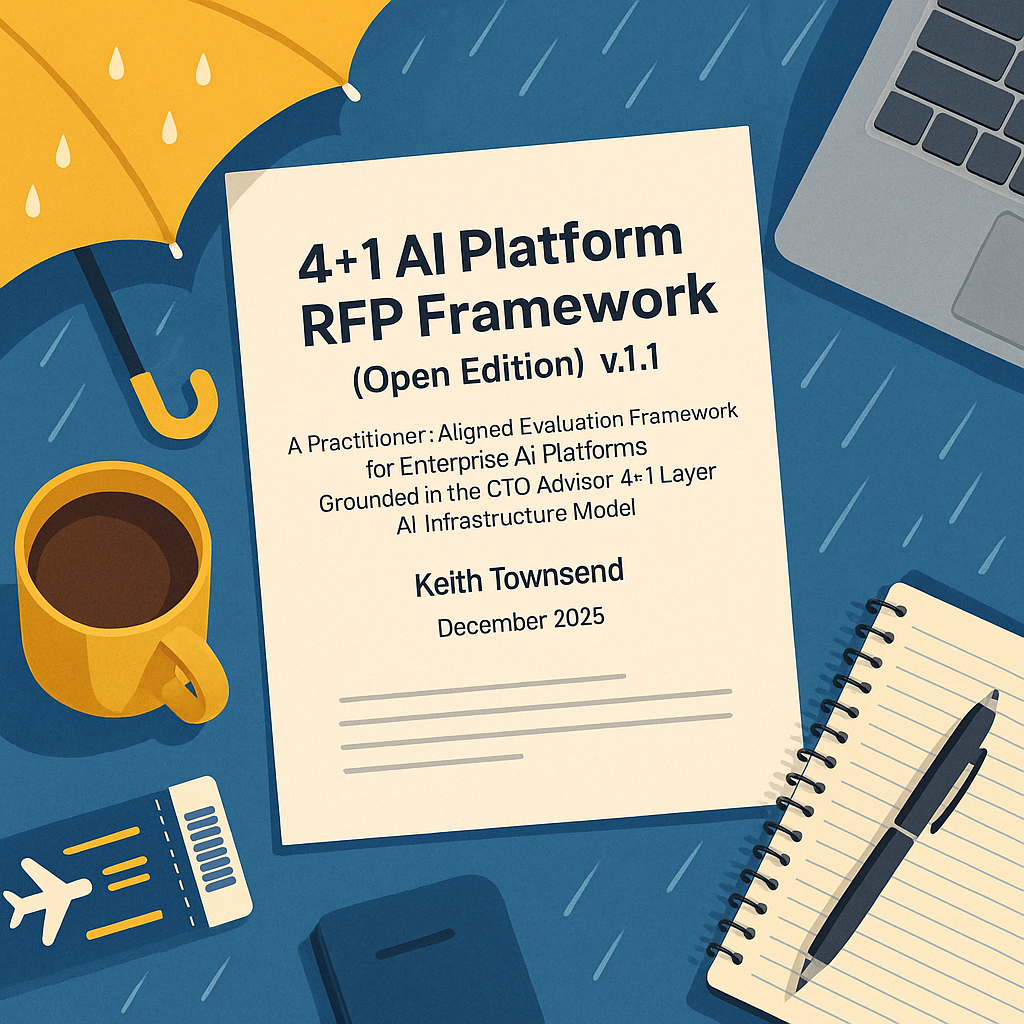
The 4+1 AI Infrastructure Model helps you design what to build:
-
GPUs, data planes, orchestration, reasoning layers
-
Who provides which layers
-
Where your AI stack gaps exist
-
-
The Fourth Cloud Framework helps you decide whether you should build anything at all:
-
Can you operate an advanced platform sustainably?
-
Do you have the team, funding, and lifecycle discipline?
-
Who owns the gaps when vendors don’t?
-
What happens when “temporary” integrations become permanent?
-
Put differently:
The 4+1 model helps you design AI infrastructure.
The Fourth Cloud framework helps you decide whether you’re ready to operate any advanced platform at all.
Most private cloud failures skip that second step.
What the Fourth Cloud Framework Actually Does
The Fourth Cloud Readiness Assessment & Evaluation Framework is a reference guide—not an RFP checklist—that forces an uncomfortable but necessary conversation early.
It helps organizations:
-
assess their operational maturity honestly
-
choose the right path (build capability, stage adoption, or proceed)
-
understand the real cost of integration gaps over time
-
avoid treating private cloud like “installed software”
-
decide when not to issue an RFP
In practice, it shows that:
-
70–80% of enterprises should not pursue an ambitious private cloud today
-
15–20% should narrow scope dramatically
-
~5% are ready for full platform composition
That’s not pessimism.
That’s failure prevention.
Who This Is For (and What to Read)
You don’t need to read the whole framework. Use it as intended.
CIOs / CTOs
Read:
-
Executive Summary
-
Organizational Readiness Assessment
-
Gap Ownership & Lifecycle Management
Why:
-
This tells you whether private cloud is realistic for your org, not just in theory.
Platform & Infrastructure Leaders
Read:
-
Readiness Assessment
-
Cross-Layer Integration
-
Gap Ownership
-
Selected layer questions
Why:
-
This clarifies what you’ll own on Day 2—and for how long.
Security, Risk, and Compliance
Read:
-
Strategic Risk Assessment
-
Identity, Data Gravity, and Compliance sections
-
Gap Ownership
Why:
-
Fourth Cloud centralizes decision-making—and risk.
Procurement & Legal
Read:
-
Executive Summary
-
Gap Ownership & Vendor Accountability sections
Why:
-
This reframes contracts around lifecycle responsibility, not feature promises.
Why I Wrote This
I didn’t write this because private cloud is impossible.
I wrote it because selling private cloud without operational honesty keeps breaking teams.
If this framework helps you:
-
delay a decision,
-
narrow scope,
-
choose managed services,
-
or walk away entirely,
then it did its job.
Because the most expensive private cloud failures aren’t technical.
They’re organizational—and they’re predictable.
The Fourth Cloud Readiness Assessment & Evaluation Framework (Open Edition, v0.9)
is available now as a public reference guide.
Read it before you design the architecture.
Read it before you issue an RFP.
Read it before you repeat the last 15 years.
That’s the point.
Share This Story, Choose Your Platform!

Keith Townsend is a seasoned technology leader and Founder of The Advisor Bench, specializing in IT infrastructure, cloud technologies, and AI. With expertise spanning cloud, virtualization, networking, and storage, Keith has been a trusted partner in transforming IT operations across industries, including pharmaceuticals, manufacturing, government, software, and financial services.
Keith’s career highlights include leading global initiatives to consolidate multiple data centers, unify disparate IT operations, and modernize mission-critical platforms for “three-letter” federal agencies. His ability to align complex technology solutions with business objectives has made him a sought-after advisor for organizations navigating digital transformation.
A recognized voice in the industry, Keith combines his deep infrastructure knowledge with AI expertise to help enterprises integrate machine learning and AI-driven solutions into their IT strategies. His leadership has extended to designing scalable architectures that support advanced analytics and automation, empowering businesses to unlock new efficiencies and capabilities.
Whether guiding data center modernization, deploying AI solutions, or advising on cloud strategies, Keith brings a unique blend of technical depth and strategic insight to every project.