Layer 2C Validated: How Articul8’s Agentic Platform Proves the Intelligence Reasoning Plane
I Was Testing My Framework at AI Field Day 7. Articul8 Passed Without Knowing.
Last week I published The CTO Advisor 4+1 Layer AI Infrastructure Model—a reference architecture that defines Layer 2C as the missing “Reasoning Plane” in enterprise AI infrastructure.
What I didn’t mention: I’d been developing this framework for months. And last week at AI Field Day 7, I was testing it.
When Articul8 presented their platform, I asked pointed questions about Knowledge Graph poisoning, data pipeline challenges, and why digital persona vendors fail. Those weren’t random questions. I was validating whether a real implementation matched the architectural pattern I’d been mapping.
They passed. And in doing so, revealed something I hadn’t fully articulated:
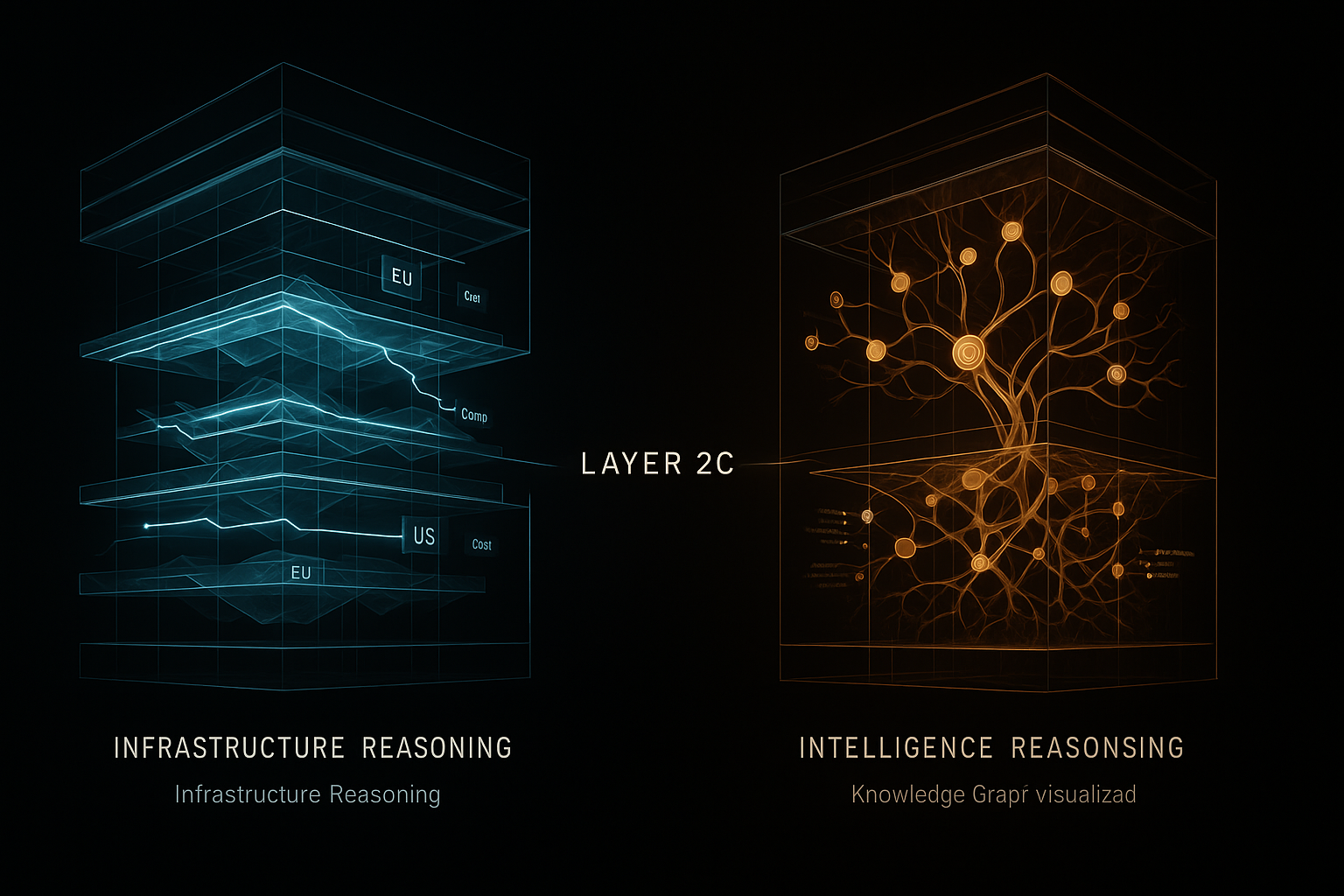
There are actually two Layer 2Cs enterprises need—and Articul8 proves the second one.
The Framework I Was Testing
Layer 2C is the autonomous policy engine that sits between infrastructure orchestration (Kubernetes) and application runtime (model serving). It makes intelligent placement decisions using business context—not just cluster metrics.
Traditional Layer 2C answers:
“Which GPU cluster should run this workload given data residency requirements, cost constraints, and SLA targets?”
It’s the layer hyperscalers provide implicitly (AWS SageMaker auto-selecting instances, GCP Vertex AI optimizing data locality) that self-hosted stacks must build explicitly.
At Field Day, I was testing whether Articul8 understood they were building a Layer 2C.
Their answers revealed they were—just not the Layer 2C I’d been focused on.
The Question That Exposed It
My question at Field Day:
“I’ve been messing around with digital personas for a few months now… where they fall far short of what you folks are doing is this data pipeline issue. How do I discover the corpus of data? How do I maintain it? How do I solve all these vector problems? Wish you would have reached out three months ago.”
What I was really testing: Does Articul8 understand they solve the complete stack problem (data foundation + reasoning plane), not just model serving?
Their response validated: Their platform handles autonomous data ingestion, builds a Knowledge Graph as governance layer, AND includes an “agentic reasoning engine” that makes autonomous routing decisions.
That’s when I realized: They’re providing Layer 2C for intelligence selection, not infrastructure placement.
The Two Layer 2Cs
| Feature | Infrastructure Layer 2C (My Framework Focus) | Intelligence Layer 2C (What Articul8 Provides) |
| Problem | Where should this AI workload run? | Which intelligence should handle this mission? |
| Decision inputs | Data governance metadata (data_residency: “EU”), Cost constraints, Latency SLOs | Domain context, Task complexity, Institutional knowledge (Knowledge Graph) |
| Output | “Run this workload on eu-central-1 cluster using A10 GPUs” | “Route this mission to: domain-specific manufacturing model + diagnostic reasoning agent + signal processing specialist” |
| Who provides it | Hyperscalers (Implicitly), Self-hosted (Must build explicitly: HPE/Kamiwaza, custom OPA) | Articul8 (Explicit agentic reasoning engine) |
| Critique | This layer focuses on physical placement policies. | This layer provides the autonomous, multi-objective reasoning to decide, not just retrieve. It is a policy engine that routes the mission based on context. |
The Architectural Pattern Articul8 Validates
Their Agentic Reasoning Engine
- The Key Distinction: Ray’s critique of “mere chatbot intelligence” is valid if you only look at the model’s output (Layer 3). But the Layer 2C value is in the autonomous policy engine that makes the routing decision.
- Textbook Layer 2C: Their platform breaks down complex missions into sub-missions and uses its intelligence to find the most suitable domain-specific or task-specific agent. This autonomous decision-making and policy-driven routing is the definition of a reasoning plane. The Network Topology Agent is a Layer 3 consumer; the Agentic Reasoning Engine is the Layer 2C policy that decides to use it.
Deployment Context: Why Hybrid Enterprise Matters
A reasonable question is whether this is just another cloud service. It is not. The need for an Infrastructure Layer 2C is most acute in self-hosted or hybrid enterprise stacks because you don’t get the implicit, seamless orchestration a hyperscaler provides. Articul8’s focus—solving proprietary data ingestion, data residency, and deep domain expertise—is the very definition of a self-hosted/hybrid-first platform. They exist to provide Layer 2C intelligence to enterprises that must keep data private, behind their firewalls, or manage their own infrastructure.
The Examples That Validated It
(No significant changes needed to these sections, as they rely on the Layer 2C policy action.)
Semiconductor Manufacturing
The mission: Root cause analysis taking days for human experts.
Autonomous routing decision: Manufacturing domain model + diagnostic agent + signal processing specialist
Result: Days → hours. This is multi-objective placement: Right agent + right data + right domain context.
Mechanical Engineering CAD Analysis
The mission: Identify components, find missing parts, detect anomalies in CAD drawings.
Autonomous routing decision: Vision intelligence agent (93%+ accuracy)
Critical validation: Auditable and traceable. Layer 2C requires observability. Articul8 already does this.
Network Topology Agent
The mission: Troubleshoot network changes, detect anomalies.
Pattern recognition: This is the same autonomous reasoning at both infrastructure and intelligence layers.
What This Means for You
If you’re building enterprise AI infrastructure:
Question 1: Do you have Infrastructure Layer 2C?
Question 2: Do you have Intelligence Layer 2C?
Most enterprises have neither. Complete AI platforms need both reasoning planes:
- Infrastructure Layer 2C: European customer query $\rightarrow$ Route to EU cluster
- Intelligence Layer 2C (Articul8): Semiconductor defect analysis $\rightarrow$ Route to domain expert agents
Together: Right intelligence in right place with right cost. Fully autonomous.
The framework is published. The validation is real. The conversation is just beginning.
What’s your Layer 2C strategy?
Share This Story, Choose Your Platform!

Keith Townsend is a seasoned technology leader and Founder of The Advisor Bench, specializing in IT infrastructure, cloud technologies, and AI. With expertise spanning cloud, virtualization, networking, and storage, Keith has been a trusted partner in transforming IT operations across industries, including pharmaceuticals, manufacturing, government, software, and financial services.
Keith’s career highlights include leading global initiatives to consolidate multiple data centers, unify disparate IT operations, and modernize mission-critical platforms for “three-letter” federal agencies. His ability to align complex technology solutions with business objectives has made him a sought-after advisor for organizations navigating digital transformation.
A recognized voice in the industry, Keith combines his deep infrastructure knowledge with AI expertise to help enterprises integrate machine learning and AI-driven solutions into their IT strategies. His leadership has extended to designing scalable architectures that support advanced analytics and automation, empowering businesses to unlock new efficiencies and capabilities.
Whether guiding data center modernization, deploying AI solutions, or advising on cloud strategies, Keith brings a unique blend of technical depth and strategic insight to every project.