
Your Data Is Getting Dirtier While We Talk — UnicornIQ's Answer to AI's Unsolvable Problem
Transcript
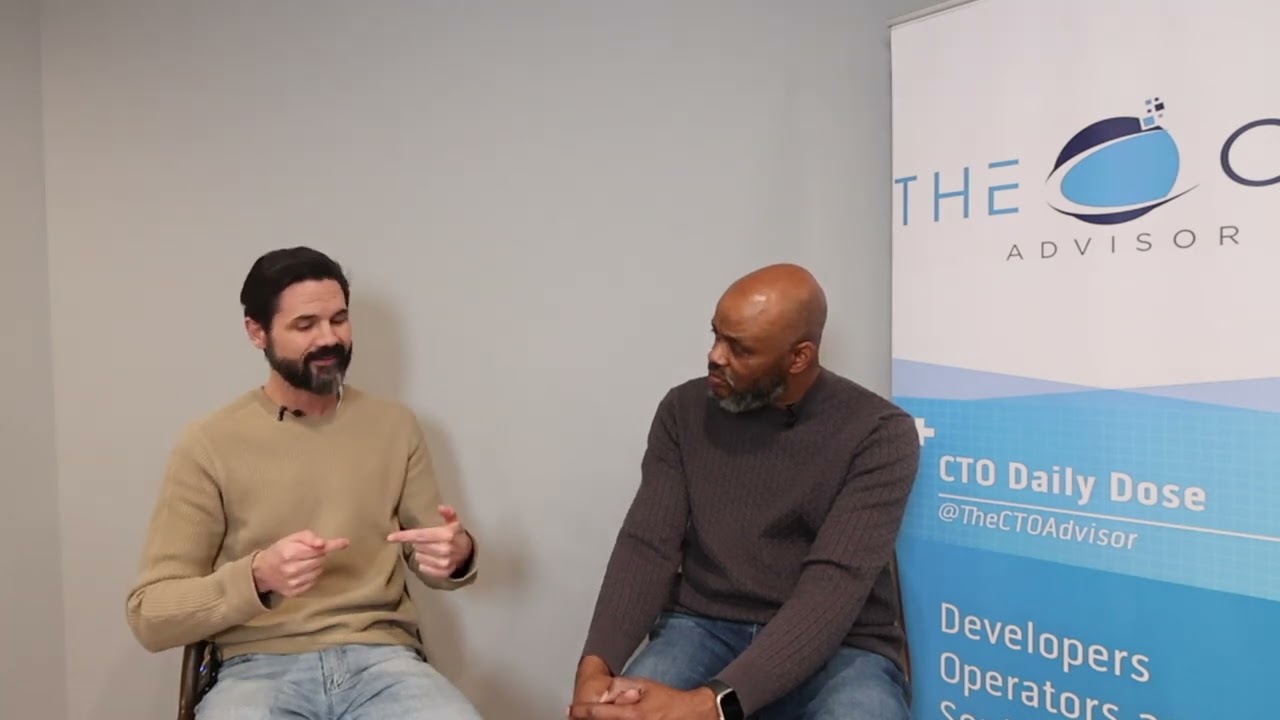
All right. This is a treat. Joe, I think you're the first person other than my family that we've done a published podcast with. And in the in my in our home. >> Well, I appreciate you inviting me into your home. That is usually recommended against. >> The you know what? You've had me at What's the French name again? Named after my mom, Auberge Place. Auberge Auberge Place. When it there's a nice iron you know, I'll put the picture as the title of the as the thumbnail.
Pretty cool ranch. You've had me there. You've had the CTO of Visier Flying Cloud there. This is the second time we've done a podcast though cuz we did a podcast uh there at the ranch. In which we ironically talked about data. >> We did. We did. >> And we're talking about data today. You're sponsoring this podcast. We're talking about your startup unicorn IQ or UIQ for short and you're solving where I think is a very unsolvable problem.
>> Agreed. >> Garbage in, garbage out. Everyone tells us that you need to clean up your data before you put it into AI. The problem is is that once you clean it, it gets dirty again. >> Absolutely. It's getting dirty in real time. While we're talking, your data is getting dirtier. >> The the we're building technical debt. 80% of uh you know, we've seen the numbers. I've heard CDOs chief did chief data officers talk about this number time and time again.
80% of their data scientists spend, I'm sorry, 100% of their data scientists spend 80% of their time cleaning data instead of analyzing data. Now, everyone in our organization uses a the and they're pseudo-data scientists. >> Absolutely. Absolutely. Cuz if you just slap a very expensive piece of computing over dirty data, eventually, if you throw enough money at the problem, it'll fix itself, right? >> Yeah, the we're infrastructure people. So, you know what? The application's too slow, you throw more CPU and memory at it.
The application goes fast because CPU and memory is cheaper than developer. >> Okay. >> However, this is not the case. GPUs are quite expensive. CPUs are expensive. This whole inference pipeline is expensive. And even if we could throw money at the problem, we may not be able to keep up with the problem because the data is growing faster than we can throw CPU and GPUs at it. >> Agreed. It's hard to think around the problem cuz all the marketing is saying just wait for the rag to fix it.
Wait for AI and inference to fix it. But I think people forget that incentive drives behavior. Who's selling rag? The people that are charging you by the drip for it. Of course, they want you to use that to fix it. If I'm selling you fuel, I want you buying Ferraris, not Corollas. >> This is true. So, on top of that, they abstract away the problem so much, and the models are improving I would say exponentially, that there's this false sense of the problem is solved.
But we see the cracks all the time. >> Right. Right. Yeah, so I think when you when you look at it, an engineer would say that we're we've moved into a non-deterministic behavior. But what that really means is that I can't trace and troubleshoot AI's answer back to exactly why it gave me that answer. It's doing some level of magic that isn't completely traceable in that inference stack, right? So, this creates a problem. Think about an employee that works for you, right?
AIs are artificial intelligence, we have human intelligence. So, you're working with human intelligence, and you ask me on your staff, "Hey, Joe, what should we do next with our marketing launch? " And I go, "I You know, I don't know. " That's AI, right? I'll give you an example of how AI inference works. If I ask it to build me a go-to-market strategy for Unicorn IQ, it'll build me one. And if my next question is, "Show me your work.
" Any AI prompt I type that into will immediately start lying to me. It'll start trying to provide human logic for how it made its decision. " >> And that is the That's both the brilliance and the frustration with AI with generative AI. It looks like intelligence, but it's not intelligence. And what asperates the problem or exasperates the problem is the concept that once I put garbage in, that predictive nature. So, if it's inferencing off of bad data or inconsistent data.
We like to use the example of a Ford truck that, you know, 1935 Ford truck came in black. Black only. That was in the spec sheet. That is truth. Fast forward to 1975 or 1985, that truth differs. And when you give this to a rag system, what's going to be the the result? >> Absolutely. So, the result is not just the hallucinations we're getting. So, there are all the scary numbers out there. We've talked about them.
85% of AI products fail. 95% of projects fail. Nobody's going to get a real number cuz there's nobody that goes out reports their failures, right? You know, that's not a thing we normally do. But the fact of the matter is even when AI projects aren't failing, they're generally not getting us the result cost-benefit that we were expecting out of them, right? Maybe they're stalled versus failing. What's happening is is a few things. First, we're making an a smart assumption that went wrong when the context changed.
The smart assumption is I use chat GPT or whatever your AI flavor of choice, they're all comparable, it doesn't matter. I use that for public knowledge and it's awesome, right? Like I can write like Twain, I can think like Plato, and I can math like Einstein with AI. That's awesome. So, I should be able to apply that same thing to my corporate data and get the same result. Different data set. That's where the thing breaks down. First of all, the AI itself is trained on the entire corpus of human knowledge it's been digitized.
That's the largest data set ever available in our species history. Your data in comparison is 1/1 billionth of that size. So, you're already searching for a needle in a haystack every time you do inference, and then that data's dirty. I jokingly and lovingly say that if I went and ask it's Benioff in charge of Salesforce, right? Right. " The the CEO of Salesforce would tell me, "Eh, eh, no. " If he was being honest, right? Our data is just continuing to get bad.
So, that's always churning in rag. We're always working harder for no reason, even if it's giving us decent results. We're paying way too much for those results. >> So, let's talk about how you solve that problem. Give me the the elevator pitch. How are you taking which is a problem that we've had since the first time we've said saved data to a bit to disk has been the problem with knowledge management. How are you helping solve that problem? >> Mainly begrudgingly, Keith.
This was not the problem I originally set out to solve. We were trying to build a higher level sales intelligence system. And what we realized is that to get to that level, I've got to bring in my customer's data. So, we started doing that. We started testing. Everything fell apart every single time because we couldn't get accuracy close enough to be a usable system people would continue to adopt because the underlying data was dirty. So, we started looking at that problem and thinking about it.
Now, when people talk about data hygiene, I believe that they overgeneralize it. They think of it like a light switch. Like, I need my data's dirty now and I'm not going to disagree with that too much, but I don't have the money to switch the lights on and make it all clean. Right. >> Which one your time? >> Right. I agree. But, while you can't just pay for switching a light, money or time, do you really want to knowingly invest hundreds of millions of dollars in an AI stack that's working on a data set you know is bad and getting worse?
That that that just seems like a stop if I can't. >> So, this is we've seen this play out time and time again with >> cloud, big data, you name it. >> The once we figure out that once we think we can out-engineer our bad data, our projects typically fail. So, you're helping to not clean up the data, but help me discover truth. >> That's right. So, what what we're doing is first, we don't want to touch your data. Your source data is the is is the closest thing to fact that exists.
Even when it's wrong or right, I don't want to be the one making up new wrong out of it. So, my job is to sit out of the line of your data. You can still have whatever rag inference BI AI any of the systems you use, I don't get involved with them. I create a data plugin that can ingest today from unstructured data like like you did files we use on a daily basis as knowledge worker, PDFs, documents, the stuff that makes up 80% of your rag layer.
I parse it, distill the information out of it, and then my system goes through a series of mathematical calculations to find out how confident we are in that data. Now, some of it's rocket surgery. Some of it's basic, right? Let's say you have nine out of 10 dentists agree, right? That commercial we've all seen? Well, great. I can probably trust nine dentists more than I can trust one. But it doesn't mean one is wrong, and it doesn't mean nine is right.
It means I'm higher confidence. >> Right. So, we're only ever assigning confidence based on what we can see. >> We're not saying this is fact or false. We're saying Same thing as if I ask Keith a question, he gives me an answer. " He might say 80%. Cool. Great. Now I know how much I can trust Keith's answer. That's what we're handing to the inference layer. So, when the infer- when the inference layer or the AI, your prompt, right?
Like the the thing you're trying to do, asks a question, it first is prompted to call the source of truth. The source of truth provides back a list of facts that exist in your data with a link to the original source that you can find that exact word in, that exact sentence, that exact fact in. " The interesting thing is that by moving this left of the AI stack, I can do it deterministically. I can meaning I can give you results we can verify.
And I end up optimizing the AI stack to the right side of me. Meaning, your prompts respond faster. The quality of response is measurably better. And you're burning less CPU cycles and tokens to do it, which means reduction in cost. Oh, by the way, if you're running that privately, that's also reduction in power, cooling, and fresh water for the coin. >> So, I'm hearing I'm creating this rich data set, this metadata around my data, which isn't in itself a new concept.
What is new is applying this to my AI data pipeline. That's a lot of work that I've put into creating this metadata registry to help me um increase the confidence of my AI output. Who owns that now created metadata? Because now this is actually quite valuable. I cannot just use it in my AI pipelines I I assume. I can use it in all other types of business analytics. What's gating me from either taking that system and and applying it to other systems within my environment or even taking my ball and going somewhere else?
>> Nothing. We're We're actually designed to be a completely open module. So, if you if you think of me as a data hygiene black box, and I I I use black box as an analogy. I'm happy to tell everybody what happens inside the box. But, on one side I have data plugins for any supported data set, right? So, right now G Drive is one of the ones I support. So, I could reach out to G Drive and pull the files and data out of there.
I can parse them and distill the information, and then I create a vector database, which is just a source of truth. It's It's not really even metadata about your data. It's the facts in text with a vector index in a gravity-weighted database. I expose all of that via API and MCP server. So, I'm designed to integrate with whatever stack you have and sit in the back. So, to give you an example, let's say you have an AI sales chatbot that just isn't getting traction because it's not giving right enough answers often enough.
You've already invested a ton of money into a rag and inference stack sitting there. You don't want to rip and replace that. Not for me, not for anybody. Don't just add a prompt to that existing agent and tell it to check for truth first. You'll instantly get better results across that entire stack because you're grounding in confidence even in the noise. >> Yeah, that's how virtual CTO advisor works. The is grounded in my data set. My data set is relatively small, only, you know, a few thousand uh instances, but I even have problems in that because truth has changed over the 10 years that I've been writing content publicly.
What I believed in 2019 about AI no longer applies in 2026, but that data is there. So, you're helping me solve that problem even in my small data set, helping me establish truth or confidence, and then using the larger models. I will challenge you here, though. What happens when the data or the answer doesn't exist? Because that happens in my data. " If someone goes goes to virtual CTO advisor and ask it about a topic that is not trained in or not aware of, then it will hallucinate.
>> Absolutely. Absolutely. So, I let me let me let me start with an analogy. Um as we talked about, I own a cattle ranch. When I bought that cattle ranch, I started learning things I've never done before, like raising cattle, like castrating bulls, and wrestling cattle out of hay feeders, and all sorts of fun stuff. I also started investing in heavy equipment. So, I year ago bought a Bobcat, piece of heavy equipment to run. >> A one one?
Yes. >> It comes with a manual, and that's great. The manual tells me how to use it. But I can use that machine any way I want. And I often use it in ways that are very dangerous and not prescribed by the by the manufacturer. Our system is designed to use it however you want. We have some prescriptions for how you use it as to what you're trying to get out of it, but it's designed to be a very flexible modular system, so it can plug and play into a lot of different use cases.
I'm taking the long way around to the answer is it's going to depend on what you want out of your system as to how it handles a question it doesn't know the answer to. So, I'll use sales as two examples. If I'm a pharmaceutical rep talking to doctors and I say the wrong thing, consequences, major consequences. So, in that case, if they're asking a chatbot a question the chatbot doesn't have truth to, they should get no answer and they should give the customer no answer for any amount of time until they have the right answer.
Now, if I'm selling Cisco switches, I might not have the same worries. Like, it's not quite the same. Right. You know, if I accidentally say it's 52 ports, which is not a real thing, by the way, but instead of 48, long story short, that's a different type of brawl. Right. If I'm launching nuclear missiles, that's a whole 'nother level of fact I need. So, our system is designed to be integrated into what it's trying to do. So, for a general sales team, when they ask a question that's not supported in truth, they can click a button that says ask an SME.
That'll trigger a human in the loop session, chat session generally. When that SME answers, we'll actually record that as a digital fact, right? We'll create a new artifact out of that accepted answer, send it back into the pipeline, so next time the question gets asked, it doesn't have to be answered by a human. But that said, that human could still click a button and say just give me inference anyway, right? Like, when you're using AI to theorize about where the industry's going, wrong answers aren't a problem.
You're brainstorming, right? You want AI to get you your brain thinking. So, in that case, great, inference even if you don't have facts. It depends on the situation and what's going on, so we configure it to work that way. But, the magic of what we did is not ignore human in the loop because everyone thinks it's a dirty word. We built human in the loop in as a feature. So, I'm taking friction away from a specific job task while pulling knowledge out of their head and building it into digital truth.
>> Last question is about commercials. If I don't ask you about how I pay for this thing, my audience will kill me. So, what is this? Is it SaaS? Is it on on prem software? Am I charged by the number of connections? Like, what's the commercials about? >> So, Keith, this one's hard to explain and I don't know how far I'm allowed to say. I've been in IT for 30 years. When I started, we used to solve problems by building systems that solved the problem.
I've spent the last 15 years helping companies take garbage to market. It's lock-in for the sake of lock-in. It's cost for the sake of cost. It's SaaS not because SaaS is the right delivery model, but because SaaS gets me ARR and that's what my VC wants to see, right? We're not making decisions based on anything but money in this industry right now. I decided to do the opposite. This is a modular, open, integratable system. I deploy it in your stack.
You own it. You take care of it. You don't trust me with your data because you shouldn't trust anybody with your data. And I'm not asking you to make me an exception. And I'm going to charge you flat banded pricing based on the ingest cost. No surprises, no nothing. Extremely fair pricing down to the CTO advisor and up by ExxonMobil or whoever. >> Well, Jared, I really appreciate you spending the time coming and talk to me about Unicorn IQ.
If this just wet your whistle about the topic and you want to dive deeper, we actually did a lightboard. >> We did. >> And the massive CTO Advisor Studio basement. And we talked through just the overall architecture and the philosophy around the product. The link will be below to watch that video or in the show notes from the if you're watching this or listening to this via your favorite podcast. If you enjoyed the conversation, click subscribe. ai. >> That's a proper AI website.
You want to learn more about the CTO Advisor. com. com. Until then, see you on socials. Talk to you next CTO Advisor podcast.


