Why choose one when you can have both, On Premises & Cloud
Transcript
hi my name is shikha mittal and I'm a senior director of product management at VMware I had a global team that is responsible for delivering multi-cloud hybrid Cloud desktop as a service as part of digital workspace Solutions I'm very excited to be here today at CTO advisor hybrid Cloud conference and in this session we're going to discuss what hybrid cloud is why it's all the rage different considerations to think about and successful examples of organizations who have deployed this model so why choose one when you
can have both on-premises and the cloud so let's get started the concept of hybridity is not new in fact take Greek mythology for instance with a centaur a powerful creature where a fantastic Horsemen has become one with a horse more importantly it's an example where there is a mix of unique capabilities from two different worlds if you fast forward to today this still Rings true across many different Industries in fact we see entire Industries adopting this hybrid approach whether it is retail with your brick and
mortar stores and online shopping Automotive with gas and electric or education with classrooms or online learning closer to home in the IT world what exactly is hybrid Cloud especially with all these terms you have distributed Cloud multi-cloud super cloud so what exactly is hybrid cloud so simply put it's essentially a mixed deployment where you can have applications running using a combination of storage Computing and services that span between public cloud and private Cloud private Cloud meaning your internal Data Center now it's worth noting that even
though we are talking about hybrid Cloud there is an overall hybrid strategy that includes different hybrid elements and I am particularly calling out three here infrastructure management and applications so let's take a look at this sort of interesting view so you have infrastructure which is a little bit more intuitive when we talk about hybrid Cloud so you have your storage networking and Computing in your private data center on premises most likely and then you have you know public cloud of which you can have one or
many but the point is that infrastructure itself can almost be considered as a fungible resource so that you can have your portable workloads that can span between on-premises and the public Cloud they can mix and match and go back and forth so that's essentially the hybrid infrastructure as part of your hybrid cloud and then you have management of course for a hybrid Cloud it's always better if you have a holistic management view which can span your on-premises and your public Cloud but even within the management
piece there is a lot of hybridity that's going on because it is using Elements which are local like app packages data status topology and it is also using the cloud elements for instance a dashboard troubleshooting notifications and so on analytics experience so there is a hybridity element even within the management piece and then you have applications and there's a whole hybrid assortment of these you have win32 apps virtual apps uh SAS apps and now a new uh you know kind of modern apps that are taking
advantage of technologies that are sort of born in the cloud so now let's take a look at what exactly is the industry saying what are the analysts saying well as per Gartner Cloud migration is not stopping anytime soon in fact they are predicting that this will reach nearly 600 billion this year in a conference that they had in December they are in fact forecasting the public Cloud spending to reach a trillion dollars but the main thing is that the main drivers of this public Cloud spend
are expected to be multi-cloud and hybrid cloud they also note that more than half the it spent is also shifting to the cloud hybrid or not so this in itself is an indication that you know this the I.T staff and capabilities are essentially geared towards a cloud that's where the the spend is so this will also be driving this kind of a mix at the 2022 state of the cloud report from flexera it's essentially saying that multi-cloud hybrid cloud is on the rise in fact take
a look at the vast majority of the multi-cloud organizations that they surveyed are all thinking in terms of hybrid cloud so yes hybrid cloud is indeed All the Rage as suggested by these robust growth numbers and it kind of makes sense because we are seeing organizations who have been on premises they're running out of their data center they're struggling with skilled I.T workers they see the promise of the cloud with the scale the flexibility everything as a service they are also seeing some of the cost
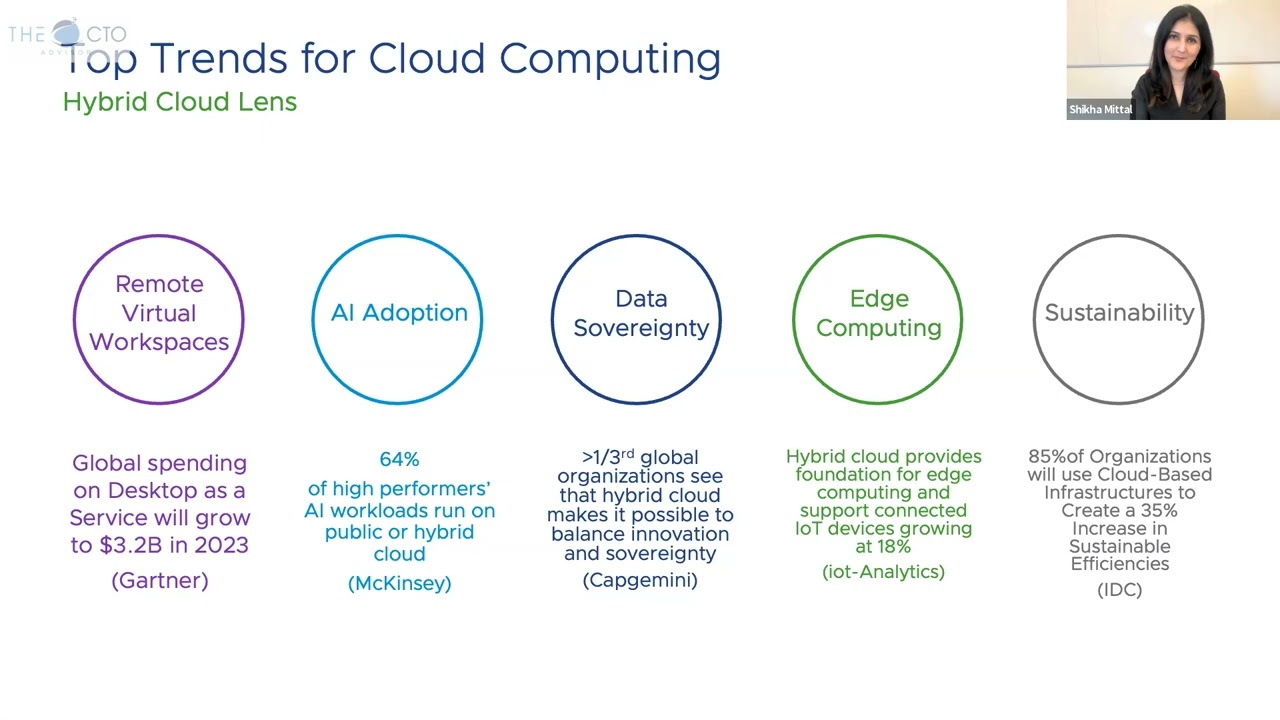
implications of the public cloud and they see that hybrid cloud is the easy bridge to uh cloud in the conversations that I've been having with several organizations in the last few years in fact many of them do not see hybrid Cloud as a transitionary phase as originally thought instead they see this as steady state because it is a perfect solution to get Best of Both Worlds so now let's take a closer look at some of the top trends that are driving uh public Cloud adoption but
see it specifically with the lens of hybrid Cloud so the first one here is remote virtual workspaces the last three years have served as a catalyst to uh to accelerate the adoption of BDI and as for organizations who are looking to provide remote and secure work the hybrid Cloud Advantage here is that organizations can choose from solutions that can serve up a virtual desktop either from on-premises or from the public cloud based on a host of parameters like proximity to data end user location the security
profile of the end user Etc the next one is AI adoption as AIML becomes more pervasive organizations do recognize that it's a lot more economical to use the vast Computing resource that it is that is needed in the public Cloud for data analysis while reserving some of the other workloads on premises data sovereignty is another example where initially organizations thought that the private data center is the one hammer that they have for all problems whether it is data security data compliance but no you have Sovereign
clouds that can be stood up which are closely following the rules of the hybrid Cloud workbook and then you have Edge Computing again a huge accelerator for hybrid Cloud because hybrid Cloud serves almost like a foundation to make Edge Computing possible it allows the application and the data to be closer to the edge and as the number of iot devices for instance keeps growing um Edge Computing is also going to grow and thus really driving hybrid cloud and then you have sustainability today organizations take ESG
pretty seriously they're looking to reduce their carbon footprint and the least you can do is say you know move some of the workloads to public Cloud thus reducing your utilities and going towards that sustainability goal so if you think about the benefits of hybrid Cloud cost savings is a big one if you can scale your Computing resources and eliminate massive capex in which is just reserved for handling short-term spikes then you are definitely taking care of a huge amount of cost savings the other piece which
we don't talk about a lot is in the public Cloud there's a lot of cloud spend that is wasted uh in fact in the same flexera report you will see that the wasted Cloud spend has gone up um and it is now I think 32 or something which is pretty shocking uh when organizations are adopting the cloud but don't really know what that cloud Bill even looks like it keeps growing but you know there's a lot of that wasted spend um so with the hybrid Cloud
you can start to take reins back be a little bit more organized and control that that's data privacy and control because hybrid Cloud gives a very easy way to separate secure sensitive data and allow internal ID staff to be in control of critical operations scale and demand another big one here where you can scale resources Up and Down based on demand to meet your burst or fluctuating needs there's improved I.T efficiency because now you're able to improve your speed of deployment the agility with which you
can respond to your business needs so this provides a lot of efficiency by adopting public Cloud to your on-premises deployments and then of course optimizing it spend and skills if you're able to mix and match between on-premises and the public Cloud it means that you're not really training or hiring completely new staff you can train your existing I.T staff to take this on so what kind of use cases uh does this actually provide well typical ones that I see uh Cloud bursting seasonal bursts whether it
is retail or Finance this is a big one um and it's great to have a public Cloud to essentially catch that overflow demand you have Cloud specific Services image recognition language translation perfect for the public cloud while the rest can continue to be in your private data center you have Disaster Recovery in the cloud a huge use case I I see all the time and it makes a lot of sense especially if you're doing this in active active mode or even active passive you can use
the cloud as your Dr site use it on when needed at least the organizations are able to shut down or evacuate their data center needs on premises otherwise it was just sitting there waiting for a disaster to happen which nobody ever wanted uh hybrid Cloud also allows the uh the ability to support app migration to the cloud so as your apps are are making that shift modernizing the apps not a problem you can again have Best of Both Worlds and you can also support modern workloads
that are using some of the cool technologies that cloud provides and in terms of Industries uh that are really leveraging uh some of these benefits to be honest I I think um this is seen across the board but I I did call out a few where this becomes even more pertinent you have for instance Finance you know where your trade orders are placed in the private Cloud analytics are served well in the public Cloud you have Healthcare with patient data sensitive data for compliance and so
on staying local in the private data center but the modern Healthcare applications are served out of the public Cloud retail very similar payment information legal regulations and so on that can stay local but hosting operations uh easily can be put in the public cloud and then you have the government and public sector where again data is processed on premises but ID modernization is happening across the board and it's pretty fascinating to see and that is all served well uh in the public cloud but as with
anything uh there are challenges and organizations do have to watch out for a few things in order to have a successful hybrid Cloud deployment and I'm particularly calling out three things to watch out for so there's data integration and synchronization that that organizations need to think through um it's easy if the data is completely separate but in many cases the data has to follow the user or data has to follow the workload and there are several tools and vendors which provide Solutions so that really needs
to be thought through the second piece is the network connectivity or network segmentation that is needed between the private clouds public clouds a lot of considerations to think through and also we find that depending on the the different departments in the organizations that we talk to sometimes the requirements don't even necessarily match which makes this um even more of a spaghetti of requirement friends that really needs to be thought through so that's another piece which can take a bulk of the discussions and then there's unified
management it serves nobody any good if the organization is leaping into the hybrid Cloud world but is only setting up a different silo where does an entire team that is a separate team looking at cloud and a separate team is looking at a private data center then that the hybrid Cloud advantages are completely lost so yeah three things really to pay attention to uh to make hybrid Cloud successful and I want to share three examples of organizations who have gone through this process uh particularly noting
what kind of outcomes they were looking for what kind of challenges they faced and how they went about the deployment so starting with the National Stock Exchange of India this is the second largest electronic stock exchange in the world and they sought to modernize their ID platform sounds great but why hybrid they could have easily done this uh in their private data center itself well they had a few needs they wanted to address three s's speed security and scalability and they needed to be agile while
doing this which their private data center was not able to afford so they were not as agile in their private data center not to mention their data gravity or data residency requirements as part of their compliance uh use cases and they also needed to keep up with the demand of the uh of their own developer base because they were trying to roll out modern services to meet their customer needs and their existing private data center was not agile enough to keep up with that growing demand
hence hybrid Cloud so how do they go about this well they adopted a hybrid Cloud platform that spanned public cloud in this case AWS and the private cloud and essentially they were looking for abstraction commonality a common platform that gave them storage compute management that made it easier and now actually with the hypervisors also looking at on-premises Solutions there are a lot of options in the market so I guess that's a good thing because it allows um you know you'd have a lot of choices uh
in terms of what uh what options to follow to have this kind of a platform but it's important so they also looked at Network segmentation to secure their different applications this gave them a lot of flexibility because different teams could work on different segments which worked out well and they also really stressed on the need for this holistic management view because they were also keen on limiting their costs in terms of Manpower training they also virtualized their data center which was great because then they could
extend what their private data center could do and meet the needs of their developers as well the second example that I have is the College of New Jersey it's a regional University based in the northeast of U.S and they were trying to provide a secure digital learning experience especially coming out of the pandemic that was a new normal and they wanted to provide that as a modern solution so why could they not have done this on premises why hybrid well uh in the attempt to do
this modernization they also wanted to start curtailing their on-premises maintenance they wanted to get away from that Hardware business which was not really their core competence and with the everything as a service public Cloud really uh was very attractive but why couldn't they go completely into the public Cloud well they had certain workloads especially applications that use GPU intensive uh workloads those needed to still stay on premises again to manage the costs so they needed a mix of these kinds of applications some served in the
clouds some staying on premises and that's how they used a hybrid virtual desktop solution and served up their almost 8 000 students with the desktop which served their needs so it was very specific depending on the end user depending on what applications were needed the appropriate desktop is spun up so that's really smart and they were able to roll out a BYOD experience for their 8 000 students and not only that with this they were able to scale down some of their compute resources especially after
graduation in the summer so very well thought out and extremely successful in case of their outcomes the third example I have here is Hartford Hartford Healthcare and this is a teaching based hospital and they serve about 17 000 patients a day and they're really cool because they have this laser focus on patient experience that is their differentiator and they really wanted to double down on it and you know what they were looking for is to improve that experience and provide real-time collaboration now the challenge they
had is that over a past decade they had really grown a lot through mergers and Acquisitions and they had a lot of dispersed care teams dispersed hospitals dispersed processes and so on so their challenge was to come up with a consistent way to provide secure remote access to their uh to their staff and secondly turn around and provide remote Wellness appointments and informal consultations to their patients as well they also wanted to use that as an as a way to Source Global Talent because why not
that's what remote work allows you to do so they wanted this to be really easy to use and you know source that Talent they also wanted to increase their scale and capacity agility where they could leverage some of the Cutting Edge telemedicine applications that were served up in the cloud but they wanted to also take to keep serving some of their existing custom applications but they didn't want to refactor and re-architect their on-premises environment so yeah a tall order a lot of things that they wanted
to achieve but they did this extremely systematically and they are very successful because they went about it sort of in a very methodical way they of course started with the hybrid Cloud architecture which I think was Central to their success they were able to extend their on-premises into the public cloud in this case it was Google Cloud because they had some of these telemedicine applications that they wanted to take advantage of it was served up through a virtual desktop which is great they again used a
hybrid solution there so that they could redirect whichever application just the virtual app just the desktop whatever was needed they were also able to keep their data center on premises Data Center costs and check reduce some of the spend there send as the others into the public cloud and really setting the stage for not only modernization with what they have right now but becoming prepared for what is to come I think in the healthcare space specifically there's a lot it's almost like a revolution that is
happening with all kinds of applications and even compliance regulated uh apps that are available in the public Cloud so this is going to be a very interesting space and definitely with this move Hartford Healthcare is poised itself for growth so a lot of advantages of hybrid cloud with these three examples and this was essentially my short capsule of hybrid cloud and I hope this was useful and I look forward to the discussion thank you as promised wasn't that a great session if this is your first
session of the day and you're wondering what's next well you have options you can hang out in the chat room now and you can see there's a conversation going on in the chat room and the session that you're in this will be open until the end of this hour and the top of the next hour the next session will start if you want to go into the breakout room there's a general chat session you leave here go into the lobby and then enter General's chat you
can chat with your regular attendees I'll be floating between the two chat environments love your feedback if you have any questions please you can DM me within the platform or on Twitter at CTO advisor enjoy the rest of the conference


