
VMware’s Multi-Cloud Glue Is Gone — What Europe Is Seeing First + My DGX Spark Breakdown
Transcript
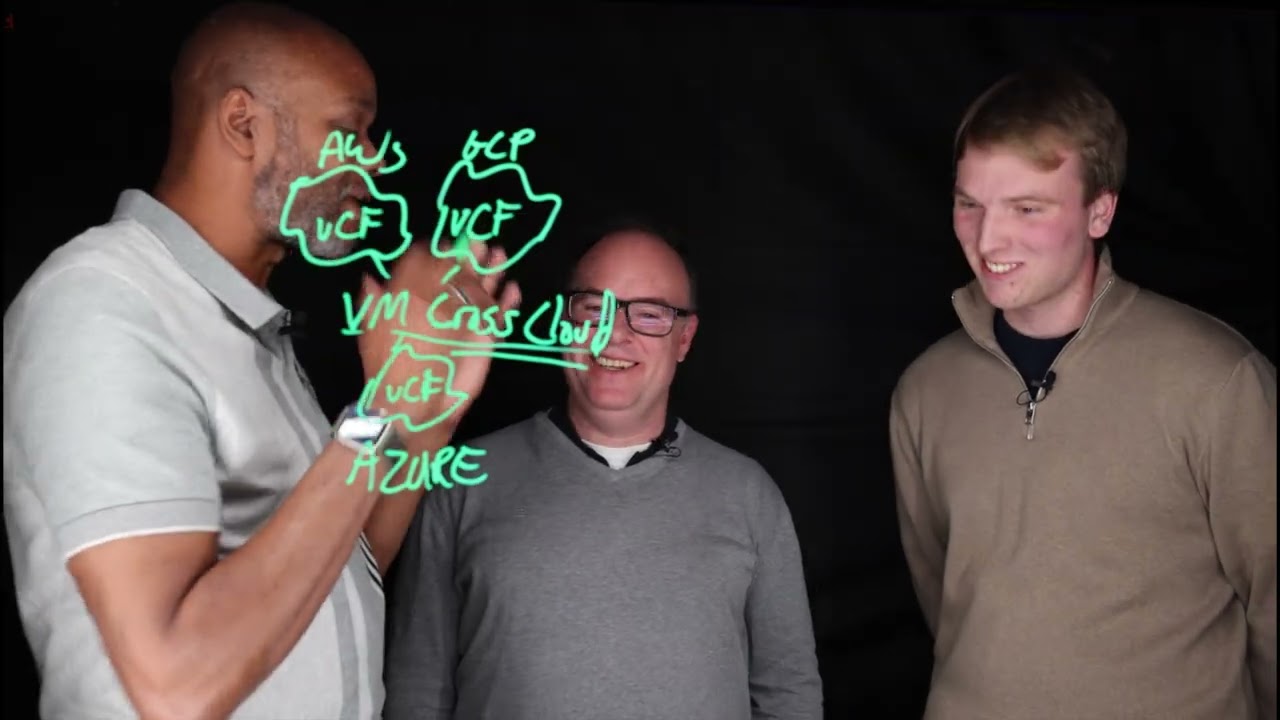
Hey, E. Sovereign Cloud is a big problem, not just here in the US, but also in Europe. Grab my friends, Yens and Ernie. Arnie, off the show floor to talk specifically about this problem in this world that's been created because of the gap that VMware has created with what used to be the VMware Cross Cloud solution where they put orchestrate our workloads across multiple clouds. And solve kind of this multi-cloud management problem for us, which kind of collared the the the overall challenge of managing or complexity of managing multiple clouds.
Now, the new VMware solution is basically VCF everywhere. If you want a sovereign cloud solution, whether you're talking about AWS, GCP, or even Azure, you need to be prepared to run VCF in each one of these clouds. So, before we go into kind of the solutioning and talking through the problems, you guys want to introduce yourselves? Sure, I'll start. Yes, so my name is Yens, Yens Ertner. Teaching information systems at Ansbach University, Ansbach University. And here at AWS re:Invent as part of the German press delegation, covering the event for a couple of German IT magazines.
I'm Arne Bauer. I'm with Zeta Consult, and I'm also here at AWS re:Invent as part of the German press program, especially focused on the startup track. So, a little bit offside from what Yens does here. And and yeah, that's that's my role. So, guys, talk to me about the landscape in not just Germany, but Europe in general. As people are coming out of the big disruption of Broadcom buying VMware and kind of the house disrupted strategy for sovereign cloud. Yeah, I think there's a lot of like turmoil in the markets that um I think keeps a lot of people busy all over Europe.
So, um yeah, as we all know, VMware was a big player in that field. Um up until now, they are still basically about to with that Broadcom acquisition that took place 2 years ago. Hock Tan did a couple of very clever things, basically. So, he saw that there's this challenge about like sovereign cloud and maybe also some repatriation themes going on. But uh so, he kind of consolidated everything into VCF, VMware Cloud Foundation. Great idea, basically overdue somehow. But what people don't like so much is kind of the unpredictability that he brought into the game.
And that of course gives her certain drive and edge to the to the situation. So, people would argue I think the folks on the VMware Cloud side or VMware Cloud Foundation side that they bought some certainty at least to the technology uh perspective. Arnie, what are you seeing? Has this been Has this created certainty a little bit of uncertainty or are there any technical gaps in the vision? So, I feel like what what Yens says is definitely the biggest point. And um there is becoming a little gap when it when it comes to the certainty, as you've said.
And um going back to what you've said, the um multi-cloud or sovereignty movement that has gained very much attention in Europe through Broadcom, through this a big bang which has become um we we got this a gap and we got this attention and and focus on yeah, getting sovereign. And this is what VCF and it is still a focus on one vendor. So, um yeah, it it can be used very smart in different cloud and multi-cloud situations. Um and I feel like this is where the trend is going and going multi-hybrid cloud.
Yeah, so this idea that multi-cloud is here, there was a big announcement right before this whole show at AWS re:Invent that Google Cloud and uh uh and AWS are going to partner on uh networking and make multi-cloud networking a little simpler. This is the reality. Most companies can't be single cloud cu- companies from both a technical perspective, organizational perspective, but especially from a regulatory perspective. Sovereign Cloud is here. I just got off the flow the show floor of AWS re:Invent. I saw AWS advertising the double container data centers where they can bring in these data centers to create individual AWS regions.
So, multi-cloud is a reality. What we don't know is what happens when we don't accept the VCF vision, whether it's from a commercial perspective, from a technical perspective, and we no longer have this VMware Cloud or VMware Cross Cloud glue to connect all of the clouds. What do we do? We're at AWS re:Invent, so we have to talk about AI and agentic AI. Is this a problem that agentic AI could do? Can I just replace VMware Cross Cloud with a with a AI agent?
So, I believe AWS wanted us to believe yes, or they want to get it possible through AI agents. And I feel like it is a beautiful vision. It is, because it seems like it is easy. It is we have dashboards or prompts, manage all your clouds, but it is not there yet. It isn't. They are not in the beginning. So, no, AI is not the solution for managing multi-cloud or even managing one cloud sovereign. Maybe can't be by design.
Yeah, I think it helps you drive up developer productivity or even writing or publishing or whatever productivity in all these kind of intellectual pursuits dramatically, but it's not there to solve like networking challenges here. So, I think you have to approach this in a very different way. And there are containers and Kubernetes and all of that stuff. Of course, like if uh the whole storyline with VMware and the cross cloud isn't there anymore, I think people are in kind of a yeah, situation.
So, let's talk about a simple, but yet complex problem. I I want to I want to direct this technical problem to I have EC2 living here in AWS. I have Google Compute and Azure Compute living in their respective containers. And I want to orchestrate the provisioning of a VM based on my sovereign cloud rule. So, if I have a work process that can only happen in a region that's available to Azure, what's admittedly complex still is to create a simple workflow in which I can provision to my developers in an invisible way from Azure to AWS to GCP without there being a ton of friction.
I I understand you're involved with a startup in Germany that's looking to solve that that those types of problems. Uh yeah, I think like you remember VMware vRealize Automation area, I forgot called differently. That I could buy it in the cloud. Yeah, right. I think they had the same approach already like 10, 15 years ago. So, they said we give you this one self-service portal that gives you governance and now you can deploy your VMs, VM-based applications. I think what you brought up is a very, very like challenging and also solvable problem.
Uh so, I think it's now the time has come for so-called internal developer platforms. So, what we are involved with is a IDP platform that brings kind of best of DevOps platform engineering, call it GitOps nowadays. So, some sort of Git-based thing is the source of truth, be it GitLab, GitHub, something on Azure or so. And then you basically take the original idea that VMware was pursuing like not totally successfully like 15 years ago, give the people a self-service portal that can like deploy things by an infrastructure as code approach.
GitLab Git being the single source of truth in a CICD kind of co- product plus uh like complexity taken away by a very, very uh strong foundation. The product we are talking about is based on the open source backstage by Spotify. And uh the team made it more digestible, I would say. It is definitely. And I think this problem you've you've um talked about before, uh let it break down into two, I would call it layers. You somehow have to talk um with those different cloud vendors.
And um you somehow have to bring the self-service portal back or the internal developer pro portal. And um so, what we do at the GitOps director is um we use Terraform or infrastructure as a code for talking to those vendors. Um for those who don't know Terraform or infrastructure as a code, Open Tofu, it basically brings abstracts the vendor uh portals away and replace them with code which can be managed. It can be versioned and it brings all those devops duties into cloud management and then you've got one problem.
You don't have the visibility. It is not as beautiful as those I have to admit very structured, very thought thoughtfully designed vendor portals. So and that's where the internal developer portal made by or made with backstage by Spotify comes in place because and with this you're able to bring back and vendor independence and completely easy and also thoughtfully designed platform back and bring back the safe service to those cloud vendors. Yeah, cuz when you said you were replacing basically their work cloud with code, I got a little apprehensive.
Whoa, whoa, whoa, I don't want to I don't want to go like I really like I I love the interface. I love the click ops and that's that's been one of the the missing gaps. >> But here I think the I think that I can get back into place. That actually would help, yeah? Because it helps you do any kind of code that you want basically. Yeah, the and this is something that we played with and my viewers have seen me do build entire applications or manage like I could tell you how to use GC code cloud from the command line myself.
I get cursor to do it all for me. I know what needs to be done and that's the problem, right? If I'm in one cloud, I know that a VPC or the equivalent of a VPC needs to be created. I don't know the commands to do that. So I need some type of central orchestration and this getops solution that you guys are describing does exactly that. So we can't talk about anything today without talking about GitHub. And both of you had questions about this thing that I bought, which is the DGX.
Exactly. Spark, which is my little workstation, my arm-based workstation with that that our friends at Nvidia calls a personal supercomputer. I think that falls a little short. But you guys had questions for me. What do you want to know? Yeah, I think it comes from our joint experience at the university. So we have a couple of like Nvidia Jetsons devices like around. We play around with a lot of technologies and now the question is how can we enable the next generation, our students who are doing the bachelor programs for information systems or for data security and privacy, how can we enable them to get their hands on the latest and greatest affordable hardware that needs to be squeezed into a tight university budget and coming to the budget.
I saw your LinkedIn post. I think you also have some sort of chief financial officer that you would have to present your credit card bills to and I'm not sure if she was totally pleased when she saw the the bill, yeah? Yeah, I think her the the reaction was who is Nvidia and why are we giving them $4,000? And they were bad. It was it was a $4,300. And it has for my business model, it has paid for itself because of my specific business model around creating content.
So they'll be create content around it, but that doesn't speak to the university use case, right? And I think the Jetson is a very good device to compare this to. The Jetson gives you the ability to see the the Nvidia framework, right? Not a really great device to do real inferencing on, but a good device to understand what the software looks like. The GB10 base, so this is GB10. This has the This is what makes it a supercomputer. It has the Grace Blackwell 10 Nvidia GPU in it.
So this is equivalent to basically a 5070, but with 128 gig of RAM. So from a CPU compute perspective, you have this Blackwell chip with 128 gig of RAM, which means I can run 70 billion parameter models. I can never think about doing that on a Jetson. I can barely do it on most traditional desktops. Even if I took dual 5090s with 48 gig of RAM, now I'm squeezing the 70 billion parameter model onto the system. This is a system that runs off watts of power.
And that can get you a 70 billion parameter model. Well, two 5090s perform better? Absolutely, but it'll also soak up about 700 watts of power doing that. >> So it's not for gaming apparently, right? Uh I am the there's people who have actually installed uh games on it and it and this is where the 5070 comparison comes to is it's equivalent to running you know, a gaming desktop with a 5070. And if you look at the frame, it's about the size of a Mac mini.
That's pretty impressive. It is. Talking about, you know, budget and size, what would you recommend? Would you say it is the deal for, you know, people on a budget or universities or is it better to go with those graphics cards and build yourself or get a pre-built a small PC for somebody? AMD does have the alternative. And this is called the Strix by form and it is half the price. It is $2,000 and it performs very similar. But you're paying the extra $2,000 for the Nvidia software experience.
So if you want to get the latest models without having science experiments, you want to program and learn you want to learn what it's like to use a data center size DGX systems, it's very difficult to reproduce that without something like the Spark. But if you just want to learn AI and play around with models and a powerful inferencing platform, again run a 70 billion parameter model, but you have to just, you know, look for the right models to download that's that's quanti- quantify quantisized for that platform, you can save yourself $2,000 per device which has So on a budget, hey, there's no need for the CUDA and all of the advantages of Nvidia, but my recommendation is to go with AMD Strix 5 system.
If you want the biggest and finest of Nvidia and Nvidia CUDA, then this is I in my opinion the cheapest best option, the most bang for your buck. Mhm. Guys, where can folks find out more about this GitOps product you're you're you're developing? I could tell you you were Alfred. com and quite easy and yeah, just check it out and if you have got any questions, just go to the contact form or and hit us up. I'll have a link down in the show notes.
Now if you want to find out more about the CTO advisor and the advisor page, I'm on LinkedIn. I'm on X. DMs are opened. See you next CTO advisor CTO talks.


