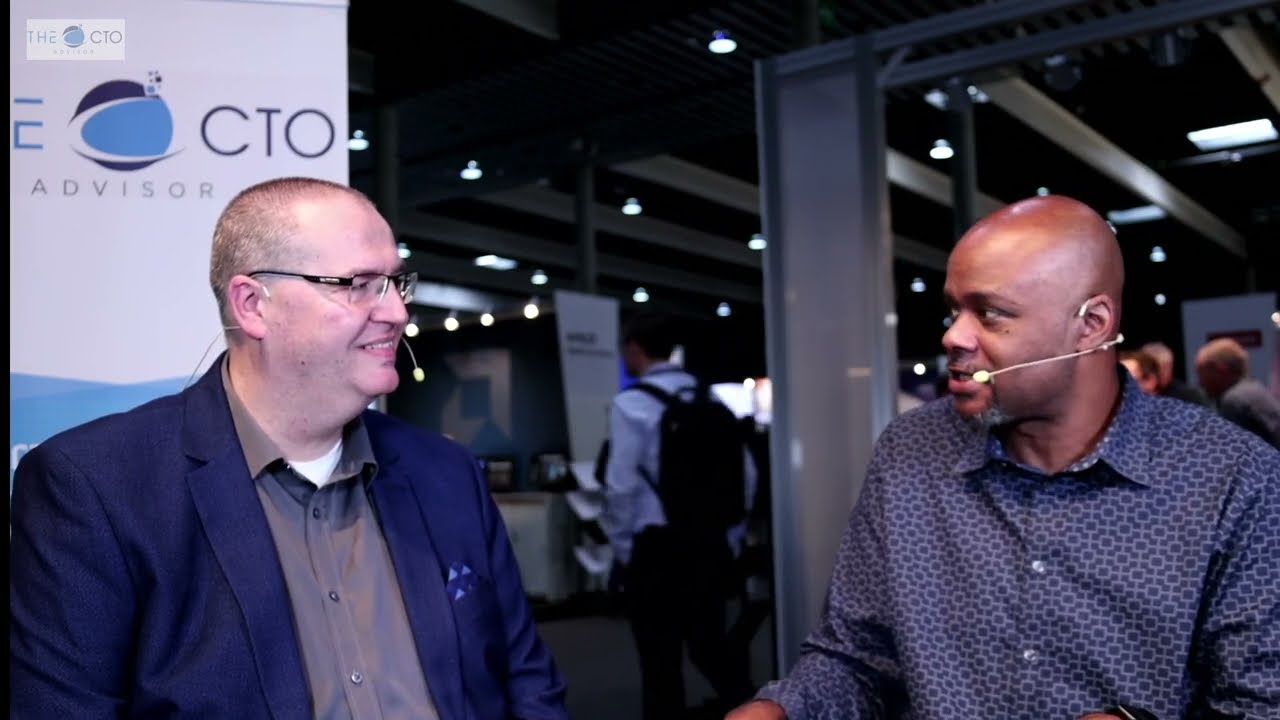
VMware Explore 2022 Europe - Cohesity EMEA Field CTO Mark Molyneux
Transcript
(tense music) >> Welcome back to VMware Explorer, Barcelona, day two. I'm here with Mark Molyneux freshly minted, field CTO for Cohesity EMEA. Mark, welcome to the show. >> Thank you. >> So Mark, we were just talking prior to the show, small world, you know a fellow member of the influencer community? Nigel Poulten. >> I do, I do. >> A bloke with a heavy northern accent. Just you're new to this role of working on deventive side only six months?
>> I am, yeah. I joined Cohesity in May. Prior to that I was at Dell Technologies for three years. I was a business development CTO there. So I was using my experience as a customer to give more of a strategic vision to Dell's customers at the time. And obviously now I've joined Cohesity. I'm doing a very similar thing here and what I'm doing is I'm building on my experience as an ex-customer. So I was at Barclays Bank for 12 years.
I was a director there. I ran their storage group, their public cloud operations and their virtualization group. >> So here at VMware Explorer this, this has to feel a little bit like home. >> It does. >> Yeah, you're a little familiar. A little bit of cloud, little bit of storage, a little bit of everything. How have you found to show so far? >> I found the show really good actually. Yeah. Yeah, it's, it's great to see everyone back.
You know, I wasn't expecting so many people there actually to be honest. So close after the pandemic. But it's really good to see everyone back. It's got some strong presence there from all the vendors really. I'm particularly impressed with what Cohesity have been able to bring to the event as well with show stands and the test lab as well. >> So we've had a bunch of folks from Cohesity to um, everyone from Sanjay to Teresa Miller, and they've given us some perspective.
But here in the EU and EMEA in general, the customers ask different questions. How are you finding kind of the culture of EMEA versus maybe the US? >> Yeah. >> From a customer engagement perspective? >> I think, I mean the customers in EMEA are very much more interested in regulatory aspects, compliance aspects. They're very concerned, not so much around the technology products that manages data but more the outcomes for data. So I think certainly the mere customers that I've spoken to have really got to grips quickly with the value of data and what that can actually bring to them.
So when they're talking to cus.. to companies like us it isn't so much a data protection conversation or ransomware conversation is the bigger thing, you know. So what are you going to enable me to do as a customer to be able to do better things? How am I going to be able to monetize the data? How am I going to be able to become compliant to PRA regulations, for example, Or DORA in the EU, the Digital Operation Resiliency Act. Because, customers are now worried they have to have that operational resilience built into their stacks and most customers don't.
>> So, operational resiliency, I like that term. I don't know if I've heard it phrased that type of way. What is operational resiliency? >> So operational resilience is the ability to have your infrastructure recoverable in a short form factor. That's probably the simplest way to suggest it but what most companies do is they tend to say, well backups my recovery or applications my recovery. But actually true operational resilience is mapping your applications and workloads from the top of the stack to the bottom.
And when I say the bottom, I mean beyond the application stack, I mean into infrastructure. So you can actually have a resiliency category of say one or two or three. One would be the best where your application's set. If you, if you design to these standards, which are they're coming from the financial industry but they apply to pretty much any vertical manufacturing oil and gas, et cetera. Because it's a common sense approach to standardizing how you recover your IT platforms rather than just using a traditional disaster recovery backup restore mentality.
>> So with that holistic perspective around the data. What's unique about the Cohesity story? I look behind me there's maybe a half a dozen companies that say that they can help with operational resiliency. What's unique about the Cohesity story? >> There is, I think, I mean we, we've got true operational resiliency in our minds when we designed our platform. So we've now got the the Helios platform, Cohesity cloud. Which is now a single pane of glass across everything which a lot of vendors do say, you know we've got a single pane of glass but, Cohesity has got a true pane in that it's software based it can be on or off prem.
But it can also do multi facet. So you've got data protection. You've got ransomware threat detection in there, you've got governance of data for compliance, which is a critical thing. You've also got the vault software as well in there but it's all in that pane of glass. So no matter where you are operationally you can see everything that's going on and more importantly, as a leader you can start taking MI from that. >> So this is, I, I don't know if it's in contrast or in complimentary order.
From what I remember Cohesity of from a few years ago. I remember Cohesity as the box. It was the box that replaced the theme that Dale's box does. How has Cohesity kind of made that pivot from being the box that does backup to the software that supports resiliency? >> Yeah, I would say a really strong intelligent vision around three core tenants. Cybersecurity, cloud, data management. I think what we've done is we've elevated ourselves away from the conversation around data protection.
So we are a data protection product and we are going to go and replace X, Y, and Z. Now everyone can do that. What else can you do? You know, as an ex-customer myself, I'm interested in what am I going to be able to do differently as a business? It isn't just about taking a backup and maybe needing to recover that at some point. It's actually consciously thinking about that data and saying, well, I may need to know about cyber events that have happened two months ago that I'm not, you know, the business may not be aware of and I can now find that in my data protection software through the threat detection that Cohesity adds.
Or I know for a fact that I need to keep data for a particular period of time, especially in a compliance world. You know, if you think about a financial, they have to keep data for a very fixed period of time against a relevant record strategy. But again, most companies do that relevant record strategy at the application level, but when it comes down to technology, they take it back up and then take it a week later and then keep it and keep it and keep it.
And suddenly you've got petabytes of data uncontrolled content that you could potentially be non-compliant with, you know, and then you're talking about fines and you know, regulation penalties as a result of not managing that data effectively. Which we obviously can now bring into the party. >> So the EU here, as you mentioned different data protection, not just approaches but because it's regulatory laws, they have to be compliant. So when I think of something like ransomware, malware there's the recover ability from the event but there's also detection and reporting.
>> Exactly. >> It's a critical that we report incidents here in the EU. How does Cohesity help me meet those regulatory burdens? >> Yeah, it does. I mean it's in the, in the EU, there's a data share that happens when events occur. So other companies are aware of it because although we're all operating independently of each other this is where as a business, it's not really sensible to allow the financial market, for example to be hit by the same ransomware across 20 banks.
'Cause that wouldn't do the economy any good at all. So behind the scenes, a lot of security teams do talk about events and how they happen. But where Cohesity is enabling that because most companies are doing threat detection at the endpoints, you know, or they're running antivirus or they're running some other, some other software in there to help them with their cyber security. Cohesity have actually built this into the data protection layer. So imagine cyber, a cyber event manages to get in, you know you've got a hacker and he is managed to get his way into the system and they've impacted some files.
We're going to see that within the data protection product. We're going to alert that up within hours. We're going to be able to give that to a different persona. So it isn't going to the head of storage or the backup guy, it's going to the CISO. You know, it's going to the actual security group that can then say, hey, you know we've seen these events within our data protection platform. What are we actually seeing in the live world. So we can now go out there and start proactively chasing down these events far sooner than we ever could before.
>> So we've talked about this concept of the platform engineering group or the platform group for some time where this idea that operations becomes more intelligent that CISO, IT infrastructure development start to work together to deliver business value. This is sounding like a tool that can help with that process. Has Cohesity given any thought to how to protect the entire platform versus point pieces of data? >> Yeah, I mean we, we've very much, yeah, yeah. I mean we've got, we've got particularly strong case work with especially with some of our customers around SAP protection for example.
You know, we built these things into our product because we didn't just want to talk about file-based backups. We didn't want to talk about very small nature data protection. We wanted to actually say, you know we can protect these large areas of your applications like Oracle for example. But more importantly we can say well we can protect you on premise, we can protect you hybrid, we can protect you in the cloud, we can protect you in that way. In a very simplistic way from an operational perspective.
So we start to remove the fragmented siloed operations into that single pane of glass. Now we're not necessarily advocating that you bring all these groups together behind the scenes if you don't want to but the ability to be able to have different personas access in that software, CISO's, for example to get that type of MI reporter. You know, if you take, take our vault product for example where we can actually take a cyber secure copy of certain data to be able to bring back in the event of a, you know, a brand damaging loss.
We actually have segregation of duty built into that. So you have your backup operator can still manage it but your CISO can be in there actually making sure that what you are doing is the right thing because they override. You know, they're a decision maker within that process. >> So last question we're at VMware exploring. There's this cross cloud, multi-cloud conversation. I'd be remiss if I didn't ask you about the ability to support net new applications. I understand Cohesity is great for protect, protecting VMs.
It's great for whether those VMs are in the cloud or on prem. But when I think about net new applications, Kubernetes, things that are protected via AP or protections that are initiated via API policy. What, how does Cohesity approach protecting data sets that are front-ended by cloud native applications? >> Yeah, I mean the, the product does have API capability built into it. So we are, you know, we're far more than just a software based backup. You know, we can actually protect a large number of new and evolving technology capabilities coming out of the cloud providers.
You know, obviously I'm not going to sit here and say we're going to be at the forefront of every single net new thing but we're not going to be far behind it. You know, we're always going to be very quick to market especially with cloud native. You know, Amazon for example, is an investor in Cohesity. So we are very, we've got a very strong partnership with those guys. But equally we are developing in Azure, we're developing in GCP, we're able to give customers that multi-cloud capability again from that single piece of software.
And of course especially, you know, we're at VM Explorer, very strong capability with VMware. You know, a lot of customers are, are finding VMware as the enabler to get from on-prem to off-prem via the hybrid and in some cases staying in the hybrid. And if you do that you want a product like Cohesity that can look across that piece in a very simplistic way. >> Well Mark, I really appreciate you coming and sitting on the hot seat. They're literally red. com.
We've enjoyed covering VMware Explorer 2022. Beautiful city, Mark was just telling me there's a church I have to visit. >> There is is a cathedral, the Golden Cathedral. Phenomenal piece of infrastructure. >> I love it because it's, as Mark was saying it's been under development for 70 plus years. Constant development being in a CICD infrastructure. Physically... >> Golden's own architectural vision actually being played out over decades. >> I love the analogy, analogist nature towards what we're trying to do here in IT as we manage more things with the same amount of people.
Again, thanks for watching coverage of the CTO advisor. If you have any questions for me you can hit me up on Twitter at CTO advisor. If I wasn't hard enough on Mark, relay your questions to me and I'll relay 'em to the team at Cohesity. Stay tuned for more coverage of VMware Explorer 2022.


