VMware Cloud Foundation 9: What To Do Now — Real-World Paths, Costs, and Trade-offs
Transcript
Whether you're all in on VMware Cloud Foundation and Hock Tan's vision of private cloud, you are looking to or if you're looking to keep operational consistency and you just need your licenses, or if you have one foot out the door and you need to renew your licenses and get out of the VMware ecosystem altogether, this webinar should have something for you. All right, let's kick off. Uh who am I and why should you listen to me about VMware Cloud I'm Keith Townsend, principal of the Advisor Bench.
I've been in the V community since 2003. Matter of fact, a few years ago I found my very first VM that I created. It was a VMDK for Windows NT. Uh if you're circa Y2K, you remember Windows NT. Uh it was a VMware I believe the product back then was VMware Server where you could It was basically VMware Workstation. My first VMware vSphere, as we would call the modern product a few years ago, uh deployment was 2008. It was the first time I got introduced to the concept of storage area network, SANs, and this integration between the data center and virtualization and this idea that you can lift and shift workloads from one data center to the next.
Orchestrated a pretty impressive solution back then for disaster recovery. So, we're talking about 2008 to 2009, maybe 2000 10 a little bit where I replicated my VMDKs to a data center from Chicago to Colorado Springs and I had a complete failover of a front end for a web-based mainframe application. So, wow, I'm going full circle on the quote-unquote legacy technologies. Uh I worked for a short period of time at VMware. So, obviously I've been around this community for a long, long time.
I myself personally went through all of the emotions of what we knew as the then V community basically uh being put out to pasture with the purchase of VMware by Broadcom. I warned against kind of what I envisioned Broadcom's approach would be to customer engagement. None of us guessed the impact of it to the extent that it has been. If you're struggling with extending VX Rail licenses, if you're looking at uh just simply maintaining your existing landscape, if you're looking at training and certification, all of these things have changed.
If you just simply want to run this as a home lab, all of that has changed. The community has changed. Some of the voices are gone. And we're facing the new reality and we are talking about the new reality in this webinar. Let's start out with I think the most provocative from VMware Explore 2025, Hock Tan on stage, not only said that VMware Cloud Foundation 9 have feature or equal value as a AWS public cloud offering, but it exceeds in value.
And to double down on that statement, he said hybrid the failure by a team to find a good home for a workload. He has full-on taken on the AWS philosophy that there is no better solution than a all native software solution. And you may ask yourself the question, well, isn't VMware available on all the major public cloud providers, including OCI and IBM? And the answer to that question is yes, but the shape and form of these solutions have changed to align with this statement.
Me and Steve Dickens were just talking about this on the CTO Advisor podcast. Uh this part of the conversation didn't meet didn't didn't get past the cutting room floor, but we talked about how VMware and Broadcom view hybrid differently than most of us. Before it was this cross-cloud vision in which we would use a overlay service like VMware Cross-Cloud to normalize your operations across multiple cloud providers. Now, the philosophy is we're all in or VMware is all in on the VMware take of operating cloud.
Case in point, VMC on AWS is not something you can easily purchase anymore. Well, unless you're already a VMware customer, your primary channel was through VMware. AWS is not allowed to resell VMC on AWS. And their alternative is EBS. I wrote about this the other day. It is now the solution for running VMware services on AWS, Elastic VMware services. You don't get any of the complexity of separate networking. It it is a first-party service, but you also lose the SRE fit features of VMC on AWS because AWS infrastructure is designed to fail.
And VMC on AWS was designed to fail on top of it. Well, if you're deploying EBS, now you control the bits. And if the servers fail, you need to determine how you're going to recover and spin up workloads. You also need to make sure that your licensing supports this elastic kind of use of it. Last point on the cross-cloud and Hock's vision of this is that hybrid no longer means this cross-cloud view, but a VMware vSphere fundamentally view of cloud. You're going to manage VMs, containers, et cetera across multiple clouds using VMware abstraction.
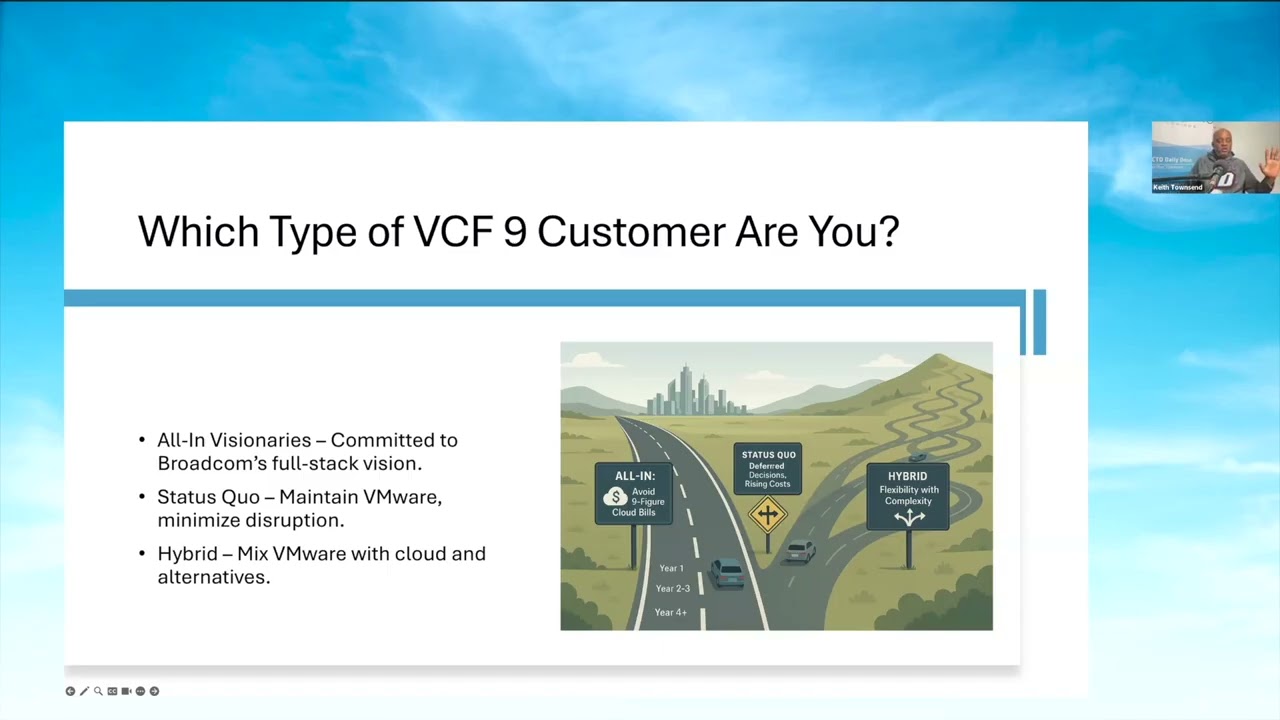
How have customers reacted to this? Well, I talked to one of their reference customers from VCF 9 launch and he was complaining about the Aria change. He was using Aria as a service and to be given only 3 months to change from Aria to on-prem Aria or Aria in the cloud to on-prem Aria, not enough time. So, the market is reacting. So, again, I see this as three different types of VMware customers. You're either all in on the vision. Hock has talked about this for the past three VMworlds that I've been to.
You have a nine-figure AWS, Google, Azure bill. Your budget has been eaten up by public cloud and you want an alternative for those workloads. On-prem is predictable. It is a cost model that most enterprises understand. And at the very minimum, if you can repatriate, let's say 20% of those workloads from the public cloud or you can slow down your public cloud spend, if you have to spend two, three, four, 10 million dollars on VMware software, that's really not a big deal, right?
You'll see this return in less than 5 years. That's the theory. We'll get into what the practical learnings are from VMware partners if they've been implementing the technology, when our customers actually seen a return on their VMware investment. So, that's customer type number one. Customer type number two, mentioned this before, status quo. You have Veeam, Commvault, HPE storage, HPE servers, VX Rail. You are in the VMware ecosystem from not just a virtualization standpoint, but you built your operations, your GitOps.
You've built your systems around VMware vSphere. I've had this conversation with multiple customers. They're thinking, oh, I'm just going to replace out the hypervisor. And then I ask them about their disaster recovery. And they said, well, we were always just replicating VMDKs before. So, basically they were just replicating the the base data to a remote location. Then I said, well, look at your run book. What does your run book have you do? Well, the run book has them reinstalling VMware.
So, there are customers who are more or less happy with VMware. They want to maintain their operations, not necessarily adopt VCF 9 because they don't believe in or don't have the need for the alternative to the public clouds. And you know what? They're just happy. I've talked to many of these customers. And then you have the hybrid customer. That customer that has one foot out the door. They need a short-term solution. Short-term because of the scenario the example the one example I gave you with disaster recovery, they can't simply leave VMware.
So, they're kicking the can down the road and they're going to look at VMware with other hypervisor or cloud alternatives. That is the three types of VMware customers that I run into consistently. There's kind of a three and a half the customer who is completely looking for another solution and they're looking to kick the can down the road. So, let's talk about one of the big takeaways from the stage last week at VMware Cloud at VMworld. Almost call it VMware CloudWorld cuz that's basically what it was.
But let's talk about one of the big takeaways from VMware's conference last week was the adoption. Pat was very proud of the level of adoption of VCF 9 versus previous versions of vSphere. And if you've been around the VMware ecosystem for any time, you know that VMware has a chronic problem of getting their customers to upgrade. 7 which has been end of life for end of life and end of support for more than a year. So, what's the trick? What's if VCF 9 is so much more how how are we seeing these adoption rates?
Well, talk to a major VMware partner who shed a little bit of light on the situation for me boots on the ground. He said, well, by default, when you go install when you buy VCF 9 the SKU and you go download it and you go to install it by default it installs the private cloud stack. You're going to install NSX. You're going to install vSAN. You're going to install Aria. You're going to install all of these components of the stack whether you use them or not.
So, I think that is one of the tricks behind the numbers that the default installation is the full installation whether you asked for it or not. And preview to some of our deeper conversation about the adoption on stage, they had I think the name of the financial services company is insurance company Grinnell on stage and that VP of infrastructure talked about how his 17-person team, not this big Fortune 500, was able to adopt VCF 9 without a lot a lot of hesitation. And I think this shows and I had this conversation on on LinkedIn.
This shows where the target to be state operating model of a VCF 9 customer is. You need a flat organization to adopt any cloud technology. Cloud does not lend itself as a operating model to our siloed approach of the past of having separate storage, compute, networking, and security teams. In order to adopt AWS, in order to adopt OpenStack, in order to adopt OpenShift, or even VCF 9, you need a relatively flat team. They can't be looking at different consoles. When you talk about AWS platform management teams, they're all going into the AWS control plane to manage the technology.
VCF 9 looks to replicate that and I think it does a fairly decent job of doing that. But if you haven't adopted that operating model, you're not going to be successful. Just plain and simple. The technology you will have installed the bits of the technology, but you won't see any of the advantages of the tech because it won't bleed through your service offerings all the way down to the developer which VMware went after pretty heavily. So, again, this is all about people, process, technology and you are not going to get there by just installing the bits by itself.
Another conversation with another VMware partner, we talked about the commitment needed to actually adopt the technology. Let's pick up on Pat's idea that you're going to save 9 million you're going to save on your nine-figure AWS bill. This isn't going to happen year year one. I can all but guarantee that in 99% of the use cases. It you didn't reach a hundred million dollars in cloud spend overnight and you're not going to save 10 million, 20 million, 30 million of that spend year one no matter what you do.
Unless you're optimizing in place in the public cloud, you're using one of these cloud economists like Corey Quinn to reduce your AWS bill, that is your surefire way or as good as you can get to surefire way of reducing your cloud spend is to optimize in place. As you think about transformation, I don't care if you're talking about SAP, VMware Cloud, cloud, big iron storage systems, mainframes, there's always this old period of overlap where you're going to have both technologies. I talked about this eight or nine years ago with HCI.
People beat me up about HCI not saving money. Well, maybe if you're a small 17-person shop, you can move from your PowerStores, your Dell PowerStores to a Nutanix flat scale-out model and save money from an operations perspective. But if you're a large complicated organization and you have multiple storage arrays, you have multiple applications, HCI is just going to be another technology that you're going to offer within that stack of technologies. VMware Cloud Foundation 9, if you're not careful, will be just another one of the technologies you adopt.
Proof points. Talking to this partner, VMware Foundation 9, you're going to spend the first year of your projects or your transformation on deployment and creating a baseline of your VCF 9 operating model. I talked to a customer, a reference customer from the VS VCF 9 launch. 2, skipped to VCF 9. They're still going through adoption pains because they're shifting their operating model, not just the underlying technology. So, that's year one. Establish your baseline. This is your overlap, your technology overlap.
You're you're installing the tech. Year two to three, now you're changing your organization. Let's think about all of the applications and it matters where you're making this change from. Are you making this change from a perspective of a platform engineering team is adopting this technology and championing this technology or are you coming from the position that your vSphere admins are now turning into a platform management team? Think about that transition. Folks who are focused on just one part of your virtual data center now have to think about identity management.
They have to think about certificates across applications and infrastructure. They have to think about how they're going to deliver containers. They have to think about how they're going to lifecycle manage the infrastructure that's associated with Kubernetes. There's a lot of operational learning and then they still need to package this into services and develop SLAs around these services. This is not a one-year return. Not if you want parity with what the cloud providers are offering. Year four, cloud at scale.
Now we're thinking about, okay, how do I actually start to get benefit? Years one through through three, I might have repatriated some workloads. I might see some savings. But to reduce my bill by, you know, 20, 30, 40% or as Hock claims, to completely displace all the cloud providers, that's not going to happen. What is the reasonable payoff for your investment in VCF 9? It is not going to be year one. So, let's walk through some of the considerations that I've had that I've seen for each one of these customer types.
The first, the comfort of status quo. You're buying the bits. If you have to choose between the SKUs of what's available to you, VCF 9, which has more than what you need, then we're uh vSphere Foundation, which doesn't have enough of what you need, you're probably going to go with VCF 9. You're going to see some price increase as a result. If you're not adopting the entire vision and replacing your observability, and replacing your security, your zero trust, is it wrapped around NSX, your firewall uh attestation is not that process isn't streamlined into vSphere's VMs turning into uh firewall rules, and deleting a VM removes the firewall rule.
If you're not that at that level of integration, you're going to pay more because you're going to have redundant services. You're going to have services that you're paying VMware and Broadcom for, and you're going to have stuff that you're uh that you probably still will pay for, Splunk. Uh uh uh uh I've run into many customers that have both NSX and Cisco ACI. The value prop that Broadcom pushes, I don't know if I've really run into many customers, large customers, that are willing to abandon these extended relationships beyond the capabilities, and sometimes limited, sometimes better capabilities that VCF offers.
But this is the majority of the customers that I see. Status quo, they're not adopting VCF 9, not the way that I would consider adoption. They are just, you know, I don't want to change. And uh if it means that I have to pay Broadcom a little bit more money, uh or a lot more money, to not disrupt my operations, to not have to re-engineer again. Data from the show, talking to yet another partner, they said that uh Nutanix uh uh a move to Nutanix cost this or this one organization 6 to 10 months of not doing any other pro- projects just to save 15% on licensing.
Eh, status quo, maybe not that bad of an approach. All right, the customer that has one foot out the door. The big takeaway I want you to walk away with this one, if your plan is to leave VMware, you know, you've been there, you've done this. I'm I'm not telling you something you don't know. And uh technology perspective, managing multiple stacks is difficult. But most of us are now in the business of managing multiple stacks. You probably have some AWS.
You absolutely have some Azure. You absolutely have some SaaS services. You have your existing VMware landscape. You're used to managing the complexity. There's not a whole lot to add there. What is to add, you better make sure you have a plan. A plan that you've talked through with some level with your VMware sales representatives. This is what I learned from the insiders, uh not just last week, but overall. VMware sales people are not incentivized to renew deals at lower deal total deal cost than the previous subscription period.
If you were paying VMware $500,000, and you think reducing your core count in half is going to result in saving a couple of hundred thousand dollars a year in VMware cost, licensing costs, you should probably have a conversation with your salesperson sooner than later. The salesperson doesn't get more credit for renewing you at $300,000 a year than they would at losing you. They'd rather just walk away from the deal. You're going to pay the minimum of what you were paying before. And if you think you're going to be completely done with VMware licensing after their current term, be absolutely sure.
A partner said they saw no less than 20 to 30 customers who tried to leave Broadcom get audited by Broadcom and have to write big checks because in large environments Broadcom counts on, there's probably going to be some vSphere somewhere in the lab, some BU is using it. Uh If you've ever dealt with an Oracle, and you're thinking, oh, I'm going to bring in some Microsoft SQL, some SAP Hana to replace your Oracle licensing and save money on your Oracle licenses licensing, you've been through this motion.
It's a very similar motion. Be prepared. So, again, touching bases again, you're either all in, you're status quo, you're hybrid. You're falling into one of these three areas. If you don't know which area you're falling in, you're in trouble. Just like the reality of hybrid cloud, you can't be hybrid cloud by accident. You have to be purposeful in your design, your governance, and your licensing strategy around which one of these approaches you're going to take. Big lesson coming out of Explore.
All right, the financial the real financial story. VMware and Broadcom has deleted, for better lack of better term, their professional services. They are giving back as much as 10% of their overall licensing costs back to customers to use for professional services enablement. There are a couple of issues with that. One, if you're all in, it's not nearly enough money. The partners who have kind of completed year one come back to the customers and tell them, hey, year one is done.
Here's the estimate for year two. One partner told me that they did just a $250,000 assessment on what it would take to move from VMware vSphere to Nutanix. That in some cases they have entitlements of a million dollars, and it does barely cover that year one implementation. So, year two and three, if you want to uh make sure you're all in and you adopt VCF in the way that you want to adopt it, whether we're talking about cost avoidance with the argument with that it'll save you money on private on public cloud, or if you're status quo, or if you're hybrid, if you're counting on professional services and that professional services budget to get you there, you might want to revisit that budget.
So again, you need to be deliberate about your approach to VMware Cloud Foundation, no matter what alternative you're talking about. Status quo, low low risk, low reward. You're just buying the SKU, and you're continuing operations. You run the risk of Broadcom pricing you out of your model. Broadcom wants to go in a direction, no matter the size of the company. They see the opportunity, the addressable market is the public cloud market. If you're not a cloud forward-thinking organization, you need to think about how you're going to actively migrate from VMware Cloud Foundation, because long-term your direction, your architecture, isn't aligned with VMware and Broadcom's product strategy.
Hybrid, you need to be purposeful about this. Yes, you're going to kind of put your existing vSphere and VMware deployment in the box. You need to make sure that you have a solid, defensible plan with your Broadcom reps on how you're either going to freeze cost or reduce cost over the long term.


