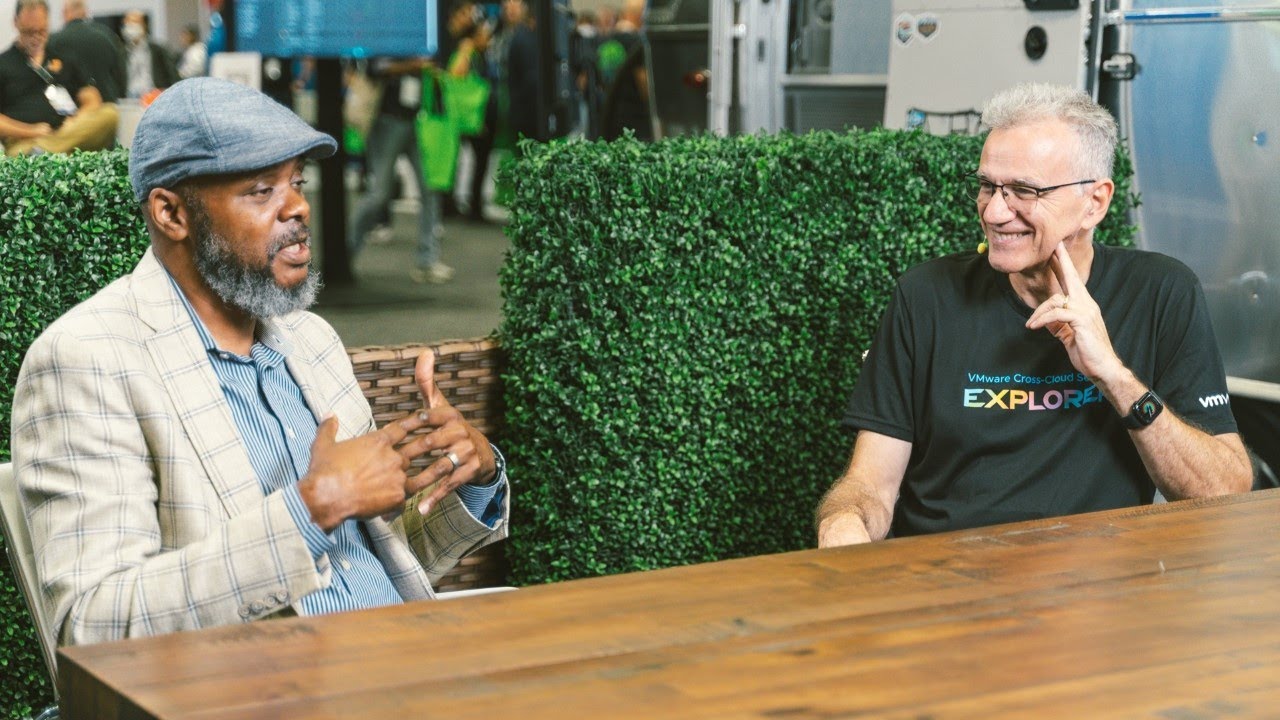
Vittorio Viarengo VMware Explore 2022 - VMware Cross Cloud
Transcript
>> Welcome to VMware Explorer 2022 with the CTO advisor studio. Come on in and consume some content. >> Welcome back to coverage of VMware Explorer, 2022. I'm tired, but I've been having fun, Victoria. This is a fun tired. We haven't done anything like this in three years. Victoria Vigo, VP of Cross Cloud Marketing at >> Cross Cloud Services, yeah. >> Cross Cloud Services What me and my friends at the cube call super cloud. >> Yep. >> But we'll get into that conversation later.
First off, I want to hit the back. What do you think about the RV? (laughing) >> Yeah. You and I have this passion in common. Every time I say that I have actually, I have two RVs. >> Yes you do. >> I have a big one for the big trips with the family which is they the big one with nine people. And then I have a small one, a sprinter ,but my wife and I on the weekends. And whenever I say that I have that they look at me like I don't fit the profile.
>> Are aren't you a VP of a major? >> It doesn't matter. I don't think you have experienced true America dream. If you haven't spent a night at a Walmart in your life. (laughing) >> You know what? I will push back. You haven't experienced the true American dream until you've spent the night in a Cracker Barrel, then you know you've arrived. >> Yeah. Right. >> It is. We share the passion. >> No, I love this country.
And, I have embraced it completely including the RV experience. >> And you, we will get into one day kind of you pulling your extended family into that experience. There's no better way. I don't think there's a better way to see America than through the windshield of a RV or a truck pulling the RV and being able to camp in amazing spots. If people don't follow you on the social media, they should. The images you captured from your last trip. Amazing.
>> Yup >> Just amazing places. Let me know. And you are a big veers too so you should compare now every time I go places where I have been, I can tell you all that I know about it. And I want the same from you. >> So let's talk about VMware cost cloud services, high level, what is it? I know on the show on the conference keynote yesterday they announced VPI aid and V aid spent maybe 30 seconds on it ,but spent quite a bit of time on cross cloud services.
What is Cross Cloud Services? >> Cross Cloud Services is our portfolio of cloud native services that allow our customers to build, manage, run secure, and access any application across any cloud. The way to think about it is that On Prem. We use the hypervisor to pull resources make everything look the same, pull the resources automate and we unleash tremendous growth and flexibility for our customers. Now, I think we have the opportunity to do it all over again ,but at a higher level of obstruction to give to bring the commonalities of the various clouds and package them as a service so that if you are an operator you can lay down for, with town.
So for example, you lay down, those Kubernetes are distribution, and then you have one place for the developers to drop the code. And then it goes to the right cloud without having to look at the differences. And >> So I got into a big debate with some folks on Twitter about this. I posted something that everyone should proceed. As a pro VMware comment said, VMware's doing the dirty work of application developer experience of normalizing the underlay whether you're talking about private infrastructure or you're talking about the clouds of the opinion you need to take that approach.
You need to normalize and make it common, so that I can bring my preferred Kubernetes distribution. It doesn't have to be, it can be a open shift. I want a consistent open shift experience across every infrastructure. My argument is that VMware is in a position to do that, but there's a lot of hard unthankful work that needs to be done in order to make that happen. The pushback that I was given was no VMware needs to own the developer experience. If VMware doesn't own the developer experience you're losing, where do you land in that conversation?
>> Woo can claim to own the developer experience. I mean, developers are the most opinionated most innovative people that I know, right. Of all the engineers that are opinionated to begin with the developers are. So I think they, they have voted with their feet with open source and whatever idea they want. EMAX whatever gets them closer to. So we do have ways to integrate with IDs and get into the developer space. But to me, the big, bigger and solve problem and where we have an in is to the operations.
That's what I've been telling the people at this conference follow the Kelsey Kelsey high tower career path. It was a VI admin. And then he saw the world evolve towards native cloud native applications, microservices DevOps, and he reinvented himself, learned these new things. And now is luminary. We don't all have to be luminaries, but the people at this conference should take that and learn how to become an operator of cloud native application. And that's where Tansu mission control. Tan is smashed, will help them be successful there.
>> So >> I think that's our angle through the operations. >> So I don't think I disagree with you. And we had Kelsey on we me and Kelsey went through really great detail about what that looks like from you know inheriting an environment where I have a net app storage array. I have Cisco network. I have a VMware VPI underlay, and I didn't design it. I came in and this has been my environment. I operated for seven years. I've come to VMware world every year.
VMware's kind of told me what I needed to do next. And I did it. That's not simple. Oh, okay. But from a roadmap perspective it was a simple roadmap in itself to tell me what I need to do now. We're in a real world that path I have to decide on my next cloud platform. I have to decide on my next torch services. I have to decide on how I'm going to approach observability. VMware seems to be boiling the ocean.
You're all those areas I mentioned. VMware has product and services in space. It's a much more complicated message to deliver. And it's your job to deliver the message to communicate that. Where do you start? >> So I've, I've heard this pushback that our because cross cloud services are happening. Azure Corp, Snowflake Alterics. I mean, how many companies the cube event we did a couple weeks ago >> Yo, everyone was there >> And these are companies with revenue. So these cross services that no question in my mind are happening.
What we are trying to do is to bring these things together as a platform. And it's very ambitious, but a company like VMware has to have an ambitious goal because of our tradition, the DNA that we have and the resources that we have now we have to execute right? Last year, Cross Cloud Service was a vision. This year with earlier, especially providing you with a common option model across all clouds. It allows you to build the inventory of what you have and then make decision on top of it, make management and then bringing NSX management as a cloud service.
I think we start to have real need behind this and we need to keep executing. The other thing that I say, I always say, do not VMware very closely use the product all day, every day do not bat against our engineering team. >> So I have to eat a little crow. I'm not going to eat my head cause I really like my head, but maybe seven or eight years ago VMware started the software defined data center pushing the software, defined data, decision, vision.
It wasn't a skew. It wasn't product. It wasn't something that you could go out and buy. It was an ambition. It was. And I looked back and I'm like, that's a great idea but how do I buy it? Like what is it? What's the skew, same question I'm asking you today. And the folks that Keith it's same answer you gave today. Today. I don't think anyone questions whether or not I can go buy the SDDC from VMware directly.
It may not be a product in itself, but the SDDC as a vision VMware can deliver on every day, all day. So I'm not going to bet against VMware's engineers. Why I am going to probe and talk about is that journey because the NetApp just recently announced their first class citizen storage for VMC on AWS. And I got to be honest. I shrugged my shoulders. I'm like, eh okay. Yeah, storage. It's tough. It's hard. The solution.
When they go and they peel back the onion I'm like, it's hard. And I found myself battling the level of difficulty of accomplishing what they accomplished the engineering effort and the expectation of the customers I talked to the expectations of the customers I talked to is kind of like, ah, that should be it should already be that there. So there's the gap between customer expectations and where the industry is at as a marketer is your job to balance the two and say, okay, here's what we can do.
Here's what we will do. What's that sweet spot where customers where this story is resonating with customers where customers are not just wholesale leaving VMware. Cause I got to be honest. There's not to your point. There's not a vendor out there that can answer any of this by themselves yet. So when people say they're going to leave VMware as a customer and go somewhere else. My big question is where? >> So I think there are three areas that are real today that deliver great value to our customers.
The first one is VMware cloud because VMware cloud gives you the same environment on both sides. And now I've talked to enough customers have done it like leak and employer Cerner, S and P global. I mean the list goes on and on and on. They just deploy VMware cloud bare metal on Azure or Google or AWS. And then they move workloads around management is the same. Whether they use a storage array from one of our partners or the local at some point doesn't really matter to us.
So that's a clear areas of value. Then the other two areas of value I think in this cross cloud service world outside of our hypervisor I think is management with Aria and everything tons. I think those are the other two areas. And the reason why, yeah, he call me a marketing guy but I'm an engineer. I've been building products all my life to me, I like to craft a great story. But then what gives me credibility is when I talk to customers and every customer I talk to right now has this challenge today, I was talking to a multinational bank the other day and they're telling me, oh, we are deploying on Azure, AWS and this, and we are going to build a management plan for this workloads.
And I'm thinking to myself, no, you're not. You're going to buy from us or from another, what we need to do a better job. I think going forward is we need to do a better job articulating the use cases. And what is the advantage of buying say Tansu and Aria from us? I think that's the part that I think we need to do better job and then keep executing on engineering side. And >> So you've mentioned Aria a couple of times and this is the other hot.
This has been the other hot conversation on social media. Since the announcement yesterday for aria, it's just realize rebranded. The engineers and product team at VMware on Twitter, pushing back hard against that. I'd love for you to make that case is aria simply realize rebranded or is it something in addition to what we should expect from and realize to be honest with you, very solid product, especially if you're consuming it as a SAS solution it's aria more expansive than V V realize was.
>> Yes, the answer is yes, there is are two aspect to aria. One is this new object model that spans any assets in a cloud, which is part of us pivoting towards cloud native increasingly. And then there is also an aspect of integrating existing assets from VDMIs and from cloud health. Things that were already cloud native that were needed anyway. So yeah, I understand why the engineers are pushing back is the object model. And then there is a rebrand slash integration aspect to it as well.
>> So let's go into some detail as we wrap up about this concept of an object model. When I think when you say object model as an engineer I think about object in AWS. When it relates to a IM role I can do incredible things with a AWS object. I can say, I can assign it right. I can assign it right across customers VPCs. I, it can, that object can do is an incredible abstraction. Are we thinking object in the same concept that when a aria object is a object that can exist from a observability perspective across clouds?
>> No. So basically the idea is that you have to have a model that tells you where your objects are without the attributes and what are the things that you can do to that object, right? So the I model gives you that across cloud. So now you have this object that happens to be instantiated on AWS. Then there are different properties, different things that you can do, but there all have going to have common life cycle things that we can do across all of them.
And if who else is going to give you that object model if it's not somebody outside of AWS, above AWS and Azure and so on. So let's make this super real. If I have an object, let's say it's a S3 block and I have that similar thing across three different cloud providers. Now, can I run a direct comparison? Can I run a report that tells me, give me my object type across this thing that I have across the three different providers, give me the data across those three objects.
>> And the cost and the uptime and the performance and all that. Then over time you can say, hey, object of this type on this cloud have better cost or performance on that cloud plus move them over. >> Right? Yeah. I can't do that with Bela. I couldn't do that with either one of those solutions so I can see why the engineers will push back and say this is more than V realized. It's a combination. It is when, and I ask this of a lot of vendors, cause a lot of vendors especially portfolio companies they'll have a costing tool like a cloud health.
And then they'll have a tool like V realized. And the question that I ask them all the time is when are the two going to merge? And this is the merger of those two and gives me that costing capability, which is critical in cloud operations, in my observability platform as well. >> But think of how powerful once this vision comes to creation think how powerful it is to know your cost across cloud and be able to act on it across all of your portfolio.
It's it's super powerful. >> Victoria. I appreciate you coming through. This has been an unsponsored video and we didn't even prepare for, I didn't tell you what questions I was going to ask. You did a wonderful job. If you don't think I did a wonderful job. If you say, you know what, Keith you went too easy on Victoria. You didn't even ask him about the Broadcom acquisition. You know what? We didn't get there. He's been asked about it.
You can Google it. He hasn't answered somewhere. I'm sure. Even still you can DM me on Twitter. DMS are open at CTO advisor. You want to learn more about the CTO advisor? Follow me on the web. The CTO advisor dot com stay tuned for more coverage. If you haven't already watched it it's the interview as we create them is coming up after Victoria leaves. Amanda Blevins is going to sit in the hot seat and we're going to ask her some great questions not about RV, but about cars.
I've been having some trouble with my cars and I'm hoping that she can gimme some great advice. Talk to you next video covering the CTO advisor at VMware Explorer, 2022.


