Unlocking the Power of AI with OAC: Policy, Provisioning, and Deployment Explained
Transcript
(dramatic music ♪) >> Hey, it's Keith Townsend. Principal of the CTO Advisor. I'm joined with Josh Hilliker, who hasn't been on a CTO Advisor video in person. So, Josh, welcome. >> Yeah. >> We're in person. >> Thank you, yeah. >> Pretty Cool. >> Yeah, it's great. >> Yeah, you've been on a CTO Advisor studio video in general. We were talking to our good friends at Dell about their VX Rail solution that was the pre-days. But now, we're back in normal times at Google Cloud Next.
Google had a really interesting set of announcements at the conference around their duet AI. And my first impression was, oh, code assistant. Yeah, the, everyone has a code assistant. But it goes further than being a cold assistant. It is kind of, I call it cold DevOps. I know you're a big infrastructure cold person and you're a big policy as cold person. So, we'll get into how that ties in a second. But the thing that I found interesting from the Google conversation, or let's call not the thing I found interesting but the problem is I can take duet.
It can look at my Google Workspace data. It can look at my security data. It can look at my application data and do all these cool things from help me create a marketing blog post from the workspace data, to help me migrate my Oracle database, to a cloud DB. To even helping me through my security logs. But there was two problems that came up to me. One, how do I do that on prem or in another public cloud? And two, how do I, and make sure that my policies are being followed in the cloud across all these platforms?
How do you think about these problems? >> Ah, that's a great. Ah, thank you so much. I'm stoked to be here, so thank you. When we look at, when I look at the how do you do governance, right? It's like and you know, the industry called PAC policy is code but it's, and it started out with that whole security compliance, right? Is important protocol turned on, right? Do I have this, have I looked at for, you know, for DDoS standpoint.
Do I have any back doors? Like, but the governance conversation is so much more rich now, right? It is around, am I executing, operating the right workloads at the right place in the right cloud, in the right way? So, it brings like that, all those pieces together of okay, am I putting the right controls in place? And we're not. What's great about to me from a governance standpoint is I'm not put, you know, cloud has opened the door for all to come play.
But in a corporation, that's a scary thing. 'cause I don't want all to play. >> Right. I want all to participate. But to participate within certain rules or guidelines. And that new governance that policy is code coming in governance says, this is how we're going to play. So, this is how we're going to do it on prem. This is how we're going to do it in the cloud. And this is how we're going to do it with our multi or poly cloud, or whatever you want to call that.
That multiple zones I'm going to operate in. We say we're going to play this way Well that's architecture. Well that's, how we're going to land our cloud databases. Whether it's how we're going to, you know, monetize our data? And use it for things like you talked about and being able to pull it into the marketing briefs or into customer support to be able to pull it into documentation the easier way and use your workspace. It's like that whole governance angle has been so exciting.
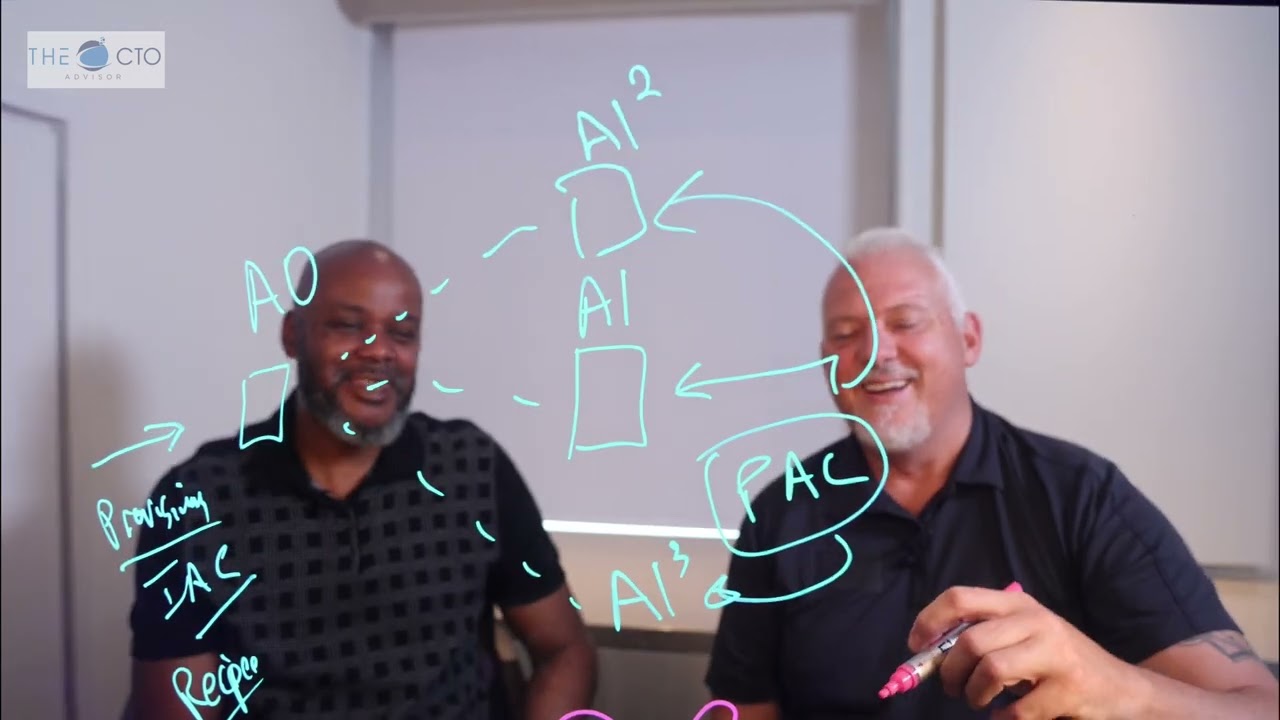
And what's interesting is for me, is that it starts, it can start at a different place in the cycle. So, let me draw a cycle, if I may? >> Oh, yeah. >> Okay. Let's do it. All right. So, let's talk, let's talk about the life, the life of a an instance or a machine, or just let's put it right here. So, we have this machine here. And when I start the machine, I'm going to be basically bringing provision of that machine, okay?
And I want to make sure I know and bear with my writing. I'm sorry. No practicing. No. So, but I'm provisioning this machine right here to get the right rules in place. Okay? So, this, and you think of this as like kind of the start. This is my A0 state, right? When I am in the cloud and I'm operating already we'll call it my A1 state, okay? And with provisioning, I am, when we usually. What we'll call this as infrastructure, as code IAC.
Where I'm putting all the rules that are in here. So, how is my data going to, you know. How is it going to be created? Who's going to have access to it? How's that going to work? So, it's kind of think of it as pre-governance on what's happening. Once it's in the A0, I'm out there in the market. I'm out there in my infrastructure, on Prem. What have you and things you know, it's working. it's doing its workload, okay?
At A1 is kind of the next day, what have you were. Where it is now operating, it's doing its business function. But my ability to do things with this is hampered. If I only play on IAC. I need to play the backwards way. >> Hmm. >> Right? So, that's where I would bring in PAC or governance. And the interesting angle for me on PAC is that I don't have to start IAC to get pack. Boy, a lot of acronyms, sorry.
I don't have to start IAC. I don't have to do IAC first to get PAC. I can do PAC in. So, I can do governance of. So, what's great is that even in a brownfield environment, I can still play with a governance angle. And so. >> So, I was abstracting the conversation in my mind, you know. We talked about machine, VM. Storage. Some type of node that we're controlling with IAC and that we're managing with PAC on the A1.
But this abstraction can be a number of things. It can be lambda code. It can be security policies. It can be whatever configuration object that we're trying to create policy around a consistent policy. And as we abstract that, that allows us to move it from A0 which maybe development. This is, you know. >> Yeah. >> We're all AI right now. So, this could be a AI process that is using one set of hardware and features on premises.
And then when we need to burst out. We can move it to A1. Our provisioning processes and language just needs to be robust enough to be able to work in A0 and A1 as well. >> That yes, I would, Absolutely. So, let me add some more here. So, we add in here, we can talk about the recipe. you know, the config, well, I can't spell apparently. So, the recipe apologies, it was run on. >> We'll get AI to fix it.
>> Okay? Yeah, you know what? Yeah, that'd be great. So, we got the recipe that all that configuration that rich configuration information that goes into A0, right? And you're right, you absolutely can take that recipe and go on prem, on cloud. Wherever you need to, right? So, you can set an A1-2, an A1-3 and say, look. I now can put this in many multiple environments and I can still use governance back on it. To make sure that all the right rules are being, you know, held up to.
Is it go right? Is the recipe maintained? Did it do the right thing? Now, one other aspect that was intriguing about this whole fast emergence of AI, right? To me is, you know, I love the sound of AI. I love using, you know, chat GPT. I love what it's done with cockpit in my code when I'm writing code. >> Right. I love what they've done now in Outlook where it's telling me what to say before I want to say it, right?
And finishing my sentences off like in a direction. Sometimes I don't want it to go but it just come auto completes for me. But it's how to get started and how do I make sure that I'm using the best recipe in town? How am I getting? So, when you talked about, you know, what's my, you know, beyond the ports and protocols but also like what's the configuration of the stack, right? Stack config matters to me and that's another element. I'm going to throw on the board here is How do I take in this world of IAC and PAC?
How do I add something to it? And we're adding OAC to it, optimization as code. >> So. Intel has this strategy or philosophy about using accelerators and offload capabilities where appropriate. And one of the things I get kind of stuck on is, okay. I have, let's say AMX or TLS acceleration on premises. And I'm creating policy around that capability here. If this is the public cloud, and I'm creating hardware based acceleration specific to my on-prem capability. How do I translate that policy to the public cloud?
>> Oh. So good. So good! >> I wasn't expecting your response to be so good. >> No, that's so good. >> You're supposed to be like, Keith, you know what? That's the future. >> No, that's so good. That's so good. So, let me show a couple different things. So, let's talk about an application and we're going to do an on-prem application versus a cloud. But in cloud. In the on-prem environment, I have the ability to do, and I'm going to get to answer your question.
But I can do things like, let's talk about the hardware config. I can do the bios config, and I can do the app stack config. And what you were talking about is, okay. I've got all this layered out with all of the configuration information I need to operate on-prem. So, I know for example, pardon me. We'll do a plug 4th gen, >> Right. >> Zion, scalable processors with AMX. Okay? >> Right. >> And they, I could just put SPR to be cool.
Since we could still say that Sapphire Rapids. >> Okay. >> So, Fortune Gen Zion scale. So, we got that on on-prem, right? And I know my stack looks like this of how I need to operate it, right? And the question is, okay, how do I take this recipe and easily apply it to the cloud, right? And what's what's great is with OAC, we start to now open up what's exposed over here. So what, what are my kind of, I'll do my what bad gear turning wheel here.
But like, what knobs are you going to give me over on? Like for example, in C3. >> Right. >> What can I touch off this list? So, we know we can touch part of this and we can touch part of this and I can hit this subset of rules. So, as you're doing policy creation that's impacting on-prem you can set the rules and say, okay, this is what it's going to be like for on-prem and as soon as I translate to C3, here are the knobs you will still send to C3.
>> And give folks context. We are using this term C3. C3 is the Zion scalable 4th gen instances available in Google Cloud. We talked about that in the Google instance. Where we talked about you do a development process on premises. You can take that same development process and migrate it to Google Cloud without making changes to the system. Now, we're talking one layer lower than that. How do we create platforms? Where does this become practical to you, my audience perspective?
So, if you're a platform engineering group. And you want to create a generic platform that's available to all of your development team. And there's capabilities you want to expose. Hardware capabilities in this case AMX for accelerated AI and machine learning. Now, that you can take these consistent systems with OAC and apply this capability to your both on point on-prem systems and Google Cloud-based systems. You can build a reliable contract or infrastructure for your developers to consume. That's the theory.
>> Yeah. Well, we're, see, okay. We're beyond theory though. >> Okay. >> Okay? So, and I'm going to connect the dots here. So, OAC is a combination of recipe. It's a combination of the module itself that does the provisioning and it's a touch to the governance with the policy. So, the beauty is like today, we just launch, launched this in the last week is for Google Cloud C3 instance with 4th Gen Zion scale processor. We have AMX support.
So, we are doing fast chat AI in OAC and stable diffusion. So that, you could do both image or text and it's available now. The beauty is when when we start to to dive into the OAC space. We talked about a repeatable known model that's easy to deploy. That takes seconds. So, I could, in a matter of three to four minutes right now, I could deploy a fast chat server and start asking questions. Now, this is not training, this is inference.
But the beauty of to, you know, anybody in the market's like you don't need to know AI. If you want this capability you need to understand how OAC works and deploy. >> So, funny enough. They gave an example of this on stage at Google Cloud this morning during the keynote. The creating a similar type of concept or platform and literally two to three minutes. So, I know that that capability exists. Josh, I really appreciate you stopping by and sharing kind of the story.
As we think through, how do we get control of our hybrid environment? How do we leverage our on-prem assets, our off-prem assets? How do we ensure governance is followed throughout the entire process? This is the low level fundamentals that we need to think about. What is it that we're trying to model? And how do we abstract that across the our different en environments? And how do we serve that up to the consumers of our infrastructures? Fabulous conversation. If you want to learn more about the CTO advisor, you can follow us on the web.
com. Thank you for our sponsors from Intel for sponsoring this entire video series. From CloudFlare, to Google Cloud, to Dell Technologies. And finally, this conversation with Intel has been a pleasure. Talk to you next CTO advisor studio production.


