KubeCon 2019 - Joe Beda Interview
Transcript
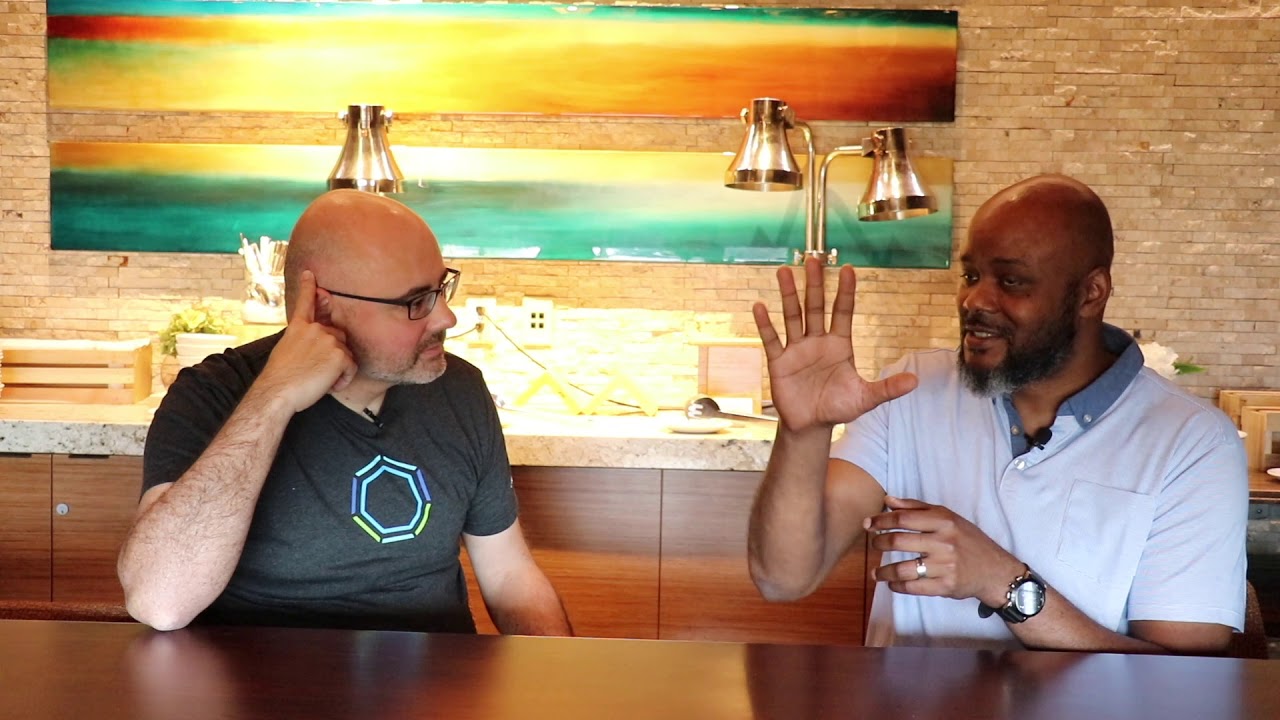
>> Hey, how's it going? It's Keith Townsend from the CTO Advisor. I'm in 64 degree weather, which is crazy for this time of year for me. I'm from Chicago. >> It's raining, and everybody's freaking out here. >> You know, I saw a guy who was nice and bundled up, and it was... >> The umbrellas. >> (Joe chuckles) >> It was crazy. You're from Seattle. >> Yeah, so you know I'm like this is just another, what is it, Wednesday?
>> Just another day. >> I don't even know what day it is. (laughs) >> So we're at KubeCon 2019. I have Joe Beda, principal engineer over at VMware. So we're just going to call you guru all things Tanzu. >> Yeah, exactly. >> At VMware. So, this is a super appropriate interview. KubeCon 2019. This is my first KubeCon. Amazing 12,000 people, over 200 sponsors. Kubernetes is growing up. >> It's been fascinating over the last, you know, five years to see.
So Kelsey talked about in one of the keynotes some of the very earliest meetups. Just to see the growth of the community and how it's changed, how it's evolved, how it's gotten more relevant, more commercial. I still think that there's a heart to it though, hopefully that comes through and you've seen some of that. I think for me that's the energizing thing about coming here to KubeCon. >> Well, I actually talked to Bryan Liles who's also VMware staff engineer, but also more importantly...
>> Senior staff, by the way. >> Senior staff. Which is a big deal. >> Yeah, no. I mean like, yeah, yeah. >> I'm a former VMware guy, so it's a big difference between staff engineer and senior staff engineer. >> No, Bryan's knocking it out of the park, he's been great. >> Yeah. He's knocking it out of the park. And I talked to him yesterday about the complexity of taking something that has a lot of heart and then bringing the enterprise along with it.
And... >> It's a delicate dance. >> Yeah, yeah. >> So I definitely felt the heart of the opensource movement yesterday. You're in a unique situation because you're one of the founders and creators of Kubernetes. You kind of created this thing that was Google-scale and helped Google set a set of challenges and now you're bringing that to the enterprise. So it's not only the technology challenges you're dealing with, it's that cultural shift of bringing what was a thing that was created in a valley and created to solve valley problems to I think the most traditional of enterprise customers, VMware customers.
Can you talk a little bit about that? >> Well, I honestly think that this is just a story of cloud in general. I think people view cloud from really different directions. I think there's this infrastructure first view, which is really about OpEx versus CapEx. Can we outsource, essentially, hardware ops. I think that a lot of people are viewing cloud through that lens. When you look at it from sort of the application developer, applicant team and developer point of view, what it really is, is it's about taking the cycles to turn the crank and making things faster.
So moving from like... So virtualization took us from, like, I need resources, it's going to be months because I have to go and order stuff from Dell and I got to get delivers and rack and stack, to all of a sudden now it's like, hey, we have virtualization, I can allocate a server using something like vSphere. Now it's like maybe on the order of a week or two weeks. >> Which was amazing case. >> Which is an amazing enabler. With the advent of cloud, now it's down to 30 seconds.
So you see these phase changes as you go from like 3 months to 3 weeks to 30 seconds or 3 minutes. >> Just from a personal perspective, I've given up my home lab. My home lab is AWS. I mean, I can literally turn it off, and turn it back on as needed and it has been from a ability for me to learn. Now, if I want to spin up Kubernetes, why would I spin it up in a... Why would I get three nodes, blah, blah, blah and spin it up when I can literally have a cluster up and running in 45 seconds or, you know, whatever the time period.
>> Yeah. So I think exactly right. So, for me, from the developer's point of view, cloud brings, you know, API for self service and elastic. You can sort of, you know... The cynical sort of developer in me, it's like, it's not talking to a sales guy as a service, right? >> Right. >> It's this ability to just get your job done without talking to folks. I think one of the... You know, when we look at Kubernetes, you can look at it from either those directions.
On the one hand, it's a way to actually start providing efficiencies and like, get more out of your resources, that whole thing. But then there's another side of it is, how do we provide a cloud like experience, API driven, self-service and elastic that is universal and runs everywhere. So I think so many folks spend a lot of time moving to cloud. They look at it from the infrastructure point of view. Then they find that they don't get the acceleration on the application point of view, without actually embracing that sort of cloud native way of building and managing and driving applications.
So I don't think there's a Kubernetes problem. This is a cloud problem around, how do application teams learn to modernize to take the most advantage of this API-driven, self-service infrastructure. >> I'm on record saying I think the Kubernetes thing is going to take care of itself from a... How do you... Like, Kubernetes right now is really hard, really complex to manage. VMware and all your competitors and partners in the ecosystem. They're making strides to meet that goal. >> We're working hard on that.
I mean, a lot of that's happening in the community also. I think a big part of our thing is that we think, the easier we make Kubernetes for everybody, the better it's going to be for everybody. >> I absolutely believe that that's going to happen. We actually sponsor OpenFAST, the openFAST homepage because we believe once Kubernetes is to a point is where the packets, you know, to these functions as a service as such. Which is what I wanted to talk to you...
Another thing I want to talk to you about, which is that developer experience. Moving from giving developer a virtual machine or no bare metal to a virtual machine to a container to now this environment in which is API driven. When you look at the cloud providers, what's appealing now, and it's not just I get some IS resources, but I get some tools that get me 80% to 90 90% of what I need to get there from these other services. How does VMware view kind of this other part, once we've kind of taken care of the uninteresting parts, the providing resources, what's the next level and being wise vision?
>> Well, at the end of the day, it's all about making developers be more effective ship software more reliably faster. And I hate to use the buzzword but so much of like digital transformation is really about this, you know, and I'm naming names here but don't take them literally. It's the Tesla's of the world learning how to become a car company. Well, the Fords of the world are learning how to become a software company. So that dynamic of software becoming a, going from being a necessary evil of doing business to something that is a differentiator and a necessary thing to succeed in the market.
That changes could happen across every industry. I think that our goal with VMware is to actually provide a modern platform such that the IT departments can enable their development teams, their application teams, to move at the speed that they need to to be competitive. Well, also being respectful of both sort of the, you know, the existing investments, the existing rules, and the complex landscape that enterprises deal with that oftentimes doesn't apply to smaller companies. >> So let's talk about how VMware is helping kind of bridge the gap between the raw...
I got exposed to the raw CNCF this week, like this is whoa. (Joe laughs) Who knew Linkerd was Linker D, like just these nuances that you don't get on Twitter, etc. So one of the things that is painfully obvious to me that a lot of the Kubernetes and open source community, they weren't born of enterprise IT. They were born in places that move fast, they break stuff. If something is something working today, great, we'll use it. If it's not great, we'll jack it and use something else.
>> Or fix it. We can, you know... >> It's kind of like if you have a car in Havana, you're not going to get new parts for it. But hey, you know what, we're going to make it work and it's going to look great. So same culture... >> I love that. That culture doesn't exist in the enterprise. But when I look at the stuff that they're doing it with what some of the companies that talked to a vendor yesterday MobiledgeX, whose time 5G in containers together allowing game developers to build a scale, being able to scale instances where players are at.
So if you're doing Pokemon Go, and there's 100 players that show up, wow, we can scale up 100 containers there. The enterprise needs that. >> Oh, yeah. >> We need companies like VMware to show us the way to kind of be the gateway to this community. Because I can't see the enterprise consuming, like CNCF projects natively. Where do you see VMware role in that relationship? >> Well, I think one of the things that influence Kubernetes but I think also influences the CNCF, the cloud native ecosystem as a whole, is a lot of times what we call Unix philosophy, right?
It's this idea when you're learning the command line on Unix, and you understand the subsystems. It's a bunch of small things that are relatively simple, that compose together to create something more complex, something more interesting. That is as opposed to, I think more traditional things like, I don't want to pick on Windows, but Windows is like, it's a more all in one experience, right? I think one of the reasons why we've seen, at least on the server side, Linux and the Unix world went out over Windows is because that philosophy is incredibly flexible in the face of new challenges over time.
There's more to wrap your head around. There's more for you to understand. But also, it can sort of bend versus break as you throw new challenges at it. So I think that one of the reasons why, you know, amongst this set, we've seen things evolve is that having all these different projects creates an enormous sort of resiliency that you don't get when you have sort of a much more vertically purpose-built type of product. I think what we're going to see now, and I think this is VMware's point of view, is that, you know, we want to walk the line where we help people view this as a whole.
This is why we introduced this new brand, this new effort called Tanzu with the idea of like, let's view this as a unit. Let's view this as an experience, where we can help folks get started, we can help them make sensible choices for them out the gate. But then as they hit limits, they can actually then go deeper and start taking advantage of the sort of beautiful chaos that is the cloud native landscape that we're in right now. >> So I love that approach.
You know, Tanzu was kind of this umbrella concept of, if you want a safe enterprise friendly way to approaching this, Tanzu is the entry point as you kind of get your... Because this is day two for me and day two, I'm starting to See how these pieces put together. >> And there's gaps in it. It's rough and it's not perfect. >> What you tend to see is the problem. There's a lot things that need to be solved. But once you've kind of gotten to your feet, where there's absolutely...
It's balanced, options are balanced. I think it's painful to go through. Make a laugh about that. It's painful to go through. But I think it will be worthwhile. >> A couple of trends that we do see here is that we do see that there are some enterprises that are further along this journey than others, and they are embracing becoming a software driven company. Their relationship to the software changes. Oftentimes, they're not just consumers of these projects, they actually turn around and they actually start contributing.
So if you walk the floor, you'll see companies out there that are end users wanting to be involved, wanting to actually be part of the community. >> It was maybe about six or seven end user sponsors app. I have to absolutely kick check by hot. The Home Depot is one, and a couple others. I'm anxious to see kind of why they're here and what they're doing. >> Then I think the other thing that we see is that, enterprises are not homogenous.
So you'll find that, you know, there's going to be certain parts of the enterprise that are like, hey, they're doing relatively straightforward stuff, this sort of like, you know, this opinionated stack for getting started works great for them. But then you may have a group that's, you know, doing really interesting forward looking stuff, doing a lot of machine learning, doing some big data analytics, doing some really interesting stuff on the edge. Those are the folks that are like, hey, this is a great starting point.
How can I break the rules? How can I actually start leveraging the rest of the ecosystem in a way where they're not throwing the baby out with the bathwater, they're not totally starting over as they need to actually do things that are a little bit off the beaten path. >> So, Joe, we could talk probably for another half an hour on this topic because it is an amazing time to be in IT. I really appreciate you taking time out of your busy schedule, kind of like VM world is my conference and you're a VMware employee, but I think it's safe to say that KubeCon, CNF...
What is the CNF part of it? >> CNCF. So the cloud native computing foundation. >> This is I think to say, this is your show, so I appreciate you taking time out of your schedule. >> Well, thank you so much for having me and it's great to see these worlds converging. It's been wonderful. >> Well, that's it for this episode of the CTO Dose one side, KubeCon 2019. For more coverage, make sure to subscribe to the YouTube channel, LinkedIn, and Twitter at CTO Advisor on Twitter.
Talk to you next, CTO Dose.


