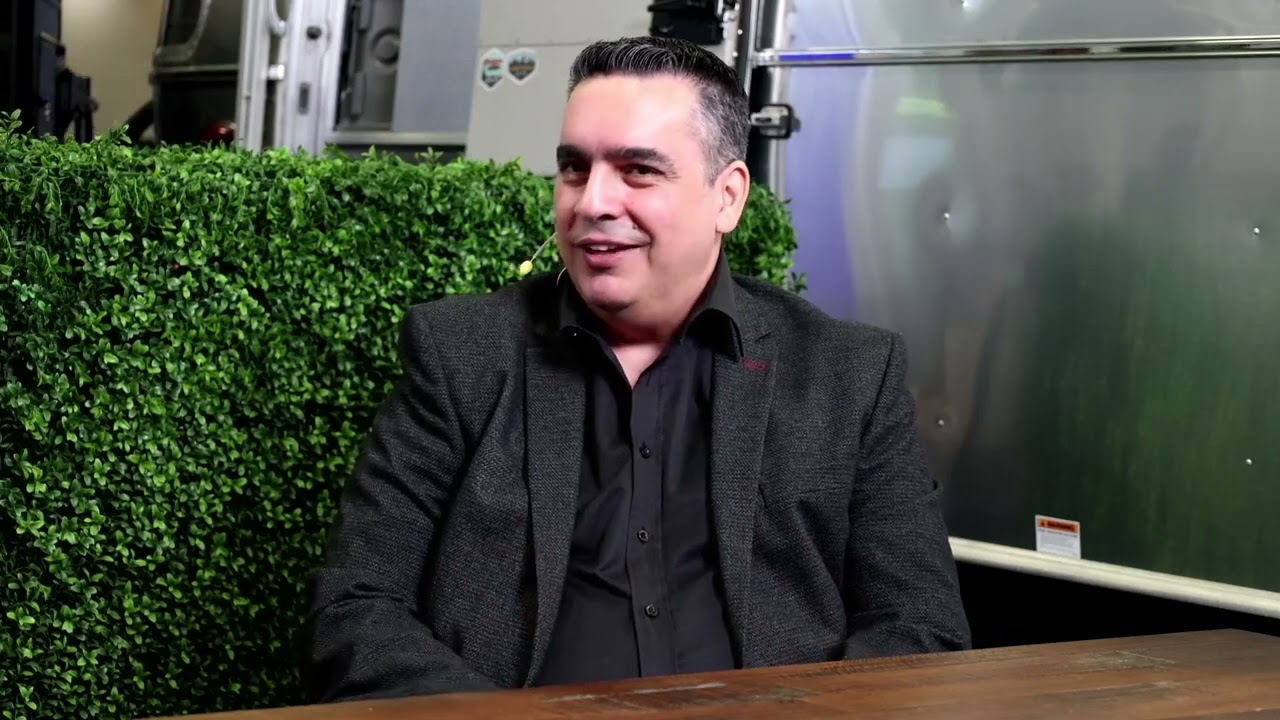
Iztik Moshaof VMware Explore 2022
Transcript
>> Welcome to VMware Explorer 2022 with the CTO Advisor Studio. Come on in and consume some content. >> Welcome back to day three coverage of VMware Explorer, 2022. We promised that we were going to bring you some of the most interesting conversations via the CTO Advisor Studio. And we've delivered on that. We've talked to VMware, Oracle Cloud, Cohesity, the list goes on and on. Independent conversations with the decision makers, the people who are on the ground making hybrid infrastructure real.
That conversation continues with Oracle Cloud Customer Cyber Reason and their global IT senior director, Iztik Moshaof, I'm sorry. >> It's Iztik Moshaof. Yeah, I went through this one. >> You know what? Before the end of the day, well, I'm going to get that. I'm going to actually practice saying your name. >> We'll work on it. Don't worry. >> We'll work on it. >> Yeah. >> Iztik, you're the unicorn. You're multi cloud, >> Yeah. >> And you're one of the first customers to embrace or at least talk about embracing the VMware Cloud Solution.
So, we're going to walk through that journey. First, who is Cyber Reason and what do you guys do? >> Yeah. So, first thank you for having me. Cyber Reason is a cyber security company. We put our goal to move the advantage to the company and not to the attacker. The way we do it is we have sensors talking to an AI server as a SUS server that sits in the cloud. We also have an on-prem solution for companies that don't want to go out to the internet.
So, the idea is you have this big server with a lot of compute power collecting logs, from everything, from your switches, your firewalls, your computers, your desktop, your iPads, whatever is connected to the network. And whenever it is, it could be like in the cloud, it could be your on-prem. It could be when you're vacationing or you're at home. So, we know something is happening. It'll tell this AI server that, give them the logs and the data. And we wrap it all in something, we call a malop, okay.
The whole process is XDR, this is the new word right now. So, we wrap it up in a malop and the malop is the whole event, the whole attack. Sometimes, you can have even two or three malops running the same time like two or three attackers that sits there or maybe it's running already a few years before Cyber Reason came and we hope you enjoy it. We give you a full forensic. You can drill down in a very nice way, drill down to the email or the attachment or the discon key or whatever the attacker came from.
And we'll give you a free forensic to help you to protect yourself, block it, or maybe even let the attacker continue and see what he trying to get. 'Cause sometimes you want to know what he's doing there. >> Right. >> I mean, you block. Yeah. >> Not only you want to just block them, you want to know well, they might get that. >> Sometimes, yeah. >> Sometimes you want to block 'em right away. Sometimes you want to see where they're headed.
>> It depends what you're doing. Yeah. You'd be surprised. >> That is a interesting business model. So, it's always curious when a security company chooses to outsource any part of their infrastructure. " >> From a finance phase, it doesn't make sense. I know. So, we will talk about ROI and CTO and stuff. So, I joined the company three years ago and I inherit a company that their IT wasn't like, there were no policies and stuff. So, everybody was doing everything, people spending with a credit card and helping others handle their cyber attacks.
So, I joined three years ago, did kind of a map, mapping the whole environment. That took me almost two months and I understand, okay so I have this floor of my own data center. It's not that big. It's not that I need to do a hardware refresh. So, I know I'm going to need to put some money on creating something that is more scalable, something more stronger that will allow the company to do what they want to do. And then I went to the management, I sat with my CEO and the CTO in the company.
I trying to understand where do they want to be. So, I plan for three years, I spoke with them. They said, "Okay, we have a momentum right now. " So, I started with the amount of people, how much do we want to recruit? Back then, three years ago, we were 500 employees globally. So, it's kind of a medium company, not that big. I mean, if you look at it globally and the growth that they talked about were thousands. So, I had to be ready for that.
So, I understand right away, I understand, okay. My floor is not enough for that. I cannot do that. So, we did start to look at the other solutions. The first thing that came up was the co-location, taking my service or even do the refresh and put them in the co-location site. And then, okay, so the architect himself is based on VMware, vSphere. So, it has to run on an ES6 environment. So, Native Club back then was, it didn't make any sense.
So, we did a calculation for three years, and then I sat with all of my R and D team leaders, all of them, and I asked them, "Okay, what would be your dream? " And they ask for a Bugatti. And I told them, "Listen, I'm far from that right now. And I can't do that. I cannot do that in my current floor. " So, they ask for tons of things. They complain about the CICD process is to take it way too long.
So, we have these sanity checks before we move the code to the production and it takes back then, it took like two weeks. >> Oh wow. >> The whole process it's two weeks and we kind of implemented somewhere about 1000 machines during the tests and then delete themself. And it was too long, and I learned the process. I understand what they're doing there. It's all based on templates with the Vanillas that you run automation on that. The automation is also running on vSphere.
So, it has to speak the same language whatever solution you'll find. And that's why it makes sense to put it on a co-location side. So, I'm putting vSphere and controlling it. I can continue with my own automation on that. So, it should be smooth. So, we calculate in ROI for three years. I did prove that it'll be worth doing that. " And right before I did it, and remember, this is three years ago, this is pre-pandemic. And then COVID hit us.
And when COVID hit us, it kind of changed everything. " Okay. We're talking about January and February, something like that. And that's when I went to speak with my management again, and I asked them, "Okay, where would you like to be five years from now? " And they did plan that far. And the dream was a lot bigger. And it all depends on what will happening in the next few months and how do the pragmatic will actually implement the business.
" And a co-location growth. I mean, the scale up and scale out is not that fast. I mean, if you want to add another ES6, you need to buy it. You need to install it. You need to maintain it and add it to your clusters and everything. And it'll take time to add an additional ES6 server. And remember, as I said, I'm handling the R and D lab. So, every process that we do there is extracting a lot of templates during the test and then delete them.
So, I need to be able to scale up and scale out really, really fast. And that's where the cloud makes sense. So, I search it up. Nobody talked about it back then. So, I went to the vendor himself. I spoke with VMware, I brought 'em to the table. I told him, "Guys, this is my challenge. This is what I need to do. What's the solution? What do I have out there? " Again, they did talk about co-locations, but then, we started to talk at the cloud and back then, three years ago, AWS and VMware had a partnership when VMware is actually in the front.
So, you can build your own ES6 on AWS data centers with the same experience of managed services. So, it was perfect. " >> The VM on the AWS underlay, which was more expandable than the AWS underling. >> You don't need to take care of power. You don't need to get to the data center to fix something because the road works closed. Remember, the beginning of the pragmatic, you couldn't even get to the servers and fix them. So, we went to AWS, we started with that and then we found a new word, okay.
>> So, talk to me about that VMC on AWS experience and what made you consider OCBS Oracle Cloud VMware solution. >> Okay. So, as I said, AWS was the only option out there back then, let me fix that. The only option that view VMware will be in the front, which means if you have any problem, you can go to VMware directly because everything is based on ES6 in my environment. So, after seeing that it's working really, really good, you can scale up and scale out in a click.
You don't even have to worry about it, the automation doing it himself. " I did convince the management to put the money over there to take this risk. But when I showed, I showed it like five years of ROI. Okay? A year later the partnership came between Cyber Reason and Oracle, they're our customers, we are their customers. They're selling Cyber Reason as a security layer of the cloud. " And remember, this is back then, two years ago. Okay?
I'm here in AWS already, I know the cloud, I know the experience, my team already learned how to handle that that there's actually transmission from C admin to the DevOps engineer because you're doing automation in the cloud for the team. So, there's also a gap over there that you need to fill. So, I started to check this, we did a PLC with the OCBS, with Oracle VMware cloud. And we sell it at the same dollar that we put on AWS is different than OCBS with Oracle Cloud.
Yeah. The interesting thing about it, I thought it would be the same because it's saying, okay, this is risk here. It's running on a service. What could be different? So, apparently the bare metal are a bit stronger in terms of CPU and memory, which is what I need in my case. Okay, this is my architect. I need more CPU and memory. Where in AWS, the focus for the environment that we took over there was more like storage >> Storage IO was better.
>> Right. >> Yeah. A lot better. And again, back then, you have this Oracle not manage service which means you still need to manage the bare metal. >> One of the things that they are very proud of, they give you access to the root and you just, >> Iztik: Right. >> But now you're back in the business of managing ES6 I's. >> Iztik: That's exactly the point. So, back at the beginning, and remember, we're learning through the phase at the beginning, I thought its going to be a problem.
I want to manage servers. I don't want to take care about the bare metal, you do that. But then, I saw that it's a great advantage. I mean, right now you can buy this service. Okay. This is a managed service on Oracle. You pay more a little bit more, but you get this service but I didn't buy that. And the reason for that is managing your risk. So, on AWS, for example, this VR8 was just announced two days ago, I think.
And AWS will probably go there in a very close period of time and I'm not sure my automation will be ready for that. Maybe there will be a gap in there. 5 because we have a thing with Apple. >> Technical debt. >> Yeah. 5 tops. >> Oh, that's as far as they go? >> Yeah. So, if I'll go to eight there's probably, >> You lose your Apple underlay. >> So, you jump, by the way, technical. So, my automation might stop working or it will work only on the cloud, not on on-prem.
So, I want to manage that, in Oracle I can do that. I'm controlling the versions, the patching and everything myself. So, what I thought would be a challenge actually turned out to work for me. It's actually an advantage. I can manage my risk. I have this cloud environment doing the latest and the best and latest. And I have this Oracle that I control. I can be the latest, but I cannot, I can control that. >> So, let's talk about the multi-cloud nature of what you do.
So, you're solid into OCBS and Oracle Cloud. But as I understand you have some Native Cloud stuff in Azure. >> Yeah, this is. >> What drove that decision? >> Research, actually. " They needed a change. For example, proxies, windows from all versions and stuff. So, there was something very, very much specific. I won't go into the details that they need to test on environment of Office 365 and stuff like that. And the only way to do it is actually using the Native Cloud in Azure.
So, now we have the GCP with our architect, the AI service sits on GCP and you need to protect it. So, we have the Cyber Reason over there. We have firewalls, we have an ES6 that actually manage the whole layer of networking. And I have Azure doing my research team doing the stuff over there and you want to keep it in a closed environment because we're dealing with cyber security. So, the things that we're doing there you have to make sure it doesn't go out.
Nobody plays there. So, using kind of a jump server into getting into this environment I have this AWS lab doing this all automation of deploying templates with a really fast deployment. We'll talk about it in a second. And I have this Oracle thing. The new thing was we jumped in two years ago to Oracle and Oracle actually opened the world for us because you get more CPU and memory. And when you deploy service, yes, IOS is really important because at the end of the day, you're writing into a disc, no matter if it's a flash or not, but when the CPU and memory are stronger, the test that we are doing are a lot faster.
So, if you remember, we talked about two weeks period of sanity tests and which was taking all time for the CICD process. And if it breaks, you need to run in again, we came down to two days from remember, two weeks came down to two days and we are running a hundred thousand servers when we run only a thousand before. So, it's changing the old way you think about our ROI because implementing the business himself, support team, think about support team. Think about sales, engineers, everything is running a lot faster.
The blueprint is crazy. So, I'm a multi-cloud and I still have my on-prem where we talked about it. So, I need something, a layer to manage everything. And if you want, we can dive into that. That's where I implemented VRealize. >> The VRealize folks would love to have that kind of high level overview. So, let's talk about that, because VMware talked about their Aria announcement. So, I would love for you to give a customer perspective of using VRealize and what you're looking forward to.
Or even if you're looking at Aria as a result. >> So, as I said, I needed a layer to, I need something to speak with all of those cloud in the same language. And what I have in common is VSphere, everything is VMware based. So, we went back to VMware, my partner, and we asked, "Okay, what's the solution? " And they introduced me to VRealize, and again, I'm telling you, I'm learning through the process, okay. Because it's not like nobody talked about it but they were all sales people.
I don't want to talk to sales. " So, I brought the VMware, they told me, "Okay, let's get your personnel ready for that. " So, I said, "No, I want to do it through the run. I want them to learn through the process. " It's working. Let's take a small part of it. Let's try kind of a PLC through the run. And then, you're learning through that. And I have to say, I have a very talented team.
So, I fully trust them. And that's why I took this risk. They learn and we didn't talk about it. But I came down from four to six admin to only two, two DevOps engineers actually. And those two that I actually moved, I moved them to my corporate IT support team. We added an additional four people over there and that's actually helped me with my SLA. So, I'm solving more problems. I got less people needed for, to do that.
>> You're a walking testimony to automate. >> Yeah. >> Reallocate. Provide better service at the end. >> And remember, it's a big risk. Okay. You're putting everything in the same basket and it's kind of dangerous. So, they showed me VR, right. " One blueprint in one place, give the experience of the R and D or support or sales engineers from, they have the same experience and it's in the cloud. It's in the same latency, no matter where they sit, they can be at home, they can be working hybrid.
They can be in the VMware Explorer doing their work or on the beach in Thailand for as far as I care, they get the same experience because it's in the cloud. And the VRealize speaks with everything, the same language, really, really fast solution, you've got great eyes on your environment because you're looking at one place, you have the VR ops layer of it. So, VR ops actually looks at the VR8 and give you the data on what's happening over there. And you're still managing your on-prem which was at the beginning was a gap.
Because as I said, it's two different versions. >> Keith: Two different major versions VSphere. >> Yeah. And VR8 takes care. " And he will decide. I mean, they will check and then decide, if they're running out of space of ES6 in, for example, Oracle, I mean, now I have 27, 28 servers, ES6 servers as my base on Oracle, when I'm doing my sanity checks we sometimes jump to an additional four servers. Okay. >> Oh, wow. >> It's running during the process, this is on two days, period, think about it.
I'm adding four servers and I'm deleting them at the end. You cannot do that in a co-location. I mean, doing that will take me two months to do that. Just getting the hardware and stuff like that, right? So, it's a new, all new world. So, when you think about horizon stuff, everything changes. The pictures show that, okay, what I planned for five years, I actually closed the gap in two or three years, which is significant. It's implementing directly the business within a lot more.
Nobody's waiting for a CPU power anymore. Everything is out there waiting for you to do what you want to do. So, things will happen fast. We grow from 500 employees to 1600 in two years during the pragmatic. So, think about it. Companies will close all around. They bankrupt and everything. And we growing. >> So, Iztik, this has been the story that I've heard consistently throughout the show. And the couple of years, companies transforming as a result of the lockdown and the pandemic and being given, IT leaders being given more leeway to try new things to solve these unique challenges.
And then at the end of it, becoming digital organizations themselves and transforming their business. I appreciate you taking the time, I could talk about this literally all day because this is the meat of what the VMware story is. Not just the Oracle Cloud story, but the VMware story of mixing hybrid infrastructures, private data center, VMware VSphere on premises, Native Cloud, and Microsoft Azure and VMware Cloud and Oracle Cloud infrastructure. You're the walking testimony. I appreciate you taking out the time. >> There is one more point.
>> Oh, one more point? >> Yeah, I got the biggest advantage I got, I didn't even think about it at the beginning. Let me guide you through. I have this AWS thing. All of my templates are over there. And when I did the migration to Oracle, I copied the data. So, I have this templates over there, also. So, all I need to do is find a tool to sync between them. And I have a DR, out of the box, which I didn't think about it.
And so, I'm fully protected right now. >> You're backing up your Oracle Cloud VMware solution to having it all on. >> Iztik: Yeah, because it's based on templates. So, the same templates I have in the same two environments. So, I have a DR. There you go, it's perfect. >> The magic of the public cloud and legacy, legacy infrastructure, huge business growth off of this model where people are telling us we need to move from, here's the counter case where it makes the case for cloud and combining your existing operations and accelerating your business at the end.
com. Stay tuned for more coverage from VMware Explorer, 2022.


