
Intel Hybrid-IT Look Forward 2020 and Beyond
Transcript
>> Hey, it's Keith Townsend Principal of The CTO Advisor and welcome to this look forward at 2020 and beyond, sponsored by Intel. So, in the look back at 2019 we established that hybrid IT is the established future of the data center enterprise IT. Hybrid IT includes the operations of your private data center assets and your public cloud. Intel, I think, is making a really great argument for their scale across hybrid IT with their relationships with AWS, Google Compute, Microsoft Azure and all of the ODM providers.
However, coming up from the rear are competitors like AMD and ARM. But, is the story only about speeds and feeds? Processor manufacturers leapfrog each other every couple of generations, so I'm not as an advisor, I'm not as interested in the speeds and feeds today as I am the overall systems. If I'm betting the future of my practice on hybrid IT, where am I looking for the processor manufacturers to go? And this is why it's important that Intel has gotten into storage and networking and we'll talk about it when it comes to hybrid IT management.
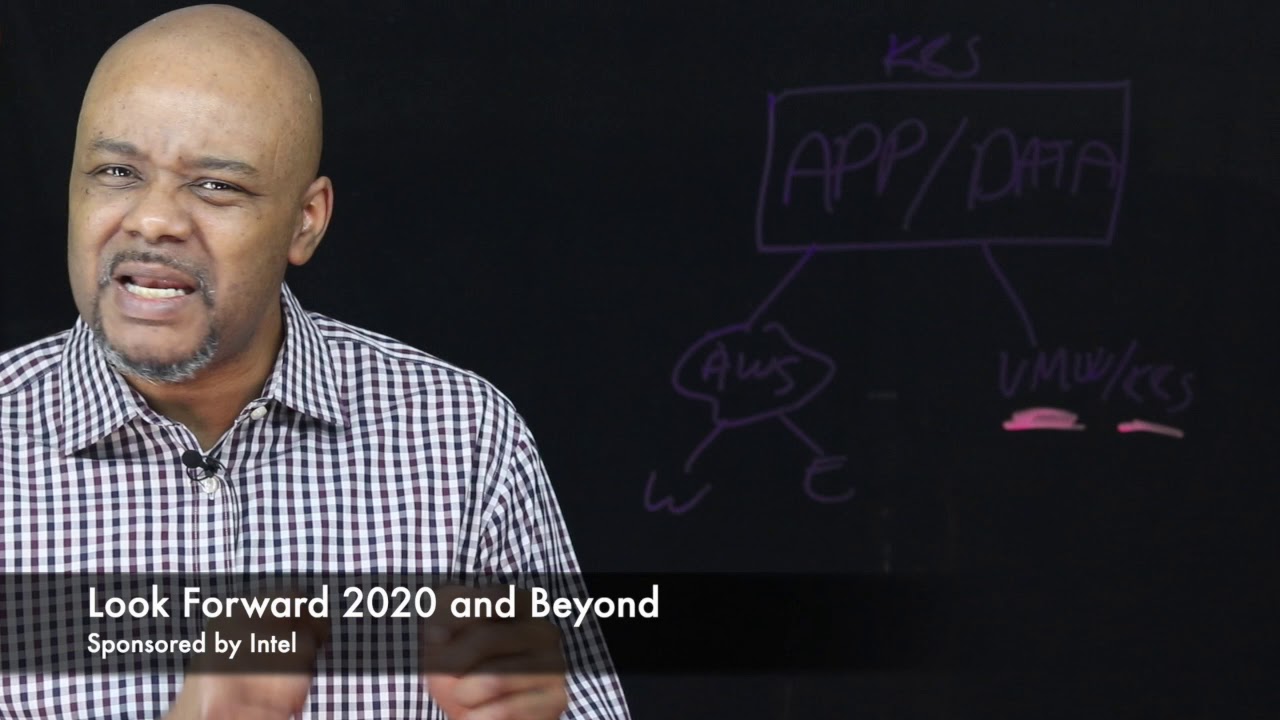
This picture, I think is a pretty good representation of the enterprise IT landscape. We have applications and data that we want to distribute across our public cloud providers and our private data center assets, but it's very uneven in the sense of our ability to control or predict performance inside of our private data center versus the public cloud. What do I mean by that? Well, in our private data center, we have tools like VMware VSphere and Kubernetes and Windows Server, Mesosphere, the list goes on and on, that allows us to predict or at least control where we're putting workloads so that we can balance the underlying infrastructure.
The public cloud providers do the same however, they don't service that data up to us. So when we're deploying apps from our application catalog into let's say, AWS and we place one load in AWS East and one node in AWS West those nodes may not perform the same because there's noisy neighbors, there's network congestion, there's all these things that we're not aware of. What does this have to do with Intel? Well, Intel is the common thread across the private data center and the public cloud.
Your workloads are probably running on Intel's scalable Xeon processors, or Intel storage or Intel networking and if Intel can surface up that telemetry data to our Kubernetes or our VMWare Vsphere running in our data center or in a cloud control plane, we can distribute workloads based on the underlying data infrastructure. How is Intel, again helping with this problem? Intel has a open-source project, Telemetry Aware Systems, which you can follow the link to their GitHub below, in which they're working with the public cloud providers, working with the Kubernetes community, to surface up this telemetry data from Intel Networking and DPDK, Intel Persistent Memory inside the servers, Intel Optane Memory storage inside these servers, whether they're on your private data center, or in your public cloud or in multiple public clouds.
I think that's the power of Intel scale. While competitors again, have interesting speeds and feeds in the moments, we'll get these moments in time where one competitor can leapfrog another one in speeds and feeds. Overall, it's about the system. How can I, as a data center manager, an enterprise IT practitioner, ensure that I'm getting the performance and value out of my workloads that I intend to receive? It's telemetry data. If you disagree or if you agree, or you want more information, you can reach out to me on the web.
You can find me on twitter @CTOAdvisor, again The CTO Advisor is the website. Talk to you next CTO Dose.


