HPE Greenlake VP Erik Vogel Everything as a Service - VMworld 2019
Transcript
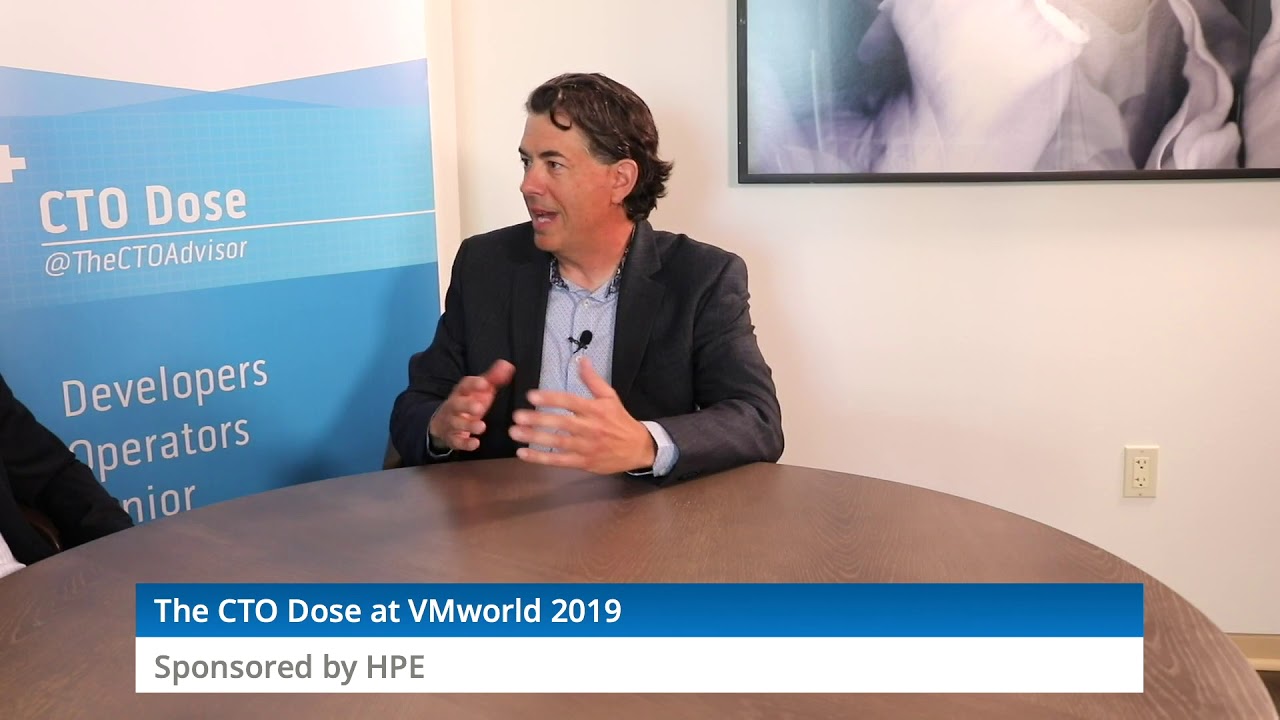
>> Hey, how's it going? com. It's been a busy VMworld Monday. But that's kind of rhetorical, right guys? >> It is, yeah. >> If you've never been to VMworld, it's hard to explain. It is a day full with IT knowledge, friends, community. It's overwhelming and it's back at San Francisco, which being in San Francisco, any time of year, is an experience So, I'm joined with Joep Piscaer, our co-host. Joep, this is our first time co-hosting together. You've done couple a CTO Doses today.
And Eric Vogel, VP, I want to say, like, CEO of HPE GreenLake. And we'll get into why we want to say that in a minute but VP of HPE GreenLake, new business unit within HPE. Welcome to the show. >> Well, thank you. >> So, why I would want to say that you're the CEO of HPE GreenLake Antonio Neri announced HPE, this ambitious plan to have everything as a service within the next couple of years. And we kind of joked, yeah, that's not a small task.
You know, you have plenty a time to go on your boat. I don't know if you have a boat but you'll have time to buy a boat, go on a boat and just relax and all the minions can go and do and make this happen. First off, why, help us with the skill. Why a whole BU around GreenLake? >> Yeah, it's what we found is GreenLake is it's own unique challenge. We're taking a traditional company that's used to selling boxes and selling hardware and changing pretty much everything, the way we sell, the way we approach the market, the way we go to market, the way we drive awareness about what we're doing.
So, it's really changing the way clients perceive us, the way they interact with us, the way we need to get in front of them. So, the whole experience, the customer experience for GreenLake is very different than the traditional sales model that we've had in the past. So, we've recognized that we really need a separate BU that's going to focus on that new customer experience which is the whole as a service motion that Antonio talked about. And hence, we've got to think differently and we have to set up a BU that thinks differently.
>> I want to know know, talk to us a little bit about the why of GreenLake. What's the idea behind doing everything as a service? What are the benefits for HPE what are the benefits for the customers? >> Yeah, I think one of the biggest influence of cloud and SaaS and the emergence of those technologies over the last three to four years is it's really changed the way our customers want to buy from us, not just us, pretty much the market. And it's not just on the consumer side with things like Uber or those types of services but you look at all the SaaS platforms, the Pluralsights, the Instructure SaaS platforms, ServiceNow, Salesforce.
And that has spilled over even into traditional infrastructure companies. So, we find ourselves, customers asking us, hey, we want to buy that way, we want to consume that way. We expect you to behave that way. So, that's really what's driving it is the market is really asking for that. This is no longer a product out sales motion but rather this is customer in because this is what the customers are asking, Microsoft learned this, right, when they made the switch. So, you can't buy a boxed software anymore from Microsoft.
Adobe went through this. And now our customers are demanding it. So, really, if we want to provide the experience that our customers are looking for we too have to move down that path and start to offer pretty much everything as a service because there are customers today that that's the only way they're going to buy from us, that's the only way they want to consume our products is as a service. So, we really don't have a choice. The market is forcing us there, the customers are moving us in that direction.
So, for us, we're finding greater customer loyalty, customers are getting a better experience. We think it makes us more competitive in the marketplace. And, more importantly, it gives us a longer term relationship with the customer. You know, we're traditionally in, we sell the box and we go and wait until we have to refresh. Now, this is an ongoing customer success. We have to continuously be there with our customers and continuously drive that on an ongoing basis continuing to add value for our clients.
So, it's definitely a different sales motion, different experience. But it's really the customers that are pushing us. >> So, we had the marketing team on earlier talking through the communications to customers. How do you kind of talk to the solution? But some of the things that I thought on as, that kind of follow on to that conversation, you know, kind of feet on the ground. OEM solutions and providing OEM solutions is one thing as a service, I can work that through.
But today, enterprise IT and enterprise banners are all about business outcomes versus the speeds and feeds of technology as before. And part of business outcomes or getting to those outcomes are services. So, help me wrap my head around providing hardware as a service, which I get but services that focus on business outcomes as a service rather than to a complete solution. There's a bit of inception there. >> Yeah, this is and I think honestly this is part of our big challenge.
You look at our cultural challenge and our people challenge is: How do we get our own people kind of thinking that way? Because we're used to addressing the problem with a product and going out there with the products and saying, hey, we can reduce your costs or improve your performance or improve your uptime with this device. Now we are saying, look, we're going to take the device and we're going to add set a services and capabilities on top of that and we're really going after that outcome, That business challenge.
If you look at why customers are buying SaaS or how they buy SaaS today or anything as a service it's really starts with the outcome and it starts with the problem that we're trying to solve for the customer. And I think that's a big part of the change. And sort of how we're approaching that is we're now starting with the customer and what the problem is that we're trying to solve and then starting to work backwards. If you look at the original GreenLake and kind of how we got that started the problem was customers said, we don't have the big CapEx dollars, our budgets are being cut, we like cloud because we can just buy what we need when we need it and if we need more, we pay more, if we need less, we pay less.
So, we were addressing that CapEx challenge with GreenLake Flex Capacity. So, it was kind of the first step. Now, we're moving even deeper in that, clients are saying: Hey, how do we handle really looking at cost analytics on top of this platform? So, we've got the infrastructure, we got software. We want to be able to allocate those costs by business process back to business units so they can see what they're spending so we have better accountability, better control, better governance around what we're spending for the services.
So, it's really, when we start to lead with this service approach and start to address the outcome we're really starting with the business problem and then building it backwards and saying: What do we have to provide? And I always like to say that the infrastructure question is the last question we're asking where we used to ask that first: What's the right box, what's the right platform? Now we're saying: What's the business problem, what types of solutions and services do we need to provide to meet that challenge and, then, what's the underlying infrastructure that has to support that?
So, we're really starting now to go the other way of gettin' customer in where the infrastructure question's the last one we're asking. >> So, one of the things that I've been asking on the ground, is some of these new business challenges that's comin' up as a result of new technologies. So, for example, SAP HANA I can now ask bigger questions and more complex questions than I could before. What customers are experiencing is that now that they can ask bigger questions they're realizing there's a whole 'nother layer of questions that they have to ask that requires more data, more processing, so that the investment they made a year, year and a half in hardware for HANA, you know what, already obsolete.
How does GreenLake kind of add flexibility to those environments, that I just need the latest and greatest hardware because that hardware helps me to answer the hard business questions? >> Yeah and I think there's two pieces to that. So, GreenLake at an infrastructure layer, a platform layer provides that growth and that easy addition, capacity addition and flexibility. What we're doing in that is we're providing an excess capacity for our client. So, if they're using SAP we kind of have a target for what they're using but we also give 'em a buffer.
In manufacturing terms we'd call it safety stock. We give 'em a buffer that sits on the floor, ready to go. All they have to do is turn it on. And they don't pay for it until they turn it on, so, until that core becomes active or they start to use something on that disk they don't really pay for it. So, it gives 'em that buffer. So, as they begin to drive that next iteration of questions as they start to take on more and more data and by the way that's increasing exponentially.
We have that capacity on the floor, so, we can quickly add it. And while we're doing that we're constantly monitoring that usage so we know when to make the next order, the reorder point if you want to, again, back to manufacturing terms to get that next bit of capacity. And we manage that for them. So, we make it a very seamless process for them so they're never behind or never out of capacity, they always have it ready to turn on when they need it and when they pay for it when they turn it on.
The other side of that is is part of sort of the next generation of GreenLake and where we're headed is we can provide SAP as a service where now we're providing the infrastructure with the application, with the middleware, fully monitored and managed and they're just buying it and consuming it as a service, an entirety. And that's quite a bit different where we just provide the infrastructure but they still have to do all the other pieces. Now we're saying, look, we can bundle that all up as part of our GreenLake workload solution and provide SAP as a service.
So, they're not forced to do that chase but rather they can just continue to consume and use it as if it was a SaaS. But the nice things is it all sits in their data center, it's all on-prem. We solved the data gravity issue because that data doesn't have to move out to a public cloud or somewhere else, it can stay on-prem. So we don't have to deal with that and we can give 'em that SAP as a service capability, fully managed, all the capacity managed in a consumption-based cloud-like economic model all within their data center.
So, I think we're addressing that twofold. One, we can take care of the infrastructure if that's what the clients are looking for. But we can manage all the way through the SAP stack as well. So, that makes sense from an operator perspective. It's kind of like you get your building blocks, you can put 'em together, create the applications you need. I'm curious the other side of this same coin, right, the developers in organizations. I mean, they use cloud services, SPOCs, they experiment, they start to use it and then as part of their development workflow they pick and choose the right services.
I'm curious how GreenLake fits into that to kind of support that developer workflow. >> Yeah, so, I think the traditional GreenLake wasn't really built for developers, right? To be honest with you we really, that was really designed for IT, to support IT needs. And if you contrast that with what AWS did, AWS started as a developer platform and really targeted developers. If you look at how it's built and organized, if you're a developer, that's home for you. So, what we're doing with GreenLake as part a sort of the next generation is we're building those services that developers are demanding on top of GreenLake.
And if you think about it, we have the Flex Capacity component. So, now we can add VM as a service, for example, where we can provide up through the hypervisor and provide the virtual machine, kind of in a VM vending type of model. So an EC2 on-prem type of capability all charged in a consumption, cloud-like economic model. So, they just pay for the VMs when they turn them on and they can turn them off. And we're also building out what we call GreenLake Central, which is our central portal.
And this is the access point where you can come in and access this environment, where you can see how it's performing, you can request these environments, you can spin them up and spin them down and manage the lifecycle of that virtual machine as if you were doing it natively in Azure or doing it in Google Cloud. The other thing we're doing is offering a container as a service. So, along the same lines: What if you just want a container solution looking to provide container as a service capability?
And we can do that because we have the infrastructure capability with GreenLake Flex Capacity. So, all we're doing now is adding another component on top and beginning to add value add services on top of Flex Capacity to provide a full stack solution. >> So, let's talk a little bit more, let's kind of delve into this Flex Capacity part of the conversation. I understand if I have stuff on the floor and I need to expand out at some point I run out of that physical capacity.
One of the challenges to agility and enterprise is not just procurement, which GreenLake helps solve the procurement challenge. It is just managing the data center. I couldn't tell you how many times I got in the HCI solution that's supposed to speed up time to value just to see that, oh, I don't have the rails for the solution, I now have to order the rails or someone stole my spot at the data center and I have to get a new spot built out for the landing zone.
I just want to buy VMs. How does GreenLake get me to the point where I'm just buying VMs? >> Yeah, so, within the data center, I think some of those challenges will still remain. So, when we provide the capacity, full capacity management we take over that headache. So, you don't run out. And we can because we can pre-provision and build it out in our factory and deliver it pre-configured it alleviates a lot of those, oh, I didn't have the cables or, they're not long enough or, wrong power supplies.
How many times have we seen that? That's taken care of within GreenLake and we can quickly get that racking rolled in. Now, if you don't have space to put it, that's another challenge. Some of the things we're doing to sort of augment that is we're looking at: What if we put capacity in a colo facility? How 'about if we build out an Equinix data center, racks based data center? We have that capacity where we hold it there, We make that available to customers, so, if you do start to run out, let's say all of a sudden you have a huge seasonal bump, back to school campaign takes off more than you thought or an application needs to scale where we're not going to have the month to get everything built and shipped in and loaded and put into your data center.
But what if we conversed you to a colo facility as an interim solution? So, giving you real-time capacity availability in a colo that then can swing back to your on-prem solution when it's ready. So, those are the things we're looking at to address a lot of those problems. We want to give that, from an experience perspective we're trying to drive a truly available capacity experience where you don't run out of capacity. Just as, no different if you were at Azure. We have to do that by augmenting what goes in the data center with something that sits outside a the data center and bringing that together in a seamless experience.
>> You know what would be really cool? If they could take something like a VCF, put it on GreenLake and then put that in Equinix. >> Oh yeah, yes. >> That would be cool. (Joep speaking) Yeah, it is. >> You know, it's interesting you mention Equinix because we have a lot a clients who want to do things like DevTest in public cloud but they want to run production in private. And, of course, Azure, Azure Stack is a great solution for that as long as the Azure Stack can scale to the right size.
So, we're looking at Equinix specifically for that type of solution because now we just have to cross the hallway where we're running in the public cloud side of Equinix for Azure and then production just swings across the hallway to Azure Stack which is running a colo for our clients on a fully managed environment. Gives them the ability of that flexibility to DevTest here and bring it inside to do production, all within the same four walls of an Equinix data center. And give 'em that ability to burst out and bring it back without having to send data across a long network path.
Now we just literally cross the hallway. >> That's a good edge computing use case. >> It is a good, yeah, it is. So, Erik you're a prolific creator of content. Where can people find your musings online? >> Yeah, I think the best part to start is just look me up on LinkedIn. So, it's Erik, with a K, Vogel. And connect with me in LinkedIn. I do have a lot a blog posts, a lot of information there, a lot of these recordings that I do, everything is available there, as well as pointers to all of our HPE internal resources that clients may want to look at and read about.
As we begin to build out our GreenLake Central, that central portal, we're going to make everything available within our marketplace part of that portal. As you know, people who buy SaaS now they want to learn about it on their own. They don't want salesmen showing up with PowerPoint decks, they want to go learn about it, try it out, test it. All of those demos, try and buys, all of that will be available within our portal coming out later this month. And they'll be able to go access a lot of that material there as well including: Community groups, Wikis, white papers, all of that.
But short term, look me up on LinkedIn. It's probably the best place to find me. >> And you can find me and this conversation on LinkedIn as well as, Joep, you're pretty prolific LinkedIner yourself. And your Twitter? >> Twitter, @jpiscaer. >> And you can find me on Twitter, @CTOAdvisor. Join the conversation, we'll have this video on LinkedIn, on YouTube. This is the new reality, as a service is becoming a critical part of enterprise IT whether you're consuming it for public cloud providers, providers such as HPE or their competitors.
We love to hear about how you're consuming enterprise IT services moving in the future. Join the conversation online. Until the next CTO Dose, find us on the web.


