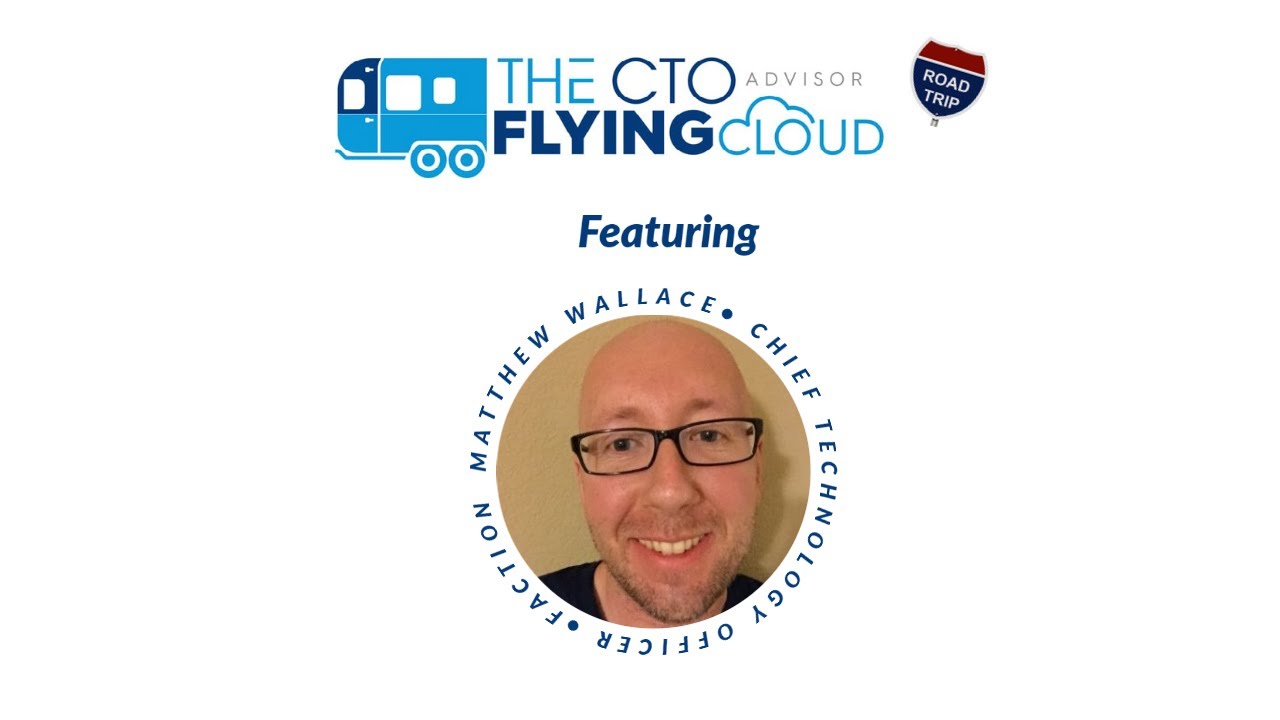
Faction MultiCloud Technical Overview - Interview with Matt Wallace
Transcript
(rock music) (engine starting) >> Hey, how's it going? It's Keith Townsend principal of the CTO Advisor, and you're watching what is in person, an amazing theme here in, I want to say Central Denver, Northern Central Denver. I'm not sure, it's just beautiful. I have with me the CTO of Faction Inc, Matt Wallace, Matt, welcome back to the program. >> Thanks for having me. So Matt, in the previous conversation where we talked about use cases for multicloud, you talk, you hint to this genome use case, and this is something that's near and dear to my heart as someone who worked in biopharma for years.
One of the challenges that I experienced practically is, as the price of mapping the human genome decreases, the amount of data that results increases. The more data, the more scientists want to collaborate on that data. The more scientists want to collaborate on that data, the more organizations want to collaborate on that data, that costs a physical problem for us. Petabytes of data that we needed to collaborate on across multiple service providers, multiple partners, multiple clouds, or multicloud, and Faction solves that problem.
How? >> You know, I like to call us the cloud between the clouds, it's because we have this multi-cloud data service, as like a core product, something that can hold those petabytes of data in one location with one copy, but make it available in each cloud simultaneously, but with a performance that makes it look like it's local. That is some really, power for unlocking some of those use cases, right? Lets you do things you wouldn't be able to do otherwise, scale across multiple clouds, collaborate across multiple clouds, even use services from multiple clouds.
You want to analyze your data in AWS, but then visualize it in PowerBI and Azure, you can do that. But really it's about creating this whole platform between the clouds that allows you to build anything that you need that can stitch these things together. Data is the center of that universe, but it's a core capability, but also not the only thing that we do between the clouds. >> The data was generated on premises. >> Yep. >> Through data collection and we took the individual genome sequencers, uploaded the data to a centralized repository.
Now we want to action that data via public cloud resources. I don't have 300 GPUs on prem. >> Yeah. >> However, you have a thing on your back that says defy gravity. >> Defy data gravity. There's something that I've just repeatedly over my career could not defy, which is, the GPUs are in Azure or Google or Amazon, that data is not there. How are you guys solving that problem? Because I need low latency and high bandwidth. >> Yeah.
You know, Faction has a whole bunch of patents and they all tie into this idea of tying resources into multiple clouds with deep network isolation. So we can actually, you know, deep in the Faction DNA is this isolation, security, performance, throughput. And that network fabric is at the core of everything that we do. We call it the FIX, the Faction Internetwork Exchange. And you can think of it as a fabric that can be divided into virtual sub-fabrics almost like at AWS VPC, think about it that way, maybe from a security and isolation standpoint.
But then what we do, is we take those data services and anything else, people turn up, even things like appliance virtual machines for example, and stitch them into multiple clouds through this fabric, but it's not like what people are used to with a typical cloud exchange where you're just tying a layer to VLAN in, and it's just an isolation. We're truly taking these environments and providing the whole thing. The managed service that ties it in, the BGP routing, data services for QOS, all these types of things that are kind of necessary to make it holistic, right?
Because it's one thing to say, "Oh, I can attach a storage array to a cloud, maybe even a couple of clouds, Oh, I've got access to this thing And it lets- This service lets me touch three clouds," but integrating a super high performance, multi-petabyte data service, with a multi-cloud fabric that provides all these different aspects of security, isolation, compliance, which as you know from your past is like a huge deal. If you're doing life sciences data, you can't go and leak people's data. You have a ton of audits to pass and integrating all these things, is just part of the challenge.
But for us, it's just part of the service that we provide. >> So, What I'm hearing you say is that you basically built, and again, you've used these words, but I want to emphasize it, a data fabric to handle the data transfer, the ability to transfer data, to and from AWS and Azure and Google and the major cloud providers. When I think about that, I think about these cloud whole tailors and when I can go in and say, "You know what, I need 40 terabytes- I mean, for 40 gigabytes of overall space, today I want two gigabytes of that bandwidth, two gigabits of that bandwidth to go to AWS, three gigabits to go to Oracle and four gigabits to go to some other cloud provider or even back to my data center.
That's a lot of engineering. >> It is a lot of engineering, certainly the automation is a big part of it. When you have a team that's engineering cloud applications, they want, the thing that's enabling multi-cloud to work like a cloud service, right. It needs to be automated, it needs to have self-service, it needs to have APIs, so we certainly provide that. And I mean, you have to think ahead to, DIY solution or a set of one dimensional solutions, is not going to to give you the ability to go from five gigabits to 50 gigabits in the span of 15 minutes or less.
And that I think is a necessary part of the idea of scaling across multiple clouds. What good is it if I say, "Hey, you can take a hundred GPUs here and shift them over here because the spot instances are cheaper or because the capacity opens up. " And so that's definitely a key part of it. But the other key part too is, I can tell you from doing this in the real world, that this idea of a data service that's attached to multiple clouds is like 90% of the problem of dealing with data gravity, but it's not all of it.
So like a great example is, I have a customer who has a very complex Azure networking environment, right? Tons of hub and spoke topologies, lots of VNet peering. And they use a particular vendors appliance to help manage that from a software defined networking perspective. We are able to actually take that appliance, they are actually able to deploy an endpoint for that into our multi-cloud platform as well, to extend their own software defined networking construct into our data service. No one else can do that.
>> So Matt, you just opened up a bag of questions for me like, Santa's bag just got opened for me. I have a bunch of questions around latency. How do I select the correct site? How do I know from a application perspective, how to select what data sets where, how to- I'm thinking about visibility and to health and performance, like there was a thousand architect level questions. >> I'm glad you say that, because this matters, right? And one of the things that I'm always saying is, people sometimes start with this idea of what it takes to do this.
And I actually have somewhere, this laundry list, because it is literally, there are a hundred things you have to worry about to do this right. >> So if you want to learn about how to do this right in Matt's (indistinct) words, I suggest you reach out to Faction Inc, link below. Faction Inc, thank you for supporting the CTO Advisors, sponsoring this content. com, is a website @CTOadvisors with Twitter, DM me. If we didn't cover a topic, I'm certain we didn't cover a topic, it's way too expansive for the conversation.
Matt, thanks again for joining us. Talk to you next CTO dose.


