Developing a IT Business Case - vBrownBag
Transcript
so let's get started let's talk about business case versus use case and I think in it we can sometimes confuse the two in it were very very good at coming up with use cases one of my favorite ones which is something that I've had to battle with in my own career is justifying something like a switch upgrade for it professionals or network professionals it's intuitive to know why would you need a switch upgrade you know if you're running 6 s year old topar rack devices or
core data center technology you've kind of passed on you know that that three terior design and we're going into Data Center Fabrics storage Fabrics all these technologies that enable east west traffic in the data center so from a technology perspective we're pretty clear on the need the need is one uh the switches are old so if the switches are old we're going to run to support issues um if the design is old new applications and the things that you guys have been learning a ton about
on the vbrownbag series automation we can't do automation with old or we can't easily do automation with old switches we can't roll out de true Dev Ops types of operating models when we look at the nature of traffic and traffic is no longer north south but east west that really doesn't support the virtualized data center uh cloudbased use cases so from a use case perspective we're pretty clear on the problems however when you take that problem to a business executive whether it's your CIO or if
you're in a smaller organiz ation and you're taking the idea directly to your management your business management team and the question is asked okay what do you need and you say Okay I I need to spend $150,000 on new data center switches and the management type looks at you and says okay tell me why you know I need to invest in your $150,000 switch project well I know my I'm still getting email I'm still being able to access the internet and send and receive collaboration and
use Skype and watch YouTube why should I give you the 150 Grand when the guy in the our plant in Alabama is asking for new air conditioning those workers are down there sweating they're working hard they're making our product I have I I have a finite amount of resources for projects you're asking me for1 50,000 the plant manager in Alabama is asking me for 150,000 how do I compare those $250,000 request so let's talk the let's talk about the first concept I want to introduce which
is portfolio ma governance or project portfolio uh governance better known as portfolio when does your organization wait project against each other some organizations have a formal process to do this they have governance boards committees that decide on projects different stakeholders whether it's the plant operator in Alabama versus the data center manager in Chicago brings their packaged business cases to before the feat of that governance committee or project portfolio Comm committee there's a weight assigned to each business case it goes through a formal re review and
then the committee comes out with recommendations on what projects will be funded and what projects will not be funded this can also include when uh ongoing projects that had been approved the year before but are multi-year projects these projects may get reviewed a formal review and determine if they still align with the business goals and whether or not the project uh is on schedule and worth funding the year forward and then there's the informal process you can go to a business leader whether it's someone within
it a CIO director and you can you know make your case for your project but somehow every organization has some type of project portfolio management some way of determining what project projects get funded we're going to talk through some of that criteria throughout this session I'll pause for a second for Twitter questions all right yeah it can be the no problem this it can be an interesting process and all can be a frustrating process because naturally we understand again we understand our challenges if if we
have five or six year old servers or if we have a vpar cluster that doesn't have enough memory if we have challenges that hamper the way that we operate our data center it can be really frustrating when we take our idea to the business and it's rejected or even when we have a great idea for optimization which is what we're going to talk about kind of what things the business values and this is basically a this is basically a 400 500 level Business course shrunk into
an hour today and then an hour next week so uh there's going to be a lot of brevity I I'll kind of highlight the things that you'll need to research out on your own and get a little bit deeper understanding and we'll come to these I think three major points for how most organizations and I I can make this generic statement from working with very small organizations to very large organizations these three core values are how projects are measured and compared to one another the first
in no particular order is risk mitigation so what risk are you trying to solve the monetary Return of the project what's the the numbers some people some organizations just care about sheer numbers are you saving me money are you making me money are you deferring money what's the money situation and then regulatory it's just our legal obligation we have to do this because we're legally obligated to do it I think we'll come back to this point several points throughout this V Brown Bag session which is
look towards your performance objectives as a clue most organizations when you go through your formal goals you have these trickle down goals the senior VP of your group group will have a goal the director of your organization will have that same goal your manager will have that goal and you'll have that goal so if there's a goal that's a organizational goal whether it's a go throughout your entire company or it's a goal throughout your entire it or organization that's a pretty good thing to become aligned
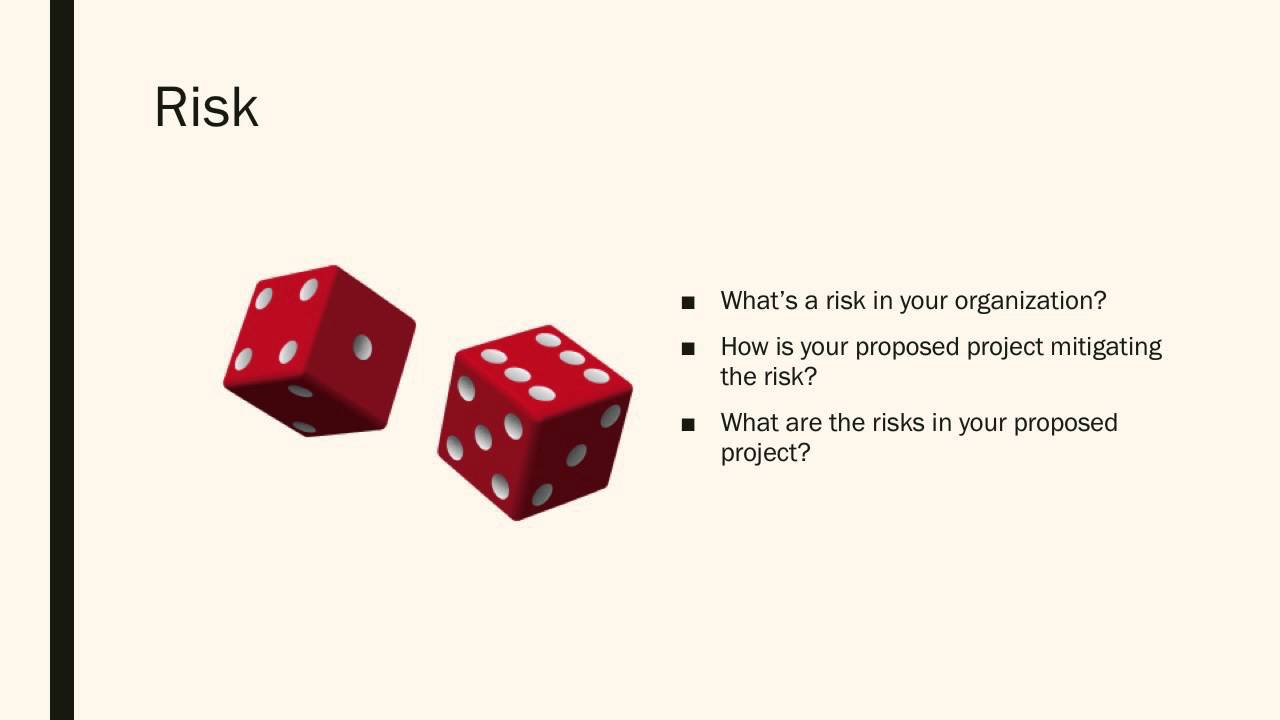
with you're going to look at that goal and then look at these three different areas risk monetary return and Regulatory push to determine if you can get your project kind of aligned with those goals in uh one of these three core measures measurements so let's spend a little bit time talking about risk it's imperative that you understand what or how your organization defines risk so you might have uh gone through kind of courses whether they're internal or at school uh about what's a risk versus a
issue the VMware cluster going down is a issue the potential of the VMware cluster going down because you lack enough memory in your cluster is is a risk so let's say we want to propose a project in which we increase the amount of ram that's in the vpar cluster we we've identified a risk something hasn't happened but something can happen will propose a project to mitigate that risk will spend $100,000 on more RAM uh you know it's pretty funny I I manage it a cluster of
itanium based servers and I just got a quote for 2.5 terabytes of RAM and the initial quote for like $750,000 talking about uh that's just in adjacent that's just crazy but let's say that it's a $100,000 project you need to say you need to from a high level and we'll get into monetary in a second you need to say okay there's a risk that we might go go down I'm going to spend $100,000 to mitigate this risk what was the value of that risk if the
vpar cluster goes down and the organization doesn't lose any money spending $100,000 to mitigate that risk really isn't a wise investment in of money you'll probably get your hand slapped and say you know what great uh suggestion but no will accept that risk if we're talking about a transactional system a Erp system something some Mission critical piece of Hardware application something that keeps track of someone's vitals in a hospital then $100,000 is a drop in a bucket to protect the company against that risk and may
be a no-brainer to get it approved so we're starting early to see we're starting early to show how we're mitigating risk R and adding business value by proposing projects we're tying something that we intuitively know knew was an issue to something that the business can Tangi tangibly measure risk is something that most organizations are fairly decent at measuring so the next uh thing that I wanted to talk about when it comes to risk is also when you're proposing a project that mitigates risk it's good idea
to have some risk of that project associated in your uh proposal every project no matter how simple that project is has risk if you come to a mature management team with a proposal of a project and you don't have any Associated risk you you stand a pretty good chance of getting challenged let's take our vpar cluster upgrade for example every time we shut down a server every time we open a chat y there's risk associated with doing so there's risk of having bad memory there's risk
the risk doesn't have to be great you know we can we can wait that risk medium high low you know in most cases doing a simple memory upgrade is low uh there's a chance that our predictions on uh alleviating the memory constraints in the cluster were were wrong and adding memory to the system uh actually caused more problems than it solved you'll have a list of risk in your business case as long with uh steps you're going to take to mitigate those risks all right so
before we again before we move on I'll leave a couple of minutes or few seconds of silence for any questions around risk and risk mitigation so risk as a central core of a part of your business case proposal all right all right let's go on to go ahead exactly so on both sides so it it may be a risk you know you're doing your due diligence you're monitoring the system and you notice hey you know what this isn't optimized and the lack of the optimization may
cause either a system slowdown and it or it may cause a complete failure of the system you've documented it and it's part of your business proposal then on the flip side as you perform the risk mitigation of the project to upgrade the memory or whatever your optimization is what's the risk to that application as you perform the mitigation this is all stuff you should be prepared to uh discuss when you pre present your business case absolutely all all right so let's talk about monetary most of
us work in operations roles so there's very few opportunities for us to increase Revenue it's rare you know if we work in a if we work in a uh e-commerce type of environment in which we can you know show more prod products per page or uh increase the speed at which transactions are conducted uh expand the audience via an expansion of the system those are rare opportunities in most of it most of it were keeping the lights on the business has already made the business case
for implementing the system now it's a question of uh how do we optimize the system so again monetary return you would think the monetary return piece of it is fairly easy to measure but it's not and I'm pretty sure as John shares the question with me at the end of this the question is probably around how do you measure monetary return and this is probably one of the most difficult things to share during or explain during a webinar because it's so different from company to company
let's take a really basic use case and V Brown Bag normally does a lot of virtualization and the argument for virtualization is really normally very easy which is we used to buy 10 servers now we only have to buy one server we've saved the company the the cost of 10 servers no brainer you would think not so not so fast when you go to account the accountants the bean counters this project portfolio committee or whatever version of who approves projects in your organization there's a way
most organizations measure monetary return one simple way would be return on investment if I bought a new tanx pod this pod will pay for itself in six months what exactly does pay for itself mean this is when we get into terms and I'm hoping there's a bunch of questions throughout this part of the presentation What's the total cost of ownership of that pod and then when we break down total cost of ownership how do we break down total C cost of ownership there's the concept of
Opex versus capex capex is something when we uh spend on physical uh Hardware most cases it's easy to the simple the definition is capex is Hardware Opex is ongoing operation cost people leasing agreements uh Services those types of things capex IEX from an accounting perspective those things are treated in two different ways when someone looks at the balance sheet of your organization they'll say what's your capex expense expense expenses versus your Opex expenses High capex expenses can depending on what investors are looking at for may
not be a bad thing let's say you're Amazon and you're building out your uh AWS cloud and there's a lot of upfront cost but you've enabled a lot of automation so years one through three you may have a lot of acquisition cost on data centers and Hardware but those costs don't carry over through years for four five and six you have a low Opex a lower Opex versus uh C uh cap capital expenditure then there's the weight something I like to call the weight of money
there's a couple of different ways to weight money just like the US dollar has a different value than the Euro and the British Town money that we spend today has a different value than money that we'll spend tomorrow the theory goes when we talk about Net Present Value is money because of inflation money is more expensive today than it is tomorrow the $100,000 that I spend today is the has the spending value power of $90,000 three years from now so when a company when you tell
a company that there's a return of or there's a Roi of three years then they'll then the the conversation so oh well now we have to look at Net Present Value you're telling me that I'll make my money back in three years three years from now this investment will look very different Net Present Value some companies don't care and they don't look at that they'll just look at okay it's $100,000 today three years from now there's a ro there's a Roi that's that's a interesting way
to measure against different projects another way to measure against different projects is internal rate of return so the company might put a value on a dollar invested versus the ROI and that allows them to compare projects Apples to Apples so we picked on let's pick on our um imaginary manufacturing company again uh the guy that wants to upgrade the switches comes through and says hey I want to upgrade the switches here's the return on here's the return on investments operating our old switches cost it this
much now it's going to cost this much with the old switches mean with the newer switches well the finance guy wants to know how do I compare that return on my dollar versus the air conditioning project it's thing such as internal rate of return that's used to compare those two projects from a monetary perspective in this area I highly recommend whenever you if you're going to throw a number and and at an executive one put it in the back of the deck because if you put
it in the front you'll get uh you'll spend the whole meeting talking about the numbers versus the true business value which is rarely an it the the dollar amount and then two you need to really know what you're talking about when you're talking about some type of return on investment if your company is a bean counting type of company work with someone in your accounting department to develop a accurate return on investment based on how your company measures the ROI all right so I'll stop for
uh questions John we get any uh questions on monetary return and I think that's the part where I'm going to show you guys a trick that I've used throughout the throughout my career I'm giving you guys you know we can take this business case discussion and apply it to any part of our industry any Department within our any discipline any business discipline this isn't it specific the guy with the forklifts and the manufacturing plant has to go through the same thing the air conditioning guy has
to make the same argument the guy who wants to buy new filing C cabinets in the uh uh finance department they all have to make the same arguments the difference becomes and where this this monetary thing where departments really care about this is when it comes to projects that you know sales marketing what we what we normally call the the business or the line of business in our business so if you work for a drug company and you want to invest in a new line of
oncology drugs then you most definitely will have uh risk monetary uh [Music] and Regulatory portions of your business case it we're you know we're we're we're we're back office it's it's really difficult for us to make a business case based on money unless it's as John mentioned it's a capex type of spending or if we're in the high portion of our career and we're going to the CIO and saying that I'm going to get rid of Five Guys in my department if you let me roll
out automation that's those are things that we can look at Opex and look at hard numbers and say that but if we're not talking if we're not in a position where we're going to the CIO and saying we're going to reduce head count count Opex is a really tough number to prove it's that Opex to me is funny uh is funny money as a consultant I can tell you you know what happens when you get when you're a director or CIO and you get Opex wrong
Opex savings wrong let's say and you guys might have seen the symptoms of this in an organization that starts to hire a bunch of Consultants to do a bunch of manual work you know we've implemented a system the system was supposed to have created a lot of efficiencies but these efficienc genes never got realized but the work Remains What companies will do is that they'll shift the budget where we used to spend the money on FTE we now spend that money on Consultants which is a
different pool of money is Project based so the same or similar people doing the same job but because I promised Opex Savings in this budget the FTE budget and my project didn't realize those savings I've had to hire consultants and hide these consultants in my budget to show that I Sav the money the Opex money that I promised to to to save so that's a little uh inside baseball for you guys when it comes to uh monetary return on it projects IEX is really again for
most most folks who are proposing you know data center type projects Opex is a thing that unless you're in a role where you can guarantee that there's going to be head count reduction or a uh elimination one of my favorite ones is you know a easy one for Opex is reduction of communication cost that's something that's extremely tangible I used to spend $100,000 a month on T1 service I've moved to vpns and now I spend and $20,000 a month on Communications that's an example of OPC
savings so if you're spending money on services and your project proposes to to save money on Services by all means goe it at OPC savings but if you're not going that if you're talking about people and you're not in a role where you can actually lay people off don't don't go down that Opex uh route all right and then the last area is regulatory so PCI stocks Hippa and FDA the list goes on and on and on if you're in the Mia APAC uh you're going
to have similar acronyms for different things PCI uh payment card industry uh s sockes s SCE bangs and actuallyy the uh truth and Reporting if if you're a publicly traded company Hippa is the health healthc care information policy and fdaa is the folks that make sure that the drugs we take are healthy for us to take all of these guys audit organizations that are regulated if you're a publicly traded company you have socks responsibilities mostly if you're in publicly traded company once a year you have
internal or external Auditors at least once a year come in and and perform socks audits to make sure that the reporting is tight out of these audits may come findings so let's say that you have a uh one common one is segregation of Duty the person who approve who uh the person who inputs the bills shouldn't be the one who pays the bills the person who checks the security logs shouldn't be the person who accesses the system if a sock auditor finds a finding for one
of your regulatory obligations that's kind of lwh hanging fruit you you can easily say so it's no longer I'm not trying to eliminate risk I'm not trying to reduce cost we might actually increase risk we actually might increase cost but the project must be done because legally we obligated to remediate this finding you may may find it as you know this is where Auditor in some cases becomes your friend you you know backup and Disaster Recovery a typical area for socks where socks becomes our friend
is when the socks auditor comes in and says you know what show me your Disaster Recovery plan and you give them a sheet of paper that says uh restore tapes to servers we purchased from CDW in Alpharetta B drr plan the stocks auditor is going to have a major finding uh you might have done that I've seen people do that by Design so they've you know they've tried to run through these projects for approval before and they've gotten their hand slapped you get a Au they
get a socks finding this goes all the way up to a board of directors when you get a major socks finding you can now use this sheet of paper as a you know what we're now going to spend a quarter of a million dollars on a proper business inity Disaster Recovery plan regulatory is not always something to be feared it's it can be a friend when looking for money to per uh to perform projects we'll take a uh a few seconds for questions before we move
on to the last slide all right so this is something we're going to actually do I'm going to over the next week I'm going to develop a business case I'm going to uh present a business case that I presented a a few years ago actually for a publicly traded company that I needed to compete for dollars against the guy that wanted to buy Fort clips and not Alabama I didn't like make this this company that I said is imaginary actually isn't very imaginary this is a
company that I worked for that I had to go to is was a publicly Crea a company I had to go to the CEO the presidents of each business unit and ask for a few m not a few million it it was a little bit less than that but a significant amount of money to upgrade the wi infrastructure we were on a hodge podge of desparate frame relay Technologies some of them managed by the tail codes some of them managed in internally some of it was
Point too it was a distributed it team uh decentralized they had their own autonomy so we're talking about a full on it transformation project I was the data center manager or uh network manager for the holding company that ran all these different companies and I had to go into to a office full of Executives uh put on a PowerPoint and say this is why you should spend all of this money to upgrade your infrastructure and deny the guy that wants the forklifts in Alabama his forklift
I I I I'll be the bad guy I had to go back to Alabama after that and and talk to that plant manager as we upgraded his systems and talk and he you know like dude you know this was my year to get my forklifts and you know you're you're here uh bringing my plant down for a weekend as you upgrade systems so that will be the next week's story me recapping how uh I convinced a room full of non-it Executives to give me uh and
another team a couple of million dollars the so presenting your case and we'll talk about this the important thing is to know your audience audience so I framed the audience do I need to put together a formal deck do I need to Pro do I need to present a project you know are we a big sap shop and I have to go through all these sap screens uh put in together all these fields enter the details for risk monetary return uh regulatory issues do I have
to put all of this information into a system that gets formalized and sent up to a committee committee do I just have to put together a real a really well-formed email you know are we are a small organization and you've taken some of these tips and tricks from this session and say okay from a high level I understand that when I ask for more money or money to upgrade the data center switches I need to come back with a business value and maybe it's not the
three different areas that Keith talked about maybe it's specifically something aligned to my goals one of my goals for the year was to show Innovation and that's lwh hanging fruit I know that the CIO had a a uh objective on his review or on his goal list to show Innovation the senior VP had one Mike director has one I have one and this is kind of lwh hanging fruit if I can put together a well- worded uh email talking about how the nature of it and
data centers changed I'm using all these fancy words like cloud computing devops and Cloud native applications for cloud native environments for uh building uh Next Generation applications and that's all enabled by a new data center fabric hey you know what you you're you're you probably earned yourself a $500 gift card in addition to getting your project approved or is it really informal you just you know what I know from a high level I can just write this thing I need $50,000 to uh upgrade the firewalls
uh write it on a Post-It note and put it on my director's uh screen and it's just that informal but know your audience know who you need to present to it may be just as simple as your director saying hey what's the project that you have on your list this year so that I can put them in my budget normally those types of low hanging fruit you don't need the help of a business someone who knows how to do business cases those projects you know how
to get approved those are just the ongoing cost of running your environment now I promised a trick the last slide and this is the trick if you want to get a major initiative passed I'm not talking about upgrading the firewalls I'm not even talking about a data center core switch projects those things and the scheme of things are really small you know depending on the size of your organization you know everything's relative in a large data center you know you might need to buy let's say
you go for a legacy uh three terior Network design and you have a core distribution layer and access layer and your distribution layer switches are and you want to replace them with seven Cisco 7ks you know what maybe that's uh $150,000 and that project and for organization the size that would have something like that in their data center probably not that big of a project but let's say that you want to deploy SD wi not only is it a expensive project it's pretty disruptive you you
know you got to hire a team of Consultants uh there's going to be some Opex spending there's going to be some capex spending uh you're going to have to engage a project manager uh there's going to be a formal project put together this is you know this is not a small project for most decently sized organizations don't go to your business and say hey I can save you money by rolling out a SD wi they're going to look at the project this is and take it
with a grain of talk not every organization is like this I've become cynical over my 18 years in it but they're going to look at the project and say you know what I have to dedicate a project manager to that I really don't understand this stuff it works really well as it does today the numbers that he's given me really isn't that significant when I'm about to spend another 1.5 million doll this year on Oracle uh on Oracle uh DB licenses you know if you got
a way to save me on these DB licenses come and talk to me about that this is how I get these types of projects approved piggyback on a business project this is you know I find it curious when people say you know what the B when we're in it and we say the business doesn't want to do X or the business has this problem unless you're outsourced it you're part of the business you are you you are worthy of a seat at the table so how
do we align ourselves with the business in infrastructure we talk about it all the time apps rule the world apps get whatever they want instead of complaining about apps getting whatever they want why don't we leverage apps get whatever they want there's a reason in my day job there's a reason why I support the sap infrastructure the there's a reason why I chose to be the Enterprise architech for sap there's not many in in my organization there's not many applications more important than sap it's easily
a third of our it budget and I'm over the infrastructure that runs it so when I want to do something I go to the sap team and say hey you know what what's what's the pain points of the what's the pain points of your data of your day-to-day job so if they say you know what we want to upgrade to sap Hannah because uh during our data warehousing is just too slow and we can't react to the needs of the business the business wants to run
these super complex curies we're using this Legacy Legacy data warehousing platform we need a new Solutions we're looking at sap Hannah in memory database legitimate legitimate use case they this is a slam dunk they'll go through those first four slides that I showed you they'll come up with a business case and they'll get it approved and then you'll be stuck trying to implement sap Hannah on your vpar cluster that matches out at uh 512 gig ram per host when these sap Hannah instances take up 1
Point uh one terab to 1.5 terabyte in memory and this is not you know over subscribed memory these things take up they use all one one terabyte or 1.5 terabytes of dis space when that group puts in their budget for hardware and they include the sap Hannah Appliance don't just say Don't just r view the the bomb and say yeah that's that's that's all we need no it's not we need that data center that we need to upgrade those 6509 and this is not you know
I say it's a trick it's not a trick it's a it's not a game this is you doing your due diligence if a major project is coming down if a major application project is coming down you review your wish list of the things that you want to get done the major projects the sdw if I'm going to implement a this is tying it all back together if I'm going to implement sap Hanah that changes this whole distributed system if I have a location in Asia that
puts in a cury over the wi and that cury normally takes let's say it takes 15 minutes to run on a non-h Hanah database and now I've upgraded Hannah to I've upgraded the database to Hannah and this query takes seconds to run but I'm on a slow W Link in Asia now I've moved the bottleneck from the database to the whink and I didn't take into account that I needed to upgrade the W link you jump on to the business case that the sap Hannah folks
are submitting you have every you you you have a seat at the table you have a seat at this conversation it is okay it it is perfectly fine for you to piggyback on these projects because you have to support the application after they're deployed now I'm really hoping you guys have some questions around uh piggybacking or projects that have been uh proposed that are not core to the it infrastructure I see Dan has mentioned that SharePoint has been his piggyback and SharePoint is you know it's
interesting if you guys have rolled out SharePoint share point is really you know an IT project that's a collaboration that's a customer facing tool it's a collaboration tool is very important and people throw uh obsc amounts of money at SharePoint there's SharePoint administrators built into uh most lines of business teams a finance group would have their SharePoint administrator a Marketing Group will have their SharePoint administrator that's a good point Dan that uh even a project like SharePoint is something that it's and let's put this in
perspective when we're talking about these types of projects the licensing cost for something like sap Hannah compared to your $150,000 switch upgrade or your SD win or your one let's say s when the project is going to cost 1 something million and on at the end of the day you you you're going to you're going to save money improve performance for the sap Hannah installation it becomes lwh hanging fruit because I can guarantee you that $1.5 million project to upgrade your sd1 or your $2 million
project to buy V blocks that pay in comparison to the $30 million you're going to the application team is going to spend to get their uh sap Hannah uh get their environment converted over to sap Hannah get the appliances stood up the Consulting dollars your your your your the stuff that you ask for from an infrastructure perspective is going to be a rounding error so we got five minutes left uh questions Ty yeah these types of things are career movers when you start to align yourself
with the application team I'm not saying become an application person but when you start to align yourself with the goals of the business not only do you get to do interesting projects your career becomes FastTrack go back give us give it some thought think about some of the people who have over the years who have progressed in their career when in traditional Industries you know what was the Tipping Point from their career and most of the time is when they worked a project that added direct
or indirect value to the business when they aligned themselves with something they stuck their neck out there they aligned themselves with something that was critical