
Dell Technologies PowerOne - Overview
Transcript
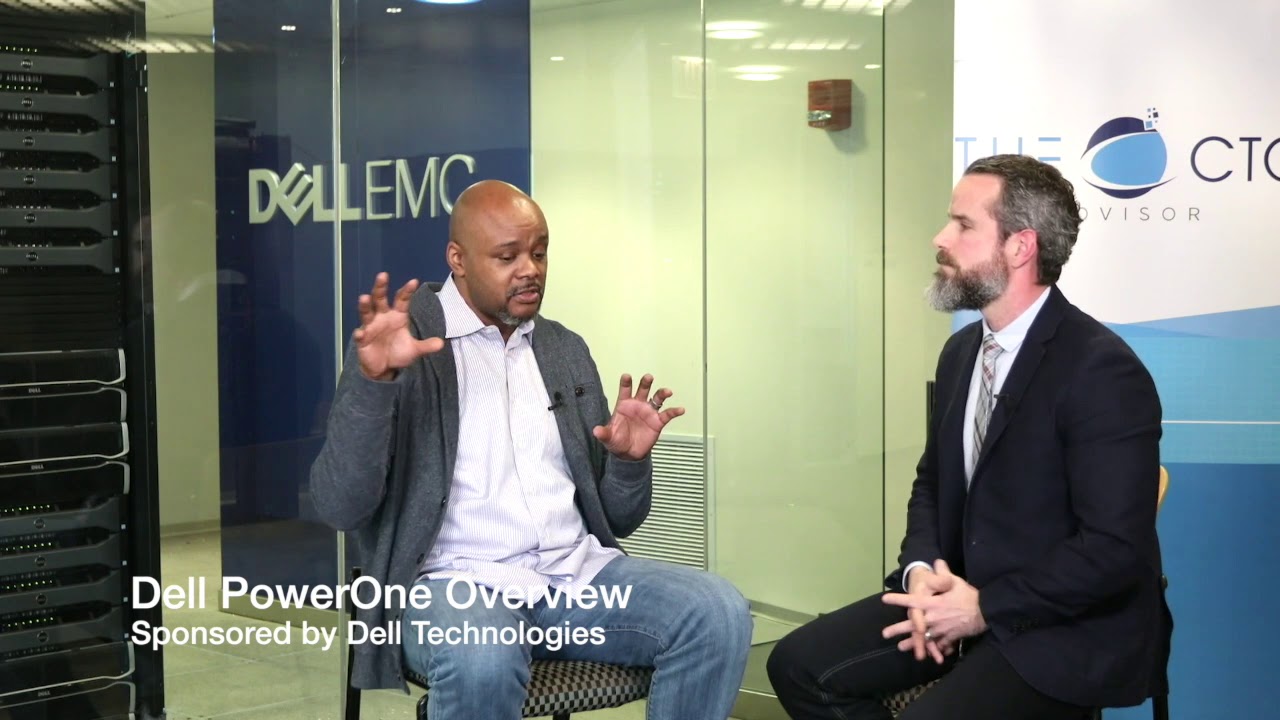
>> Hey, how's it going? It's Keith Townsend from The CTO Advisor, and no, that's not the CTO Advisor data center you're seeing in the back, that's the Dell EMC EBC Data Center. We're in Naperville, Illinois; right outside of Chicago. This video is sponsored by Dell EMC and Dell PowerOne. I have with me, Connor Duffy. Connor, welcome to the program. >> Keith, I'm excited to be here. You know this, I've been a big fan of yours and your whole team for a very long time.
I think the work that you guys do is extraordinary. I really do. >> So we really appreciate that. But, you know what, this is the CTO Advisor, we're going to get right to it. So Connor, I was at the PowerOne launch back in November. A lot of drones, a lot of talk about autonomous infrastructure, help break that down to me in laymen terms. What is PowerOne? and what does it have to do with automation? >> Right. So let me give you the most condensed description of the product and then we're going to get right into the software because that's the most important aspect, that is the protagonist of our story here.
So PowerOne is a completely engineered system consisting of best of breed infrastructure exclusively from Dell Technologies: Dell storage, compute, network, management, and services. >> So I haven't seen this in a CI system before. I haven't seen a CI system from one complete vendor. You guys have a history with CI. >> Yeah, that's right. >> Did you have to start to start over? >> No, it's actually a very important attribute. We've been in this business for over 10 years.
We've been a leader of the CI space, so we have a lot of best practices, process, and knowledge when it comes to engineering and designing and supporting these systems at scale in the field. So, these things are racked, stacked, labeled, cabled, pre-designed, tested, validated; in collaboration with VMware and because we're the manufacturer with the engineering team that designs these products. So, the actual, physical product itself, while important, because it's consisting of all the best technology in the marketplace today, what really makes this come to life, Keith, is the intelligent software that we've developed.
We've been spending a couple of years in development of this. We've just launched PowerOne before the Christmas break and we're getting a tremendous, tremendous, amount of reception on this, you know, especially with the ideology around autonomous infrastructure and what the controller brings to the market that is not comparable, so far as I can see. >> So, help me out with this concept of autonomous infrastructure, because from a marketing perspective, Ive heard from all the CI vendors that some of these same points that one, it'll save you time from an engineering perspective.
So, up front, it's engineer system, which I believe in the concept of engineer systems. I'm a SAP guy, so, you know, I don't want to spend time on making sure that the firmware from the storage array is compatible with the SERM firmware for the hypervisor. I don't care about any of that stuff, but when I here automation on autonomous infrastructure, Michael Dell described it, I think of, I can take my people, and I can have them do things other than configure nodes and do day two operations.
That's what I want. That's not what I'm getting in CI systems today Is PowerOne providing that capability for me? >> Yeah, in a very different way, right? So, the key to reducing operational complexity is through automation. To codify the processes that happen, so we can reduce human effort, right? Now, where the vast majority is going, in this regard, is building exactly that. They're investing. In fact, we just did a survey, and one third of all IT budget, apparently, is going to be going towards automation, right.
Th problem is that building automation in house is a very challenging thing that often people, Keith, they don't appreciate, and I'll tell you why. Because, if you're going to go out an build automation, which is the dominating narrative that's in the marketplace right now, all of these tools, Gardner says the average IT shops has 10 tools that they're using to automate. You have to have the right people who know how to build automation. This is a programming level skillset. They also have to have the tribal knowledge, the best practices to know exactly what they're programming.
Secondly, their infrastructure must be automatable, if that's a word, but it has to have an API that you can speak to and things that people don't appreciate, when you're building automation. Where exactly are your developers, or Dev ops people? building this automation? They have to have an environment, right? And, that's another cost, and that environment should be similar to production, I mean, you don't build and test automation in production, right? >> Some would argue. >> Exactly, exactly. And, you also have these challenges around managing the strategy.
Where and what are you going to automate? And, what makes business sense first? So, there's a whole challenge associated with building the automation. >> So, let's break this down from a practical perspective. When my CIO, CTO, came to me and said, "You know what, Keith? "I've read all the Gardener stuff. " So we go out and we get our TERA forms. We go out and we get our bare metal provision services, Pubids, Chef. We buy all these tools.
I actually put out a req for an Automation Engineer We get them in-house, and this all fails. >> Well, because not only is it a challenge Keith, to build automation in house, and to get the right people and the right tool and environment; then you've go to run that automation. And you think where are you going to run this? What exactly runs this? Who's going to maintain it? Right? >> The automation systems have overhead. I got to hire people to manage the automation system.
>> So you are teeing this up perfectly. From a philosophical perspective the paradigm shift with PowerOne is we thought, "is there another way"? " And it turns out that if you really think about you want you want all the benefits without the effort. Like everything in life. I want a six pack, but I don't want to do any sit ups. >> That's me. >> You want to consume automation you don't want to build it. You want to run that automation in a declarative way.
You don't want to have to figure out the run time of that automation. This is precisely the fundamental problem statement that we started from in the engineering process with PowerOne. We started with in-house, writing with tens of thousands and validating lines of discreet automation code. So think about a library that talks about everything that we can automate; from servers to DRAC cards, to storage to fabric to network, to hypervisor deployment and what have you. So when you've go this library of automation, the customer doesn't have to build it, right?
That's number one. Or maintain it. But how do you run that automation? And this is... Just let me finish this one thread because I don't want to lose my train of thought. >> No problem. >> So, we built a database of extensive automation for this system that you buy, but to run the automation, well, we used a lot of different software. We built a micro services. I kind of think of it as a cerebral layer; like our brain; like a runtime.
And that sequences, orchestrates and controls the automation. So when you want to declare an outcome. " The controller will take charge of sequencing all of those automations. Tens of thousands of potential steps that we are alleviating from a customer. So in conclusion, the essence of PowerOne is we are saying, you need to consume the benefits of automation. You are buying the product, not because its a tool for you to build your automation on, but so that you can achieve business outcomes.
>> So I'm buying two parts, or two things when I'm buying PowerOne. One, I'm buying, I would call it a control plane. Similar to when I'm consuming public cloud. Let's say I'm doing VMware cloud in AWS, a Dell Technologies company, VMware is, and I go and provision a VMware cloud. There's a bunch of stuff that happens in the backend that I really don't care about. >> Right. >> And there's an API that cause that stuff to happen. So what you're saying is akin to that that when I want to provision a bare metal work load or whatever it is I can go to this control plane, make that request you guys do all of those automations.
So I see the value in that because Dell obviously has this engineer system, which is point two. I'm buying the engineered system that allows you to do that, but this is still really really hard stuff. Like, there are so many variations and so many things that can go wrong. You already mentioned tens of thousands line of code inside of the database. Am I buying another headache when I'm buying this? >> No, so all of that is abstracted away from the user.
So this controller that powers the PowerOne, PowerOne Controller, is an appliance. It is not software. >> So I don't have to manage it? >> You do not have to manage it. It is completely out of band. It's resilient and it has authoritative control over all of the element managers which you still have the flexibility of accessing as well. >> I'm not a Linux Administrator so forgive me. I don't have to go and do YAML update onto the controller to pull down the new playbooks.
Again, I'm weary of these type of systems. I don't want to manage. I don't want to have to open a req for a PowerOne Administrator. You're telling me Dell is doing that stuff for me. >> Yeah, absolutely. And so, there are two ways that you can interface with the appliance, with the PowerOne Controller. The first one is through a restful API that we expose. This is built with API first methodology. So this really helps to ease with system integration, process integration within an environment.
And we also have a UI, an HTML5, a modern responsive UI experience that you can go and provision. And the way I like to think of the PowerOne is it really is a vending machine of clusters. Right? And all of the complexity is abstracted away. A lot of the complexity is abstracted away. You're also looking at a system that can scale and be provisioned very very efficiently and grow and scale resources independently. >> So I like this concept of an HTML5 interface, but what can I practically do with it.
Like give me some practicals. What can my engineers do and poke and prod at in this interface? >> To really simplify the experience we've organized a lot of the features within the PowerOne controller into three key categories. It'll make it very easy for you and your audience to remember. So we have an unboxing feature set that we call launch assist. So what I want you to think about is just like a racing car launching off of the pole. So it's all about how quickly we can get you from zero to 60.
From unboxing all the way into production. So this is a wizard driven experience that will allow you to get up and running very, very quickly. Once you are up and running, just like in a race car, you're going to have to take a pit occasionally. You need to change the tires, you need to do maintenance and it's no different in the data center, Keith. Code changes, software changes firmware, network operating systems all sorts of components need to be life cycled. We have a capability called Life Cycle Assist.
This is the category of automation within our UI Or API that can be called on, that will change the wheels. So you're talking single button systems; hardware, hypervisor updates of the technology. This is a huge burden that we're relieving from the customer. And finally is the expansion assist. The expansion assist is scaling the system; adding services, adding storage, creating more cluster, new clusters to the system in an automated fashion. So there's Launch Assist: unboxing automated experience, very frictionless, very fast.
Life Cycle Assist: getting in and out of the pits really quickly, doing all change management in an automated fashion. And Expansion Assist: is dealing with on going amendments to clusters and resource propagation. >> So build, run, deploy or some variation of that. But you've opened yourself up for this line of questioning. So you've done it to yourself. >> Okay. >> Expansion Assist. Let's talk about expandability because we're talking about CI's When I buy a CI, where I've been burned in the past is I buy a CI, this rigid configuration because its and engineered system.
And when I need to expand it I need to buy another CI Pod right next to it. >> Right. >> I'mma put you to the challenge. Can I just buy. If I need more PowerMax can I just by more PowerMax? >> Absolutely. >> Or more servers? >> Yeah, absolutely you can. Maybe this is a good time to have a segue. >> But with automation. >> With automation. That's always going to be coupled with everything we're talking about.
The software automation. So let me segue a little bit and talk about scalability. So right now what's very popular in the marketplace as an architecture is what I would refer to as symmetrically scaling systems, right? >> Right. >> So tightly coupled homogenous nodes or identical nodes like our industry leading Vxrail is a prime example. This is a great fit for a lot of customers. The resources scale more linearally. It is very simple to expand. And there is some granularity.
You can scale the storage independently, but it's not as flexible as you mentioned about just buying another storage for your VM's. >> If I'm using 60% of my compute 90% of my storage and I need a tremendous amount of storage. I don't want to scale that horizontally. I just want more storage. >> So for many customers this is a problem that may make PowerOne look a bit more ideal or suitable for the use case. You're in an environment where you just need one more terabyte of capacity.
Now in symmetrically tightly coupled system, you have to buy an identical server with all those resources like CPU and memory and it's going to consume network ports that you may not need. >> And software licensing. >> The software licensing is a big one because we know VMware in particular and almost every vendor license on the socket. >> You're right. >> So you're getting all this drag that you didn't need. And all the apex wrapper you've go to deploy, now integrate.
That you just need one terabyte. So in an ideal world you would want an architecture we call asymmetrical scaling. So you can scale storage capacity independent of compute. Now sometimes Keith, it not that one terabyte more you need, it's that one IOP. So imagine me being able to add performance independently. >> I just need another shelf of discs-- >> More resiliency >> More discs so I can get more IOPs >> Exactly. >> I can tweak it. But the key part in systems before allowed me to tweak that linear or even asymmetric scale, but I lose the integration of the automation.
>> So we're going to bring these things together, right? We talked about the software and the controller. So ideally, you want to buy only what you need and scale those resources independently. And this makes a lot of sense for many customers where their storage is growing at a multiple to their compute. You might want compute clusters of different specification, so build unique clusters. So you don't want homogeny, right? You want complete flexibility. And you also, Keith, want the flexibility Of different types of technology.
So symmetrically scaling systems are also on a single track technology. Every storage technology, for example is optimized for a cost, performance, availability kind of balance, right? I kind of call it 3D Scaling. Scale up, scale out and scale with heterogeneous technology. The problem statement with asymmetrical scaling in a data center, is that you now have to manage all of those points. >> Yes. >> Right? It's very complex and especially at scale it becomes unmanageable. >> So Connor, this is where automation and scale has broke for me in the past.
I get configuration drift and day one the thing works perfectly fine, the next day I upgrade some components and now automation is broke because I needed to scale just a small piece of it instead of these big blocks. >> Right So the PowerOne Controller is designed to address that challenge. It's a fundamental value of the product. So I've talked about how this isn't a tool to build automation that is imbued with automation. Its also imbued and we've codified industry best practices, configuration best practices, you don't have to worry about configuration and compatibilities and unknowns that often take down data centers and the delivery of that.
So over time, as you're going through change the hardware infrastructure code, the middleware, so think of the hypervisor, all of this is an automated experience for the customer. So from an infrastructure standpoint Keith, it's very much like public cloud. The customer is not concerned from the hypervisor down. They're just concerned about their VM's, there application running and everything else is a service. And I keep seeing that jokingly that the PowerOne is very much like a vending machine of clusters. So the use case here is large enterprises, medium enterprises, perhaps, really anyone that wants to do consolidation.
Multiple clusters consolidating on a single system that can scale very very efficiently. Asymmetrically. And it's done in a repeatable, programmable way. Right, so you get this known consistent outcome and you don't have to do all of the work to build that automation and that is what makes this product in my mind truly differentiated. And so far as I can see there is nothing comparable in the marketplace today, to that vision of a controller that has the intelligence. This is what we're calling autonomous infrastructure.
Like an autonomous car, you get in and declare an outcome. Take me down the road. It handles all of the thousands of potential decisions to get you there fast and safe. Similar with our PowerOne controller. You declare your outcome. I need a cluster or I need to scale it, storage independently, add more storage, add more compute. Maybe I need a cluster for short lived. This is a perfect platform to host production, test development; test and development in particular.
It's a really squash shadow IT, because you can self service deliver clusters. That is the unit of consumption with this platform. It's a vending machine of clusters, programmatically, and with our API integrated comprehensively into your processes, within the enterprise. >> Well Connor I really appreciate you giving us this overview of Dell PowerOne. I've asked you some pretty tough questions and if my questions weren't tough enough for you our friends over at Gastall Tech's Field Day; They had a storage field day with PowerOne a few weeks ago and you know what?
The delegates did not go easy on the PowerOne team. I thought it was a really great conversation, great overview of the architecture. I hope we've filled I some of the holes for you. com/PowerOne. And you can follow me on the web as CTO Advisor. Talk to you next CTO dos.


