
CPU vs. GPU - The importance of DDR5
Transcript
(gentle music) >> Hey, it's Keith Townsend, principal and CTO advisor. We're continuing our four part series on the data center of the future, sponsored by Micron. Great feedback on the last video, some of you were amazed at the 64 terabytes of storage, and memory, and the multi access across nodes. And some of you were kind of like, eh, yeah, I've seen that in super computers. Yeah, that's the point. This is commodity x86, and the advancements we're seeing in memory driven compute, is nothing short of revolutionary for what we're needing to do in today's and tomorrow's data center.
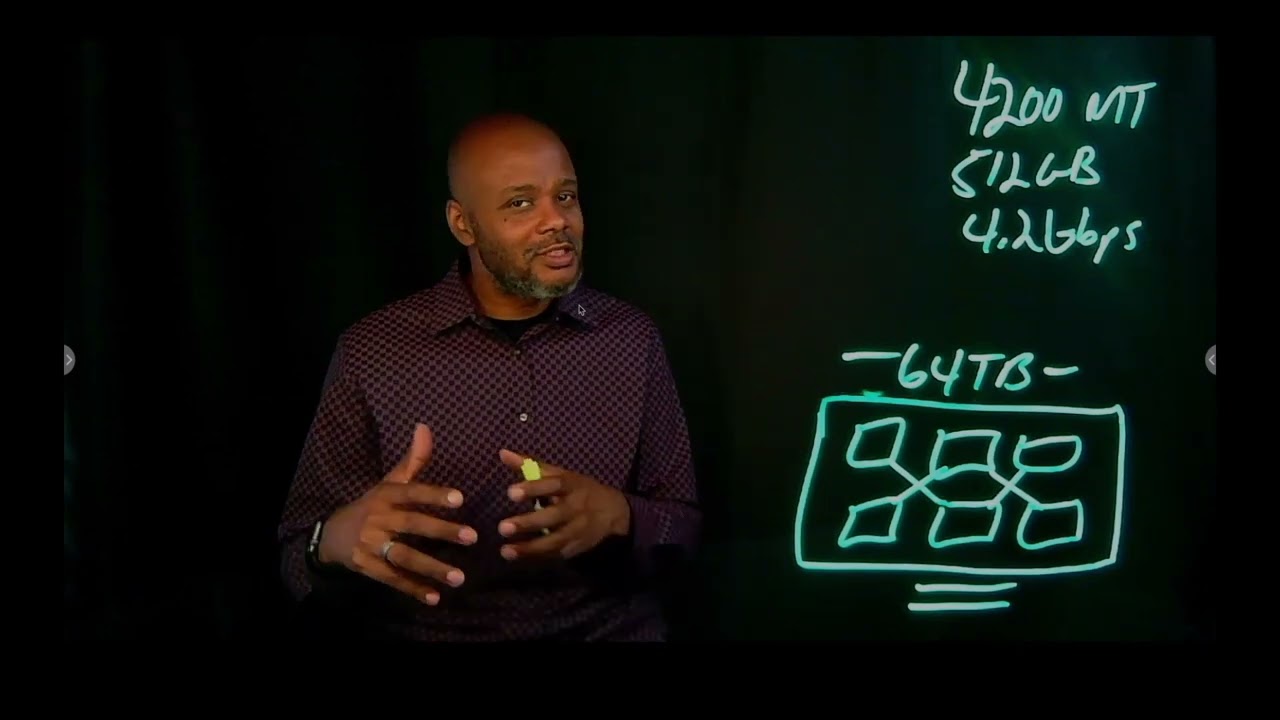
I'm throw some hero numbers out at you. 4,200 mega transfers per second, 512 gigabyte DIMM, a single DIMM with 512 gigabytes of RAM. 2 gigabytes of transfer speeds per lane. This is memory catching up to the CPU in GPU. What do I mean by catching up to the GPU? One, GPU's are amazing at doing special tasks, such as machine learning, specifically natural machine learning, which is particularly tough because it's so much data. And the faster you can churn through data, the better the performance for something like machine learning, right?
Well, what happens when you give a CPU unlimited, or near unlimited memory, or bumping up against its limits on how it can ingest memory, versus GPU's, which have relatively little memory. We fortunately don't need the answer to that question, it's already been answered for us. A set of researchers competed against one another to do some natural language machine learning, with some researchers choosing to use GPUs, another set of researchers choosing to use memory driven compute with DDR4. And the results were impressive.
The DDR4 and memory team thoroughly trounced the GPU team. And I don't think the reason is because GPUs and CPUs, one is better than the other one, it is literally because of the amount of memory, and the ability to get the memory to the general purpose CPU, or GPU, the CPU and memory driven compute team completely wiped the table from cost of system, to speed of transactions, et cetera. And we're seeing this play itself over and over again. If you provide virtual machines, you know that if you are a cloud provider, or a data center operator, that the more RAM you can get to a instance, the better.
I just saw a report the other day saying that if I spend more money on memory in the public cloud, I get better performance per BCPU. These are things that we know. So what happens to application performance and efficiency, when we expand the amount of memory that's in a single system? And we provide faster lanes to the CPUs, and let's not forget our friends, the GPUs, because we'll see the same cost performance benefits in that. Memory is magical when it comes to data center optimization and performance, that is no different.
So let's go back to our data center of the future, some of you guys, again, were not impressed with this 64 terabyte system, you're saying, wow, I see that in super compute, I see it in mainframes, Keith, what's special about that? It is commodity x86 hardware across several nodes. And if you're wondering, well, Keith, latency. Keith, memory bandwidth. Well, that's the next video on CXL. We'll learn how the industry is overcoming the links between systems, but if you want to take advantage of DDR5 today, I highly recommend you reach out to your OEM partners to learn more about their plans around DDR5.
How can you take advantage of these increased speeds for your applications today? com/datacenter.